

Updated 3 months ago
Coffee Tasting Box: Coffee Packaging Ideas: The highest level of gifting.

ypak.coffee
YPAK PACKAGING GROUP was established in 2011 and formed with 3 companies based on Hongkong, Dongguan and Foshan. We have become one of the largest coffee bag manufacturers in China. We use the best quality WIPF valves from Switzerland to keep your coffee fresh.
Conform to the plastic ban policy imposed to many different countries, we have researched and developed the sustainable packaging bags, such as RECYCLABLE and COMPOSTABLE pouches.
No minimum quantity, no color plates are required with our HP 25K INDIGO DIGITAL PRINTING service.
You are welcome to visit YPAK.
coffee tasting box
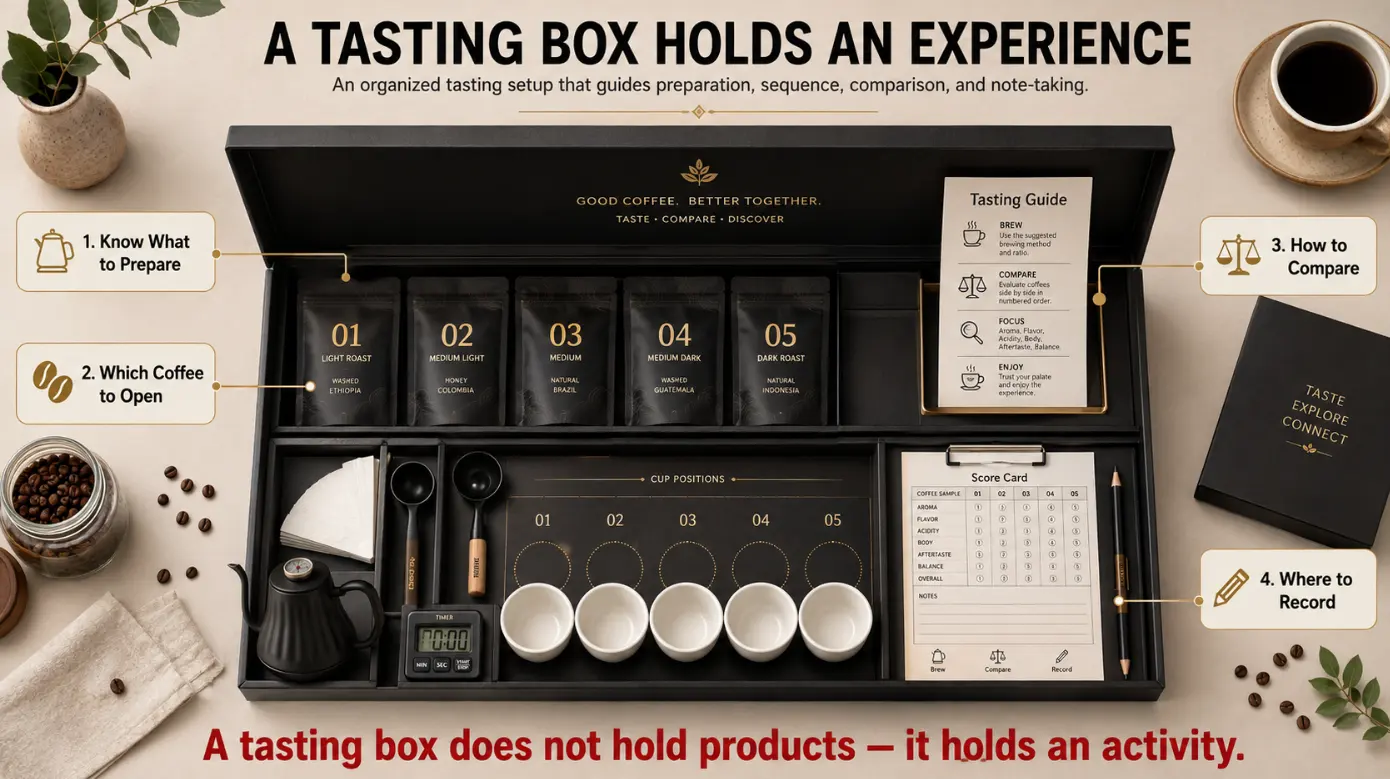
Not just products are packed in a coffee tasting box, but an activity is. The recipient must be aware of what to prepare, what coffee to open and how to compare cups and where to make observations. A guided tasting session is given a surface to operate on by packaging.
The coffee packets are not opened so as to provide the main protection against freshness. The box separates the samples and other equipment, provides protection to lightweight or fragile items, shows the order of the tasting, and has guidelines. The quality of the work done in a session hinges on how well it flows and not the number of ornamental finishes on the lid.
In contrast to a typical assortment, the brief must specify participants, brewing/cupping technique, length of the session, amounts, accessories, route of delivery, and level of guidance prior to making a choice of a structure.
Find out the Tasting Session Pre-the Package.
Start with the activity which will be carried out by the recipient. A directed home cupping, a pour-over contrast, and a joint tasting of a corporate group have various doses, vessels, guidelines and work surfaces. Dimensions of packaging should follow such session plan.
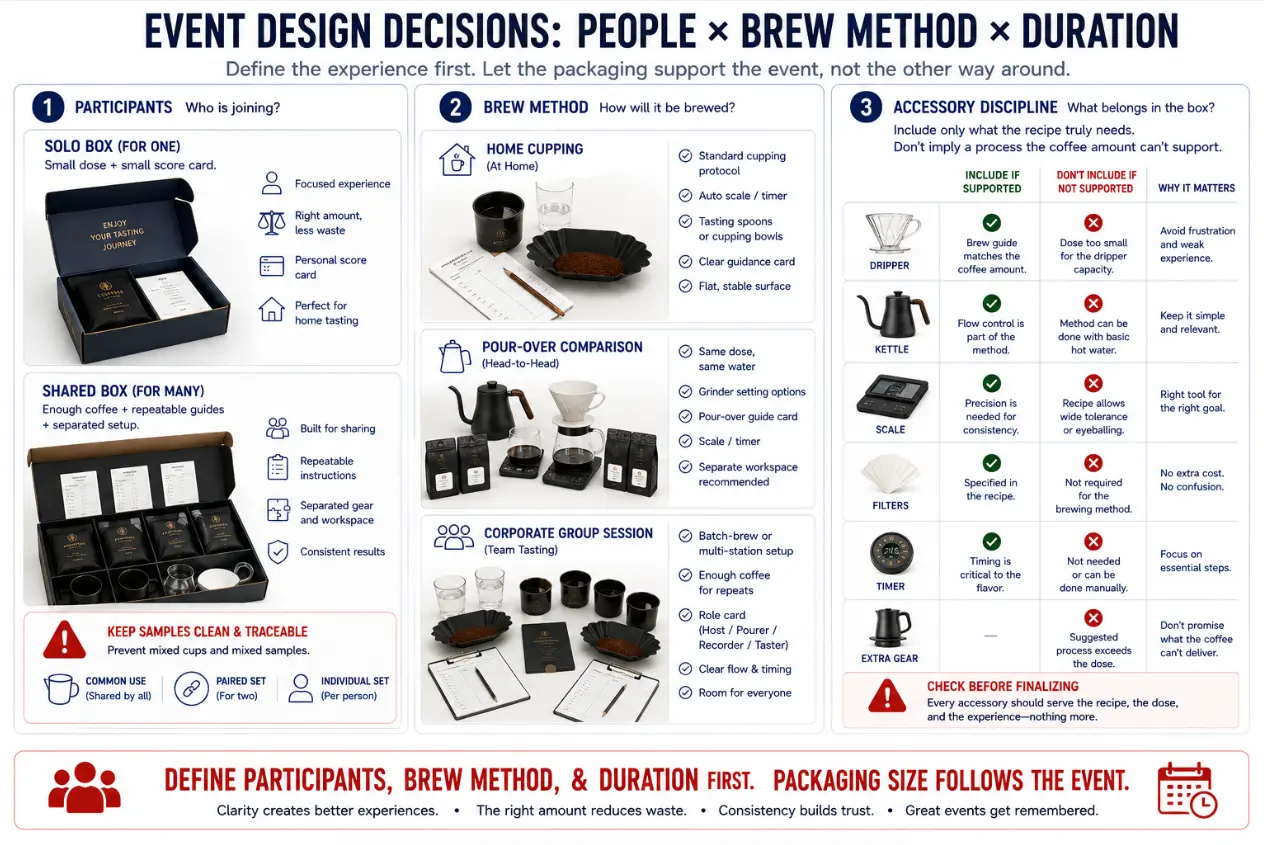
Decide on the number of participants.
A number of small doses and a small scorecard can be included in one-person box. A common box must have enough coffee, repeat instructions, properly separate equipment and a means of making sure that the participants do not mix cups or samples. Report on the nature of components shared, paired or supplied per individual.
Choose one of the methods of preparation.
An attentive approach renders devices and guidelines controllable. The components and recipes should be distinguished in case the box is created to be used in cupping and pour-over. Do not include accessories which imply a course of action that the volume of coffee provided can not support.
Copy the Component Layout to a Translation of the Session.
Arrange all filled pouchs, sachets, cups, filters, and spoons, cards and accessories in the sequence of use on a working surface. This is a physical exercise to show what should be seen at the beginning, what might be covered with something, and what items should have their own areas.
Opening layer
The initial perspective must determine the theme of tasting and display the initial action. Concise session card could be placed above the products in the event where it is not hard to remove and it does not conceal important identification. Avoid loose material that spills before the recipient comprehends the set up.
Working layer
Coffee samples and the equipment needed must be accessible without the need to take the entire box apart. The cavities can be left-right following the session and repetition of color or symbolic indicators connect each coffee to its cup location and score area.
Reference layer
Extensive processing notes, provenance, and lengthy brewing training may be below a tray, within a booklet or on a companion page. Isolating reference material and operating instructions make a clean active tasting surface.
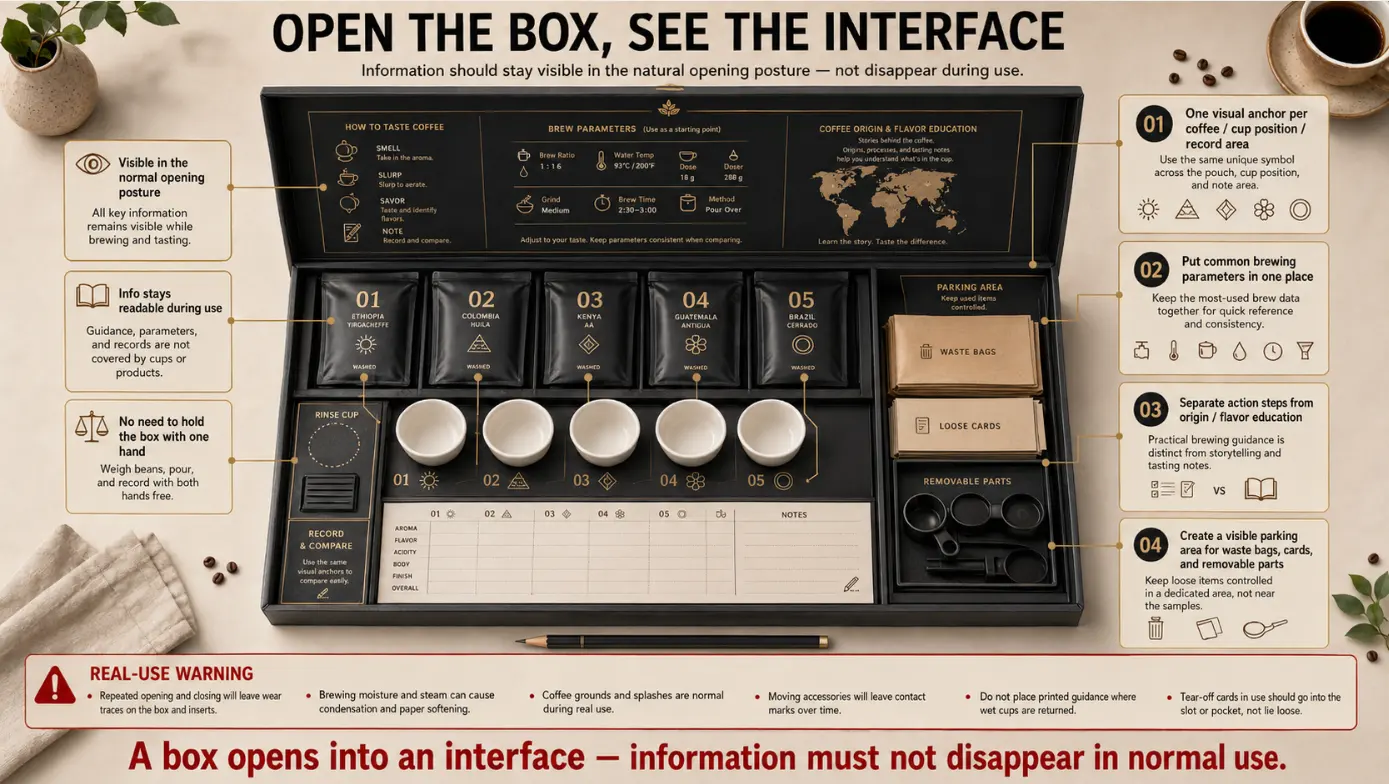
Open Box is a Tasting Interface.
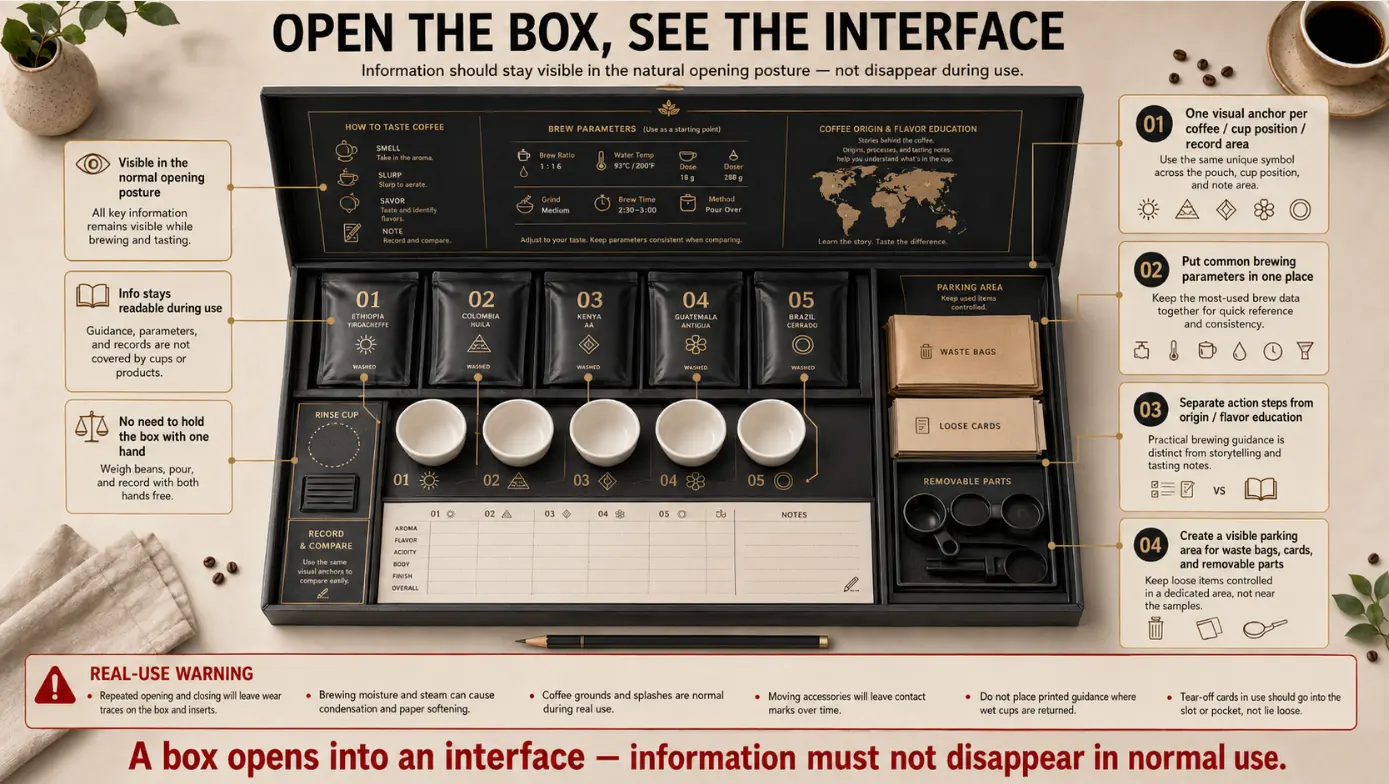
The need to use separate printed pieces can be minimized via the inside lid and the insert. However, the information must not be concealed in the average opening posture and when the products are in use. The recipient does not have to hold on to the box with one hand and measure the coffee with the other.
Create visual anchors
- Label each coffee and cup position, and note field, with a unique symbol.
- Keep typical brewing environments in one location.
- Divorce preparation measures and flavor or source educate.
- Provide a conspicuous location to dispose used sachets, cards or removable parts.
Improve the interface to withstand use.
Repeatedly opening, moisture during the brewing process, coffee dust, and the motion of accessories can be seen on the inside. Instructions that are printed should not be placed in places where the cups can be placed back wet. Removable cards should be put in a pocket or slot when in use as opposed to lying around the samples.
Engineer Protection of Mixed Components.
A tasting package can be put together of soft pouches, thin filters, paper cards, and hard accessories. All the items respond differently to pressure and transportation. The insert should not bump, but should not focus on pouch seals, valves, ceramic edges or delicate filter paper.
Make material zones.
Sample flexible can be lying in channels or paperboard separators. Cavities are supported by hard accessories. Scorecards and filters should not be damp or round. In the presence of ceramic tasting cups, a structure and shipping case that has been proven to work with weight and fragility should be used as opposed to presentation board.
Check the inverted and vertical movement.
There is no maintenance of the opening orientation in dealing with parcels. Rotate filled box in all directions, realistic vibrating or handling and repack to check on order, abrasion, and contact with product. An open cavity which is aesthetically open might require a retaining bridge, tab or cover sheet.
Size Coffee Portions in the selected Protocol.
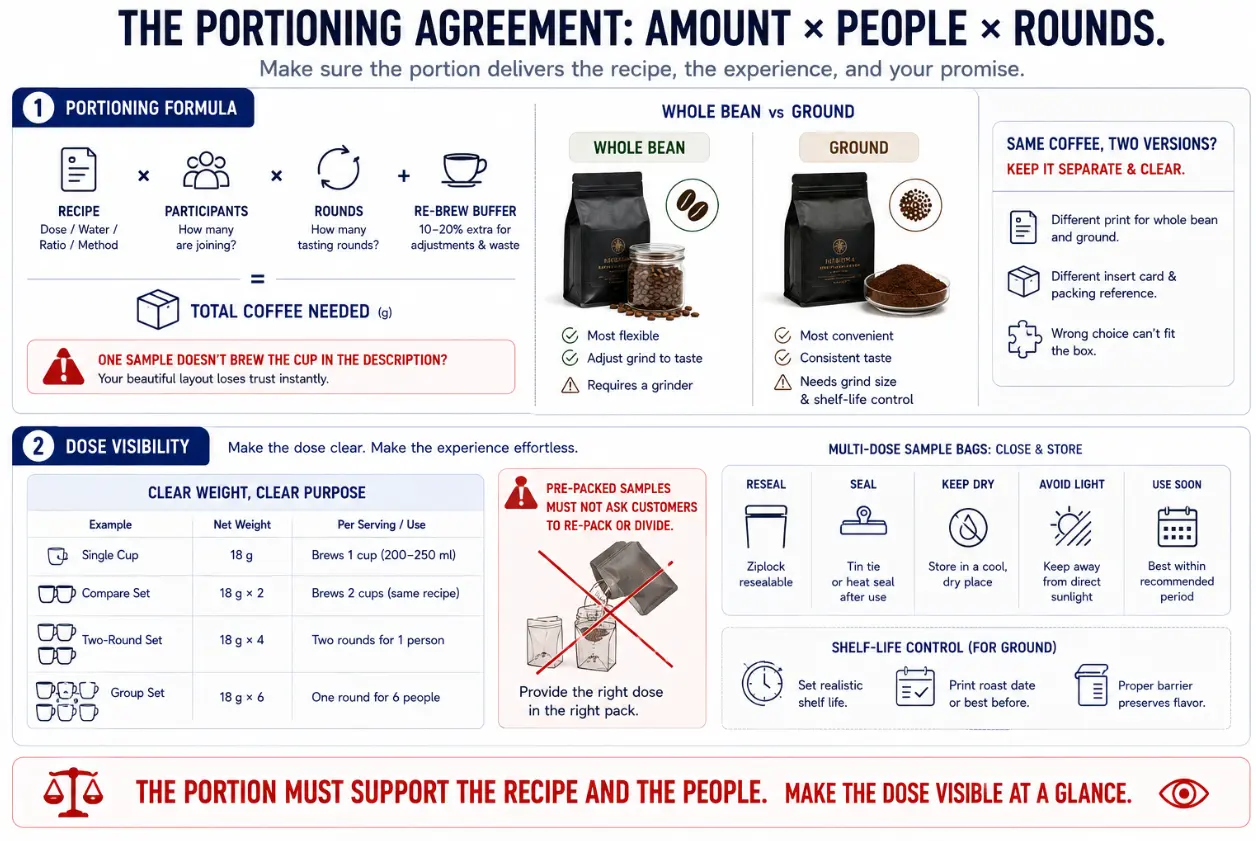
The amount of coffee used ought to be able to sustain the mentioned recipe and the amount of people involved. With a beautiful tasting layout, lack of credibility can arise when one sample fails to result in the brew that is stated in the instructions. Permit grinder-retention or repeat where feasible.
Whole bean and ground
Whole bean is adaptable, however, it needs a suitable type of a grinder. Pre-ground portions are more convenient, but require a grind specification and increased control of shelf life. In the event that the two versions are sold, separate the artwork and packing references in such a way that the incorrect choice cannot make it into the box.
Dose visibility
Label state net weight and use of each piece. In case they are pre-dosed in sachets, the instructions should not entail the recipient dividing the sachets. Where mini pouches contain more than one serving we should have to give a method of closing the package or how to store the rest.
Design a Tasting Flow without Numbered Debris.
A session does not have to progress through a long numbered list, but by named phases. It is these stages that make navigation and leave the packaging visually composed.
Prepare
Assemble water, grinder (where necessary), timer, scale, vessels and the materials provided. Parameters shared should be observed prior to opening any sample.
Brew
Correspondingly match each coffee with its symbol or color and use a typical recipe. Assume one coffee is different in parameter, not in general instructions but just cross the exception next to that sample.
Observe
Ask the recipient to note aroma, acidity, sweetness, body, balance and preference without telling the recipient what to do. Personal language space enhances the experience, as compared to a checklist of anticipated flavors and no more.
Reveal
In the case of blind tasting, put the information of the identity under a flap or card. The revelation should not damage the box or disconnect the code of coffee with the mentioned notes before.
Design to Reset, Store or Discard.
As soon as the first tasting is finished, the session does not end. Customers will re-do, distribute or store remaining coffee. The box must indicate the next thing to do, and must not get messy when the insert is half full.
Explain components separately
The paper box, the insert, the primary coffee packs, labels, the laminates and the accessories could have various disposal paths. The declarations of sustainability should be integrated to all of the mentioned aspects and recommendations in the destination market rather than its general look of a sheet of paper.
Authenticate the Experience: Real Users.
Structural sampling is a guarantee to fit, but a tasting trial indicates whether the pack talks. Give a prototype with no one who had prior knowledge of the design. Warn about the position of the single stalls or hunting-ground, or about collecting the wrong sample, or losing a card, or misunderstanding the recipe.
Record behavioral evidence
- The time needed to get acquainted with the session and prepare.
- Sample order errors, cup matching errors, dose errors or brewing parameter error.
- Objects that travel, adhere, build and disassemble.
- Omitted, scribbled, repeated or misunderstood instructions.
- Condition of the box and insert after the complete tasting.
Redesign the structure and information hierarchy according to behavior that is being observed and invest in final printing and finishes. The premium pack should contain only the minimal ambiguity but not transform the experience into dense manual.
Prepare a Good Packing and Reorder Book.
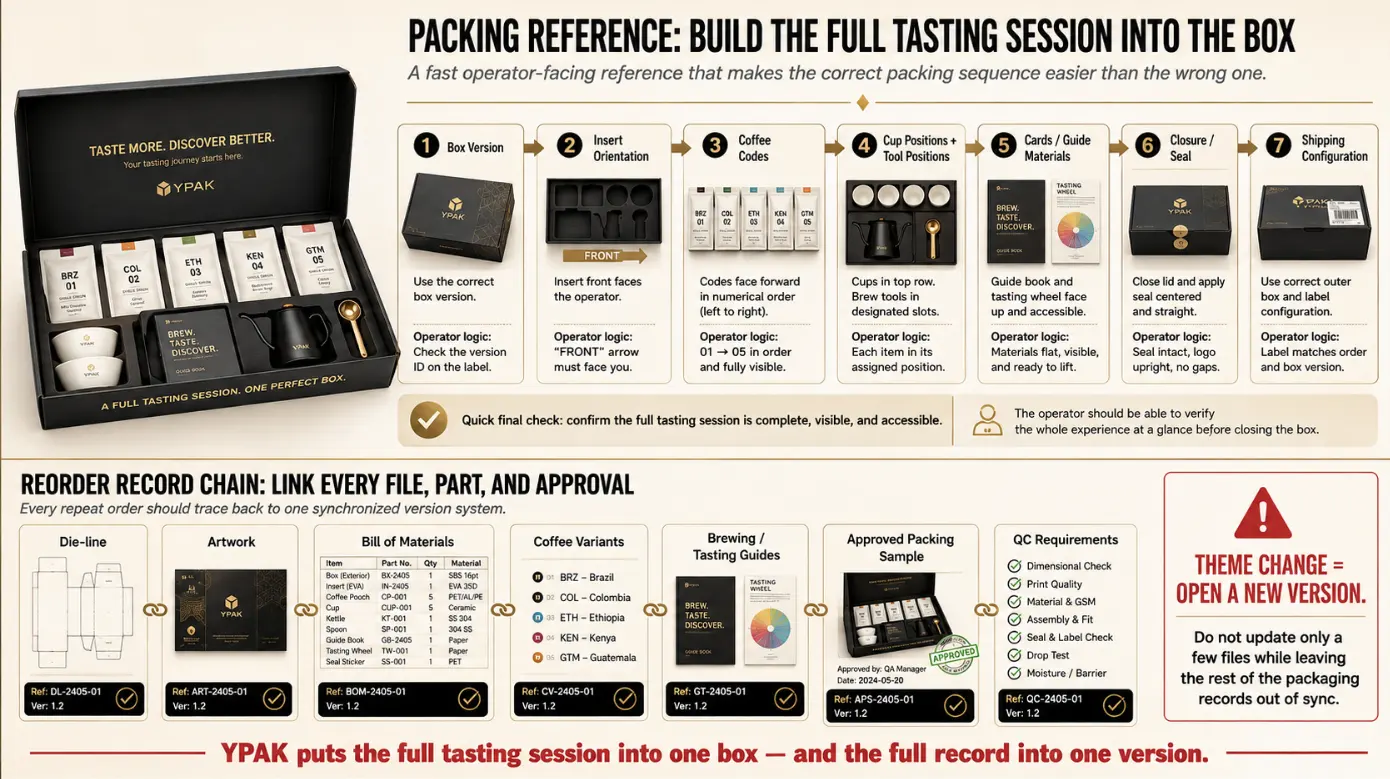
A problem of packing exists since there are several similar samples and accessories. The reference to the production should state the version of the box, how the insert should be oriented, the codes on the coffee, the position of the cups or tooling, cards, closures and shipping setup. The operators ought to possess a quick end check which would guarantee that the complete session is accessible.
Link dieline, art, parts list, coffee variations, directions, approved packed sample, and quality requirements in case of repeat orders. In case of a change of the theme of the tasting, provide a new one rather than simply writing over the individual files without making an update to the whole pack record.
Conclusion
A good coffee tasting box would be a high-quality gift that would be helpful both when opening it and until the last comparison. Ornamental complexity is less important than planning the session, delimited components, shielded mixed materials, correct dosages, relaxed instructions and experiments on real users. This can be replicated to gifting programs in instances where the box is a good tasting interface, and the production record controls all the elements.
FAQ
Written by
ypak.coffee
ypak
YPAK PACKAGING GROUP was established in 2011 and formed with 3 companies based on Hongkong, Dongguan and Foshan. We have become one of the largest coffee bag manufacturers in China. We use the best quality WIPF valves from Switzerland to keep your coffee fresh.
Conform to the plastic ban policy imposed to many different countries, we have researched and developed the sustainable packaging bags, such as RECYCLABLE and COMPOSTABLE pouches.
No minimum quantity, no color plates are required with our HP 25K INDIGO DIGITAL PRINTING service.
You are welcome to visit YPAK.
Related Articles
YPAK at World of Coffee Panama 2026: Coffee Packaging for Short Runs and EU-Bound Lots
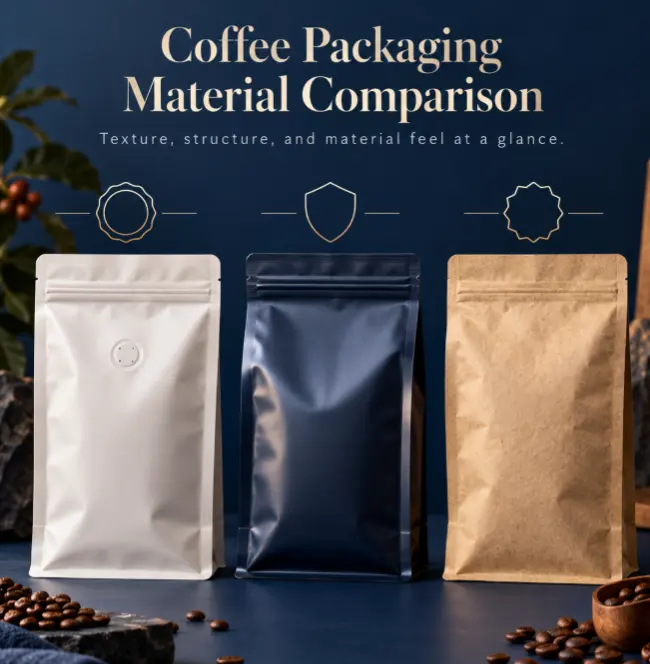
PPWR Recyclability Grades for Coffee Packaging: What Survives 2030, and What Survives 2038
Customized Coffee Packaging Solutions: From Product Ideas to Market-Ready Packaging