

Updated 1 week ago
Coffee Sampler Box: Packaging Concepts to high end gift.

ypak.coffee
YPAK PACKAGING GROUP was established in 2011 and formed with 3 companies based on Hongkong, Dongguan and Foshan. We have become one of the largest coffee bag manufacturers in China. We use the best quality WIPF valves from Switzerland to keep your coffee fresh.
Conform to the plastic ban policy imposed to many different countries, we have researched and developed the sustainable packaging bags, such as RECYCLABLE and COMPOSTABLE pouches.
No minimum quantity, no color plates are required with our HP 25K INDIGO DIGITAL PRINTING service.
You are welcome to visit YPAK.
coffee sampler box
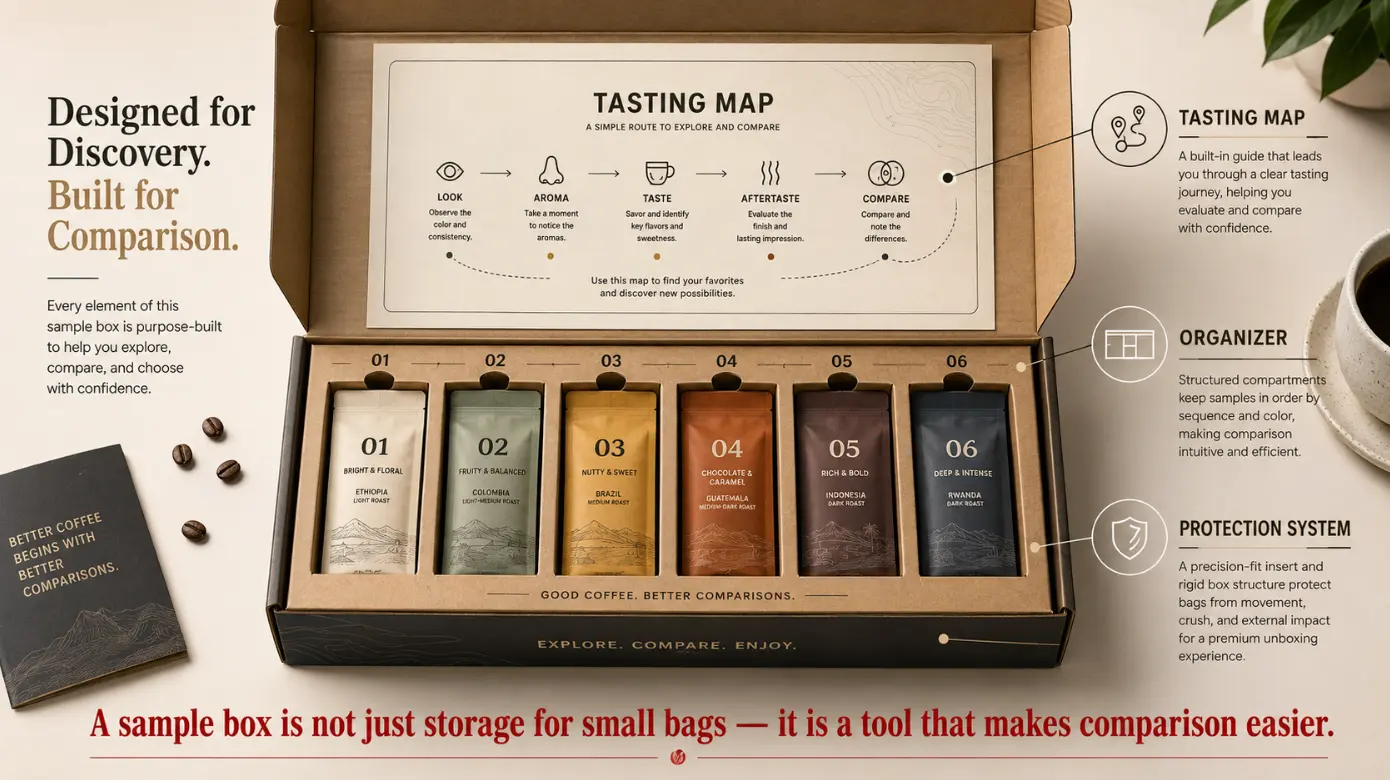
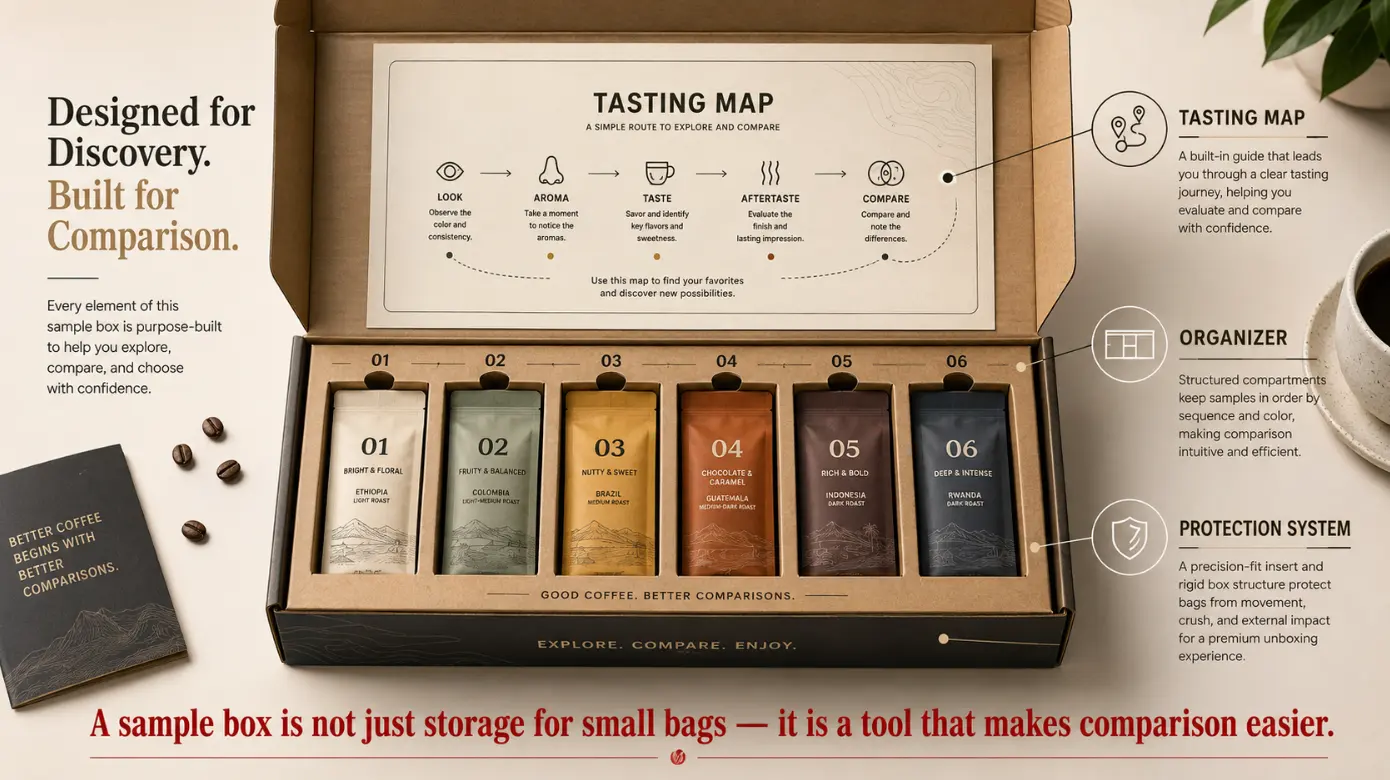
Not just to put small packs in a carton, a coffee sampler box can help to compare several coffees easier. The recipient must identify every sample, have an order of tasting, make a necessary brew and go back to a favorite. Packaging transforms into organizer, tasting map and protective system.
Freshness is left to the sealed sample pouch or sachet. The box offers secondary protection, presentation, identification and sequence. A little range of assortments can be consciously and quality when such functions are designed in unison and without a strong strict framework and an overabundance of finish.
Choose purpose of commerce preceding dimensions. A departure flight requires various data and amounts of a roast comparison, processing-method set or seasonal gift. The concept manages the number of samples, order, insert and explanation.
Provide the Sampler One Clean Clear Tasting Question.
A good sampler is one which the recipient can comprehend. The box can be a comparison of three origins, which are roasted to a close profile, an origin, which has been processed in various forms, or multiple roast expressions intended to be used in the same brewing process. Combining irrelevant products could help bring variety, yet the purpose of tasting them will be undermined.
Write promise in a single sentence.
In designing the pack, specify what the customer is supposed to learn. This sentence will serve as a product-selection filter, a tasting-order filter, a brewing-card filter, and a front-panel-communication filter. When the promise is not supported by an accessory or an extra sample, then such a sample should be sold separately and not in a cavity.
Select a Sample Quantity to make a useful Brew.
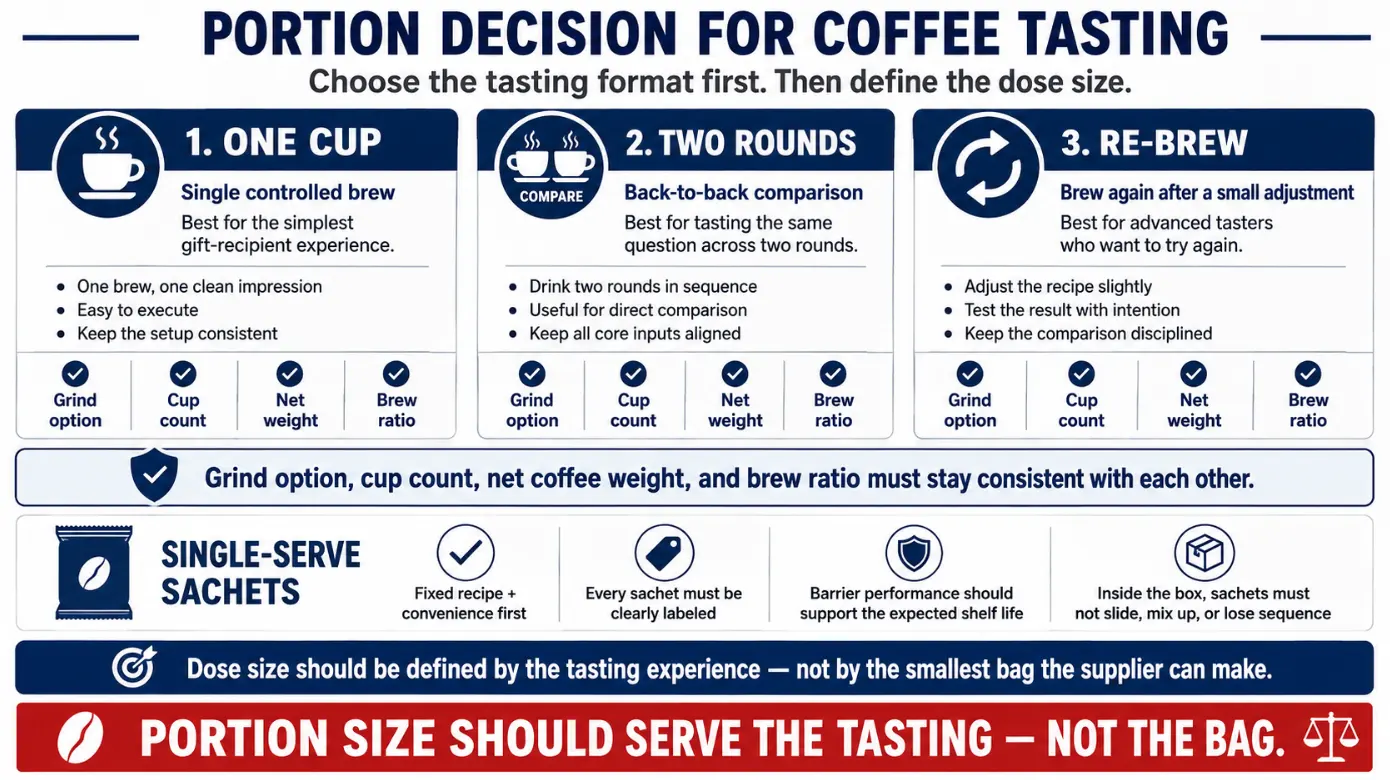
A sample size must be determined according to the desired brewing experience and not the size of the pouch that a supplier can create. Depending on the recipient, one controlled brew or two rounds of comparison or a second attempt after tweaking the recipe may be required. Grind option, number of servings, net weight and brewing ratio must be in agreement.
Single-use portions
The sequence and dosing can be made easy with individual sachets. They are good when the recipe is fixed and convenience is important, but each sachet must be clearly identified and have a barrier that can support the anticipated shelf life. The box should not allow the thin packs to slide behind each other or out of order.
Visualize the Tasting Order.
Order should be visible immediately that the box is opened. The customer need not do any reading before he knows where he has to start. Direction can be created by position, color coding, symbols or a removable tasting map, leaving the individual coffee packs reusable outside of the box.
Build a progression
Prepare the samples based on the comparison: lighter, more developed to roast, familiar, to unusual flavor, to washed to experimental processing, or less intense to more intense. The order should be conducive to sensory comparison as opposed to being alphabetical in the names of products.
Retain the order, post removal of products.
Products are returned to their intended place with labels in the cavities or keyed dividers or a printed map. Assuming that identification is in a loose card, the logic of tasting can be lost after the samples are off the insert. Division of permanent and variable information should thus be not random.
Sample Identity in All Touchpoints.
A sampler may also malfunction when all the coffees are fresh but the labels, cards, and the locations of cavities are out of sync. The identity of the product must be maintained between the approval of the artwork, and the packing and usage by the customer.
- Assign a different code, color, or symbol to each coffee on pouch, cavity and tasting card.
- Record roast date, origin, process, variety and lot with the appropriate sample version.
- Do not allow similar-looking pouches to get to the packing station without a positive identifier.
- Included is a sanctioned packed reference with the location and orientation of each sample.
Choose a Box that Can make Comparisons.
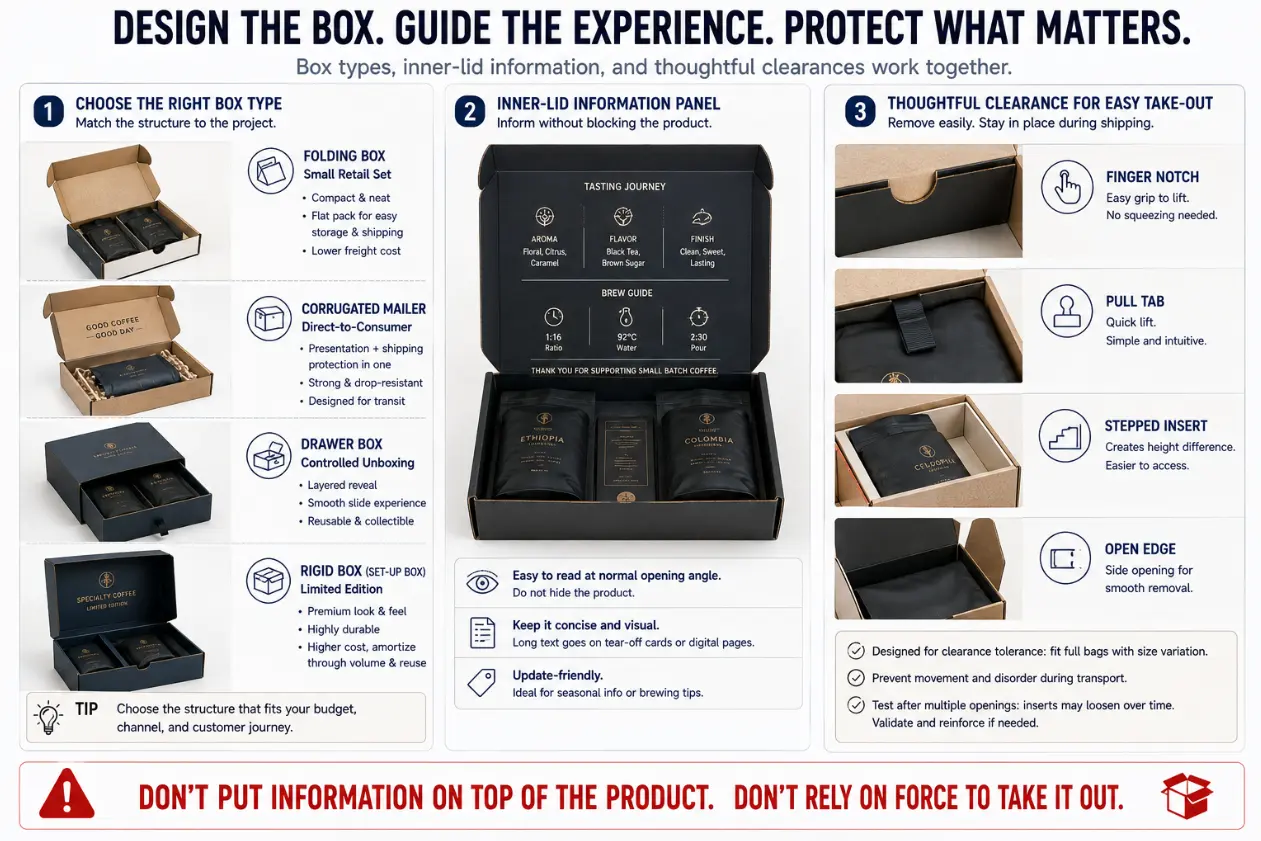
The box must offer sufficient printable space and internal structure but not too much material and freight than the program can afford. Folding cartons are suitable to small retail sets. Direct shipping can be supported using corrugated mailers. Drawer boxes will give you a controlled disclosure whereas rigid boxes could be used in limited runs in cases where the cost is justified by the price and reuse value.
Lid will act as information surface.
Tasting route, brewing ratio or brief explanation can be held inside-lid printing without covering the products. The data must be readable with the standard opening angle. Long textual material would usually be put in a removable card or a connected digital page to ensure that the box is not overcrowded.
Set aside room to clearance.
The customer should be able to remove a sample without squeezing the pack using finger access, pull tabs, stepped levels or open edges. Clearance should be able to accept variation of the filled products but should not allow rotation and mixing of the products in transit. Test repeated due to probable weakening of the insert during the initial use.
Design a Flexible Packs Small Pack Engineer an insert.
Sampler inserts handle numerous small constituents as opposed to a big load. Migration can be caused by narrow cavities, loose sachets and shallow dividers. The insert should retain order during the time the box is transported vertically in a parcel network, and also when it is reopened on a number of occasions.
Paperboard organization
Paperboard dividers can be folded into rows, channels or stepped platforms with visible edges. They are efficient in shipping and are able to bear printed identifiers. They should check their grain direction, lock design and accuracy of the folds since tolerances in one or multiple compartments may result in changing the final cavity size.
Brewing Information is Heavy in the Box.
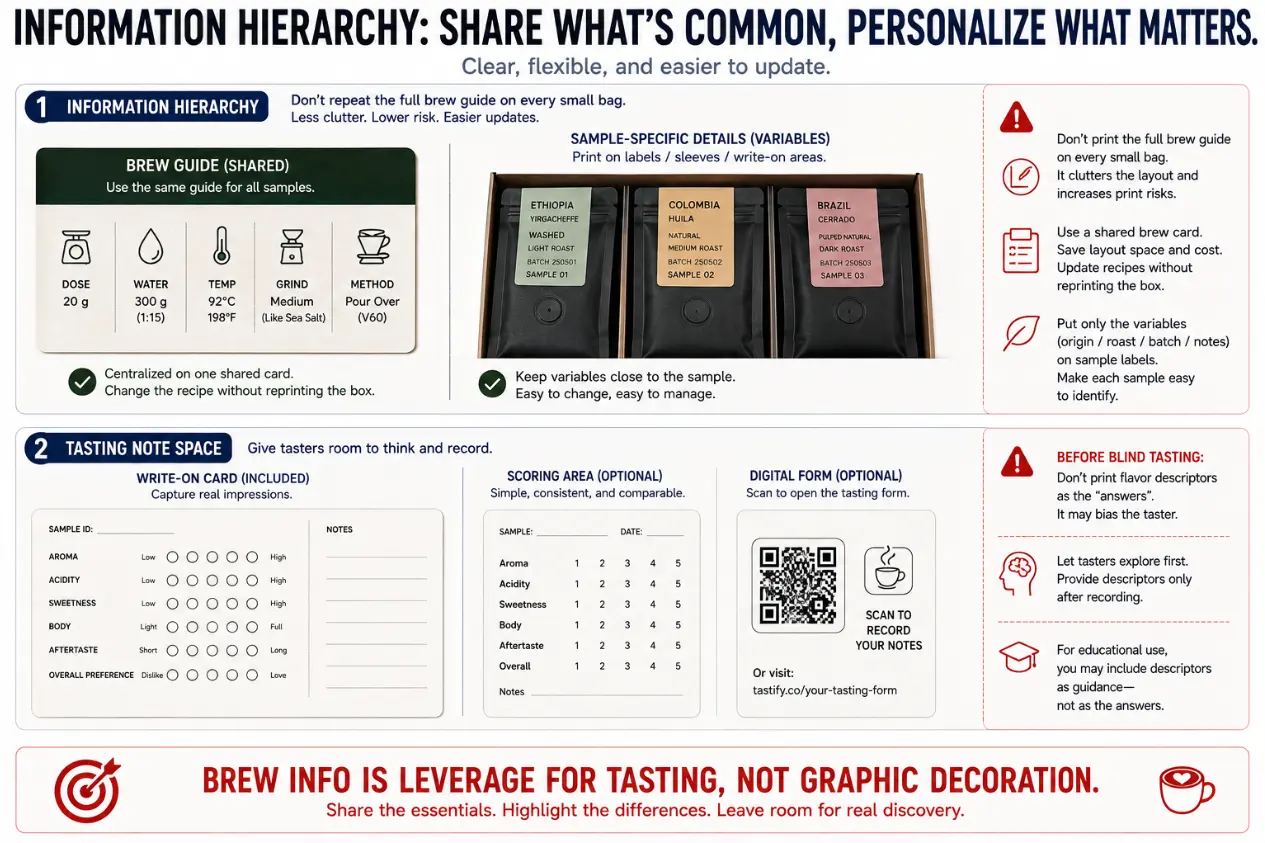
When the brewing variables are manipulated then it is more useful to compare. The pack needs to clarify the dose, amount of water, temperature, the grind directions, and the suggested method at the right level. It is about more than graphic style.
Keep the general recipe in one place and set up separate labels of the details that vary. The entire procedure needs to be repeated on each small pouch to decrease readability and risk of artwork. A common card also enables the brand to change preparation instructions without having to reprint the structural box.
Provide space to be used in tasting notes.
It can be documented with the help of a writable card, small area of a score, or a QR-linked form to allow the recipients to record the aroma, acidity, sweetness, body, and preference. Tasting descriptors should not be given as answers prior to a blind comparison, except when it is primarily educational and not discover-oriented.
Formulate a Blind-Tasting Choice.
A hidden mode is capable of adding an additional participation without the need to have a separate package. Label the samples with use codes and put the identity key either under a flap, in an envelope, or on the back of the tasting map. The code system should be easy to be verified by the packing staff.
And disclose to no harm reuse.
The reveal device must open without leaving any mess and must not ruin the main box or ruin sample identification. A folded panel or removable card is more likely to be practical than a complex mechanism. Check that the solution is not leaking during shipping and will be comprehendible without additional clarification.
Design the Packing Station in terms of Accuracy.
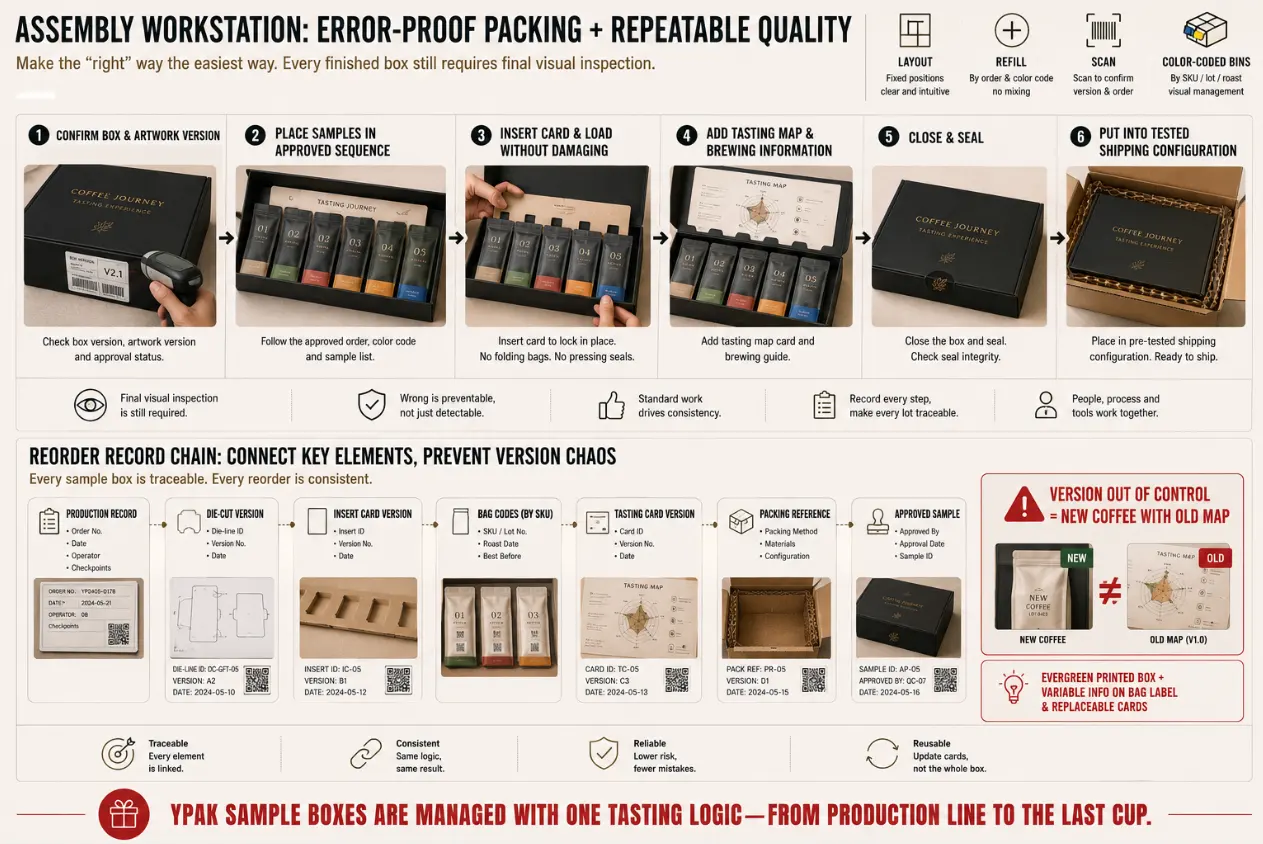
A sampler is more prone to version mix-up since multiple components that are similar are combined into a single box. The control of packing should facilitate the right arrangement rather than the wrong one. Accuracy can be aided by layout, replenishment, scanning, or color coded work bins, but still a simple visual check is required on the final pack.
Carry out a full packing simulation.
- Establish the appropriate box and artwork version.
- Approved tasting order of stage samples.
- Load the insert with no bending of sachets or seals of a pouch.
- Included the corresponding tasting map and brewing information.
- Close, examine, and position the sampler into the shipping configuration that it is tested in.
Check Finished Sampler.
The complete filled assortment should be used. Check sample movement, sequence retention, label rubbing, closure security, corner condition and access based on the distribution route anticipated by the program. When the presentation box is in a shipping carton, both layers should be tested at the final weight.
Reorders and Seasonal.
Samples collections are usually more dynamic than structural packaging. Maintain consistent branding and common directions on the box and put the origin, lot, roast or seasonal information on pouches and replaceable cards. Ensure that all the planned pouches are within the acceptable range of fit.
The production record must be linked to the box dieline, insert version, pouch codes, tasting card, pack-out reference and approved sample. The version control minimizes the possibility of a repeat order having a mix of up-to-date coffees with a map or cavity layout that is already outdated.
Conclusion
An effective coffee sampler box will transform the variety of products into a regulated tasting process. The clarity of purpose, helpful portions, apparent order, reliable identification and an insert tested with filled samples are more important than ornamental intricacy. When the brewing information, packing controls, and reorder records are brewed using the identical tasting logic, the sampler can be kept up to premium, precise and repeatable across the production process to the final cup.
FAQ
Written by
ypak.coffee
ypak
YPAK PACKAGING GROUP was established in 2011 and formed with 3 companies based on Hongkong, Dongguan and Foshan. We have become one of the largest coffee bag manufacturers in China. We use the best quality WIPF valves from Switzerland to keep your coffee fresh.
Conform to the plastic ban policy imposed to many different countries, we have researched and developed the sustainable packaging bags, such as RECYCLABLE and COMPOSTABLE pouches.
No minimum quantity, no color plates are required with our HP 25K INDIGO DIGITAL PRINTING service.
You are welcome to visit YPAK.