

Updated 19 minutes ago
PPWR Recyclability Grades for Coffee Packaging: What Survives 2030, and What Survives 2038

ypak.coffee
YPAK PACKAGING GROUP was established in 2011 and formed with 3 companies based on Hongkong, Dongguan and Foshan. We have become one of the largest coffee bag manufacturers in China. We use the best quality WIPF valves from Switzerland to keep your coffee fresh.
Conform to the plastic ban policy imposed to many different countries, we have researched and developed the sustainable packaging bags, such as RECYCLABLE and COMPOSTABLE pouches.
No minimum quantity, no color plates are required with our HP 25K INDIGO DIGITAL PRINTING service.
You are welcome to visit YPAK.
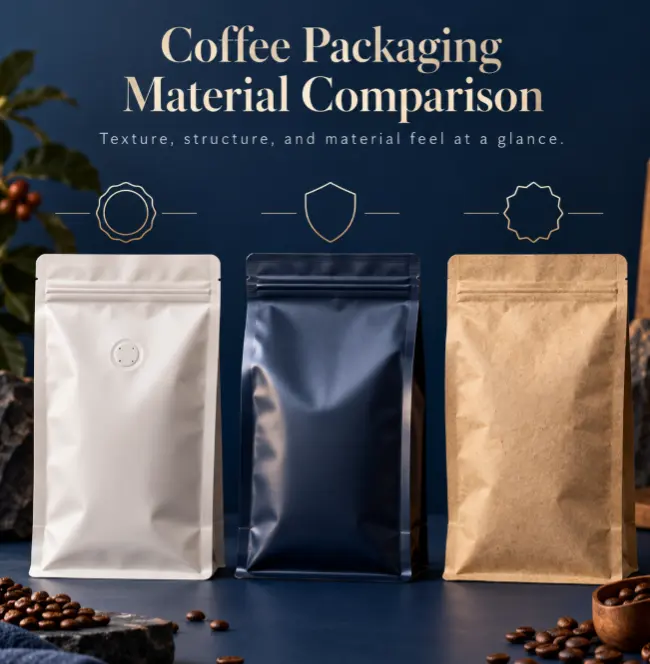
Most packaging suppliers will tell you their material is PPWR compliant. The more careful ones will show you a recyclability certificate. Both answers miss the point, because the PPWR does not approve materials. It grades packaging units against a score, and it sets a score below which a packaging unit may not be sold in the EU at all.
For a coffee roaster the question is therefore not what material is allowed. It is narrower and more uncomfortable: given the structure I am buying today, where does the score land, and when does that stop being good enough. This article works through that question structure by structure, using the criteria the Regulation itself names as the basis for the assessment.
One honest limitation up front, because it is where most published guidance fails: the detailed scoring rules are being written by delegated act, due by 1 January 2028. Nobody can yet calculate a grade for a specific bag. What is already fixed is the architecture — the thresholds, the 2038 cliff, the material basis and the list of parameters. That is enough to make structural decisions now, and it is the only part anyone can state with certainty. Figures in this article that are quoted from the Regulation are quoted verbatim; anything requiring the unfinished delegated acts is marked as such.
1. There is no such thing as PPWR-approved material
Article 6(1) opens with a sentence that is easy to read past: All packaging placed on the market shall be recyclable. It does not say certain materials are approved. It places the obligation on the packaging unit.
That distinction has practical consequences. Two bags made of the same film can end up in different grades, because the grade is not a property of the film. It is a property of the finished unit — the layers, the valve, the label, the adhesive, the ink coverage and how easily the coffee empties out of it. A supplier who answers a grade question at material level is answering a different question from the one the Regulation asks.
This is also why the phrase PPWR certified material is a warning sign in a supplier conversation. Certification schemes exist for management systems and for specific material properties. The PPWR grade is a self-assessment the manufacturer carries out, expressed in the grades set out in Table 3 of Annex II. There is no third-party certificate for it, and no notified body issues one.
2. PFAS and recyclability: two PPWR gates, one pass-or-fail and one graded
Before the grading question, there is a gate that does not grade anything. Article 5 sets limits on substances of concern, and for PFAS it sets three of them. In packaging intended to come into contact with food, the limits are 25 ppb for any PFAS measured with targeted PFAS analysis, 250 ppb for the sum of PFAS, and 50 ppm for PFASs including polymeric PFAS. Where total fluorine exceeds 50 mg/kg, the operator must provide proof of the quantity of fluorine on request. Article 5(6) requires compliance with these limits to be demonstrated in the technical documentation under Annex VII.
This gate sits upstream of recyclability. A grease-resistant coating for a paper-based coffee carton either meets those limits or it does not, and no amount of structural optimisation compensates. Settle the coating question before the structure question.
| Gate | Basis | Nature | What it decides |
| Substances of concern, including PFAS | Art. 5; demonstrated in the Annex VII technical documentation per Art. 5(6) | Pass or fail | Whether a material or coating may be used at all |
| Recyclability | Art. 6; grades A, B, C per Table 3 of Annex II | Graded, with a floor | Whether the packaging unit may be placed on the market, and from when |
3. PPWR recyclability grades A, B and C: the 95, 80 and 70 percent thresholds
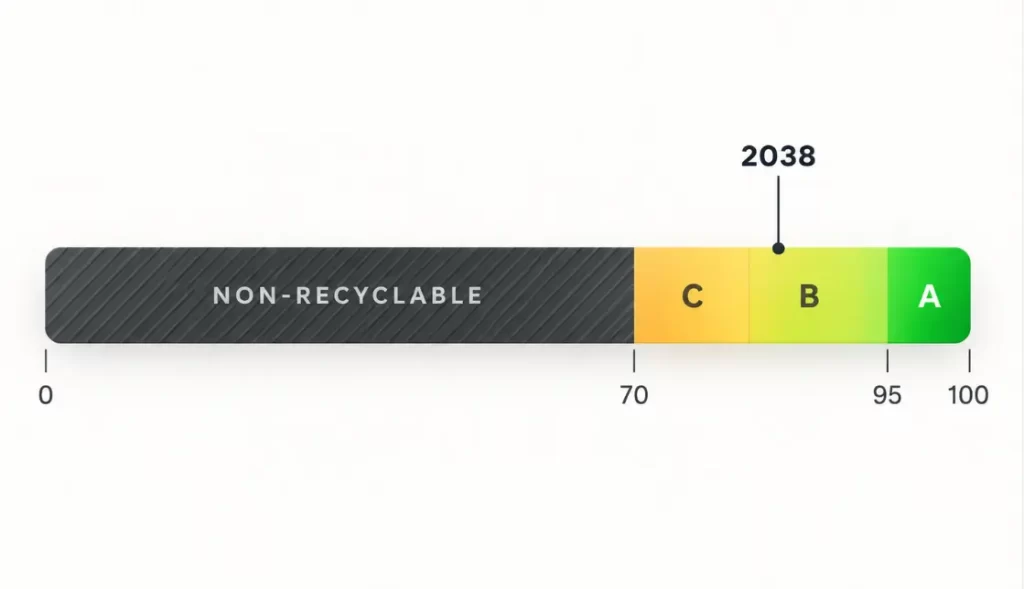
Table 3 of Annex II sets the grade structure, and it is more concrete than most coverage suggests. Packaging recyclability shall be expressed in the performance grades A, B or C, and the table assigns each grade a numeric band.
| Grade | Recyclability performance (design for recycling) | Consequence |
| Grade A | Higher than or equal to 95% | May be placed on the market |
| Grade B | Higher than or equal to 80% | May be placed on the market |
| Grade C | Higher than or equal to 70% | May be placed on the market until 1 January 2038 |
| Below Grade C | Lower than 70% | Technically non-recyclable — CANNOT BE PLACED ON THE MARKET |
The floor is stated twice, in the table and in its accompanying text: when a packaging unit’s recyclability performance grade is below 70%, it is considered to be non-compliant with the recyclability performance grades and therefore the packaging will be considered technically non-recyclable and its placing on the market shall be restricted.
Note what the bands are. They are not a scale of virtue; they are a licence. A unit at 71% and a unit at 94% both carry Grade C and both face the same 2038 end date, and neither is differentiated in the market by the Regulation. That has an operational implication worth stating plainly: if you are going to redesign, there is little commercial value in landing at 72%. The bands that matter are the ones that survive 2038.
4. 2038: why only PPWR grades A or B will be saleable
This is the part that changes planning, and it is routinely left out. Article 6(3) contains two separate market restrictions with different dates. From 1 January 2030 — or 24 months from the entry into force of the delegated acts under Article 6(4), whichever is the latest — packaging shall not be placed on the market unless it is recyclable within grades A, B or C. From 1 January 2038, packaging shall not be placed on the market unless it is recyclable within grades A or B.
In other words, Grade C is a legal category with an eight-year life. It is a transition allowance, not a target. A structure that lands in Grade C in 2030 must be replaced before 2038, and the replacement cycle is not short: a coffee bag structure change runs through barrier validation, print, filling trials and customer approval. A roaster who plans the C-to-B move in 2036 has already missed the window.
There is a second clock underneath this one. Article 6(2) defines recyclable as requiring both design for material recycling, under paragraph 4, and — when the packaging becomes waste — separate collection, sorting without affecting other streams, and recycling at scale. The second condition applies from 1 January 2035. So the assessment gets harder in 2035 and the grade floor rises in 2038, which means a design settled in 2030 is being tested twice against criteria it was not originally written for.
| Date | What changes | Basis |
| By 1 Jan 2028 | Commission adopts delegated acts with the design for recycling criteria and performance grades | Art. 6(4) |
| By 1 Jan 2030 | Recyclability must fall within grades A, B or C, or the packaging may not be placed on the market | Art. 6(2)(a); Art. 6(3) |
| 1 Jan 2035 | Recycled-at-scale condition added to the assessment | Art. 6(2)(b) |
| 1 Jan 2038 | Only grades A or B may be placed on the market; Grade C ceases to be saleable | Art. 6(3) |
5. PPWR design for recycling criteria: predominant material, eleven parameters
The assessment is not a checklist where good intentions accumulate. Article 6(3) requires the manufacturer to assess recyclability on the basis of the delegated acts under Article 6(4) and the implementing acts under Article 6(5), and Table 3 explains the mechanics: the criteria are weighed per packaging unit, and after that weighing the unit is classified into A, B or C. It is a weighted score on the finished unit, not a pass on the material.
Article 6(4) then fixes what the criteria must be built on, and this single clause is the reason this article is organised by structure rather than by product: the design for recycling criteria and recyclability performance grades shall be developed on the basis of the predominant material. The criteria must also take into account the ability of packaging waste to be separated into different material streams, consider established collection and sorting processes proven in an operational environment, and cover all packaging components.
Annex II Table 4 then lists the parameters on which those criteria are to be set. The list is expressly non-exhaustive, which matters: it tells you the direction of travel without letting you claim a complete score. The eleven parameters named are these.
| Parameter | How Table 4 frames it |
| Additives | Additives can cause incorrect sorting and contaminate the resulting secondary raw material |
| Labels | Coverage rate affects sorting efficiency; label material and adhesive type affect secondary raw material quality |
| Sleeves | Coverage rate affects sortability, and sleeve material affects both sortability and recyclability |
| Closures and other small packaging components | Explicitly includes caps, lids, seals and valves; component material affects sortability and recyclability, and small parts can be lost in sorting |
| Adhesives | Residues downgrade secondary raw material purity; washable adhesives allow separation without residue |
| Colours | Heavily dyed materials in paper or plastics can cause sorting problems and downgrade secondary raw material quality |
| Material composition | Use of mono-materials or material combinations that permit easy separation and ensure high yield is preferable |
| Barriers and coatings | Their presence can make recycling more difficult; combinations ensuring high yield are preferable |
| Inks and lacquers, printing and coding | Inks with substances of concern hinder recycling; released inks contaminate wash water, unreleased inks impair stream transparency |
| Product residues and ease of emptying | Residues affect sortability; design should enable easy emptying and a fully drained condition |
| Ease of dismantling | Components firmly attached to each other affect sortability; design can facilitate separation into material streams |
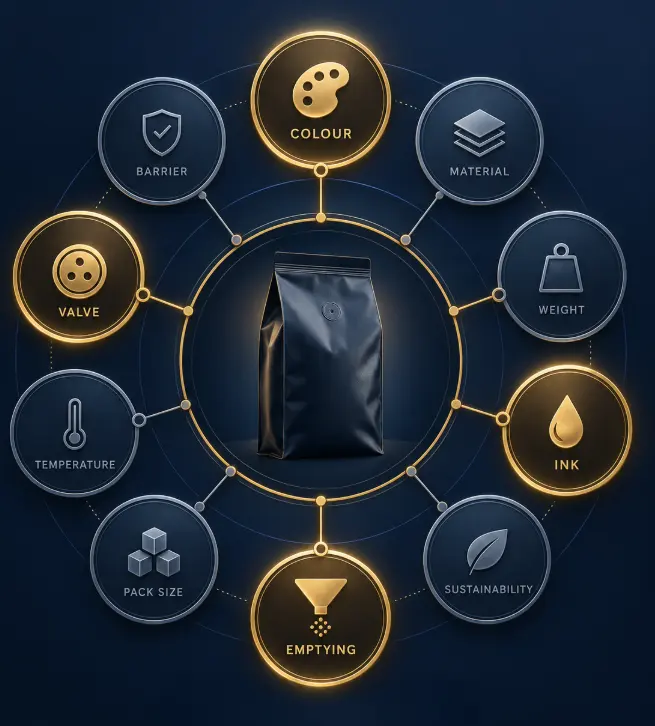
Read that list as a diagnostic rather than a specification. Four of the eleven are things a coffee roaster chooses without thinking of them as recyclability decisions at all: the colour of the bag, the ink coverage, the valve, and how cleanly the bag empties. Those four are where most of the recoverable points sit.
6. Mono-material PE coffee bags: what the PPWR actually prefers
Of the four structural families in coffee packaging, mono-material polyethylene is the one the Regulation’s own wording pushes towards, and it is worth being precise about why. Table 4 does not say mono-PE is compliant. It says that use of mono-materials or material combinations that permit easy separation and ensure high yield of secondary raw materials is preferable — and it repeats the point under barriers and coatings, where combinations ensuring high yield are preferable.
Two of the four overarching considerations in Table 4 reinforce this: the criteria must consider the ability of packaging waste to be separated into different material streams, and collection and sorting processes already proven in operation. A single-polymer structure does not need that separation step, so it does not depend on infrastructure that may not exist locally. The advantage survives changes to the delegated acts, because it comes from the architecture rather than a point value.
The honest complication is the barrier. A mono-PE coffee bag that meets a roasted-coffee shelf-life requirement usually needs something more than PE, and that something is a parameter under Table 4. The three options behave differently, and they should not be treated as interchangeable in a technical file:
| Barrier approach | What it is | Why the distinction matters in the file |
| AlOx coating on PE | A sub-micron aluminium oxide layer deposited on the PE film; the polymer stream remains PE | A coating rather than a second material stream. Table 4 lists coatings as a parameter because they can make recycling more difficult, so the layer thickness and the carrier material both need stating |
| EVOH tie-layer | A polar barrier polymer co-extruded into the structure | Introduces a second polymer into the stream; the file must state its share and whether it is compatible with the PE stream |
| Aluminium foil or metallised film | A metallic barrier layer, laminated or vacuum-deposited | Moves the unit towards a composite classification and brings a metal stream into the assessment |
Our own mono-material construction, YPAK-Shield 2.0, sits in the first row: Mono-PE with an AlOx barrier. Using our laboratory data, the published oxygen transmission rate for that structure is OTR < 5 cc/m²/day and the water vapour transmission rate is WVTR ≤ 0.5 g/m²/24hrs. The reason we lead with the AlOx variant rather than a foil laminate is precisely the paragraph above — a coated PE stream stays a PE stream. But note what we are not saying: we are not telling you this structure achieves Grade A, because the delegated acts that would allow that calculation do not exist yet. Anyone who gives you a grade today is guessing.
7. Multi-layer composite coffee packaging: which layer costs the grade
A conventional three-layer coffee bag — printed outer, barrier middle, sealant inner — is not automatically penalised. What the criteria test is separability and yield, and Table 4 addresses both directly: material composition, ease of dismantling, and barriers and coatings are three separate parameters, and components that are firmly attached to each other affect sortability.
The layer that costs the most is usually not the barrier. It is whichever layer is thin, firmly bonded and chemically different from the dominant stream. A 12-micron PET outer on a PE sealant is a small share of mass but a real complication for a PE stream, because it does not separate in a float-sink process and it cannot be counted as PE yield. That is the structural point behind Table 4’s preference for combinations that permit easy separation: the criterion is not how much material you use, it is whether the non-dominant material can leave the stream.
Three practical levers follow, and all three are design decisions rather than purchasing decisions. Reduce the number of polymer types rather than the number of layers — co-extruded layers of the same polymer family behave very differently from laminated layers of different families. Move print to the surface that is removed before recycling, so that ink does not enter the wash water. And treat the sealant as the anchor: if the sealant defines the stream, everything else should be chosen for compatibility with it.
8. Paper-based coffee packaging recyclability: where the boundary sits
Paper-based coffee packaging — cartons, drip-coffee sachets, bag-in-box — has an advantage that has nothing to do with the paper being renewable: paper collection and sorting are long-established, proven processes, which is exactly the phrase Article 6(4) uses as the basis for the criteria. That works in paper’s favour under the parameter on sorting efficiency.
The complication is the functional layer. A paper structure needs grease, moisture or oxygen resistance, and that resistance comes from a coating or a film. Which of the two it is decides the classification, and the Regulation gives a threshold that is far more useful than the general debate about composite versus mono: if a given material represents only an insignificant part of a packaging unit, and in any event no more than 5% of the total mass of the packaging unit, such a packaging unit should not be considered to be composite packaging.
Five per cent of total mass is a number a packaging engineer can design to. A dispersion coating applied at a few grams per square metre can sit under it; a 20-micron PE extrusion layer usually will not, on a typical carton board weight. That single threshold often decides whether a coffee carton stays in the paper stream or becomes a composite, and it is a design variable rather than a supply-chain accident.
Two cautions before this becomes a claim. First, the 5% figure is framed in the Regulation as a rule for not treating a unit as composite, not as an automatic recycling qualification, so it should be used to decide the classification question and then tested against the criteria like any other structure. Second, coating chemistry is where Article 5 bites: a coating chosen to satisfy a grease-resistance specification still has to clear the PFAS limits in Article 5(5), and a PFAS-free coating chosen at the wrong coat weight can fail the functional test while passing the chemistry. Our own position is to specify PFAS-free coatings and validate the barrier separately, rather than treat one as proof of the other.
9. Aluminium foil coffee bags and recyclability: when the barrier earns its place
There are coffee applications where nothing else works: long shelf life across a long distribution chain, high humidity, or a product where oxygen ingress is commercially unacceptable. Aluminium foil delivers barrier performance that no polymer combination matches at the same thickness, and saying so is not a concession — it is the reason the Regulation grades rather than bans.
What the Regulation does is make the cost explicit. Table 4 treats barriers and coatings as a parameter because their presence can make recycling more difficult, and a metallic layer that cannot be separated takes the unit out of the dominant polymer stream entirely. Under a weighted per-unit assessment, one parameter cannot be optimised at the expense of the rest without consequence, and the arithmetic runs against a structure whose whole reason for existing is the layer that causes the problem.
The practical resolution is segmentation rather than a house standard. Most roasters do not need foil across the entire range: a 250 g bag sold through a domestic specialty channel and a 1 kg bag shipped intercontinentally do not have the same barrier requirement, and treating them identically means paying a recyclability penalty on the volume that did not need it. Decide the barrier per SKU from the actual shelf-life and distribution requirement, and keep the high-barrier structure for the SKUs that genuinely require it. That single discipline usually moves more volume out of the penalised structure than any change to the structure itself.
10. Degassing valve recyclability: a component the criteria must cover
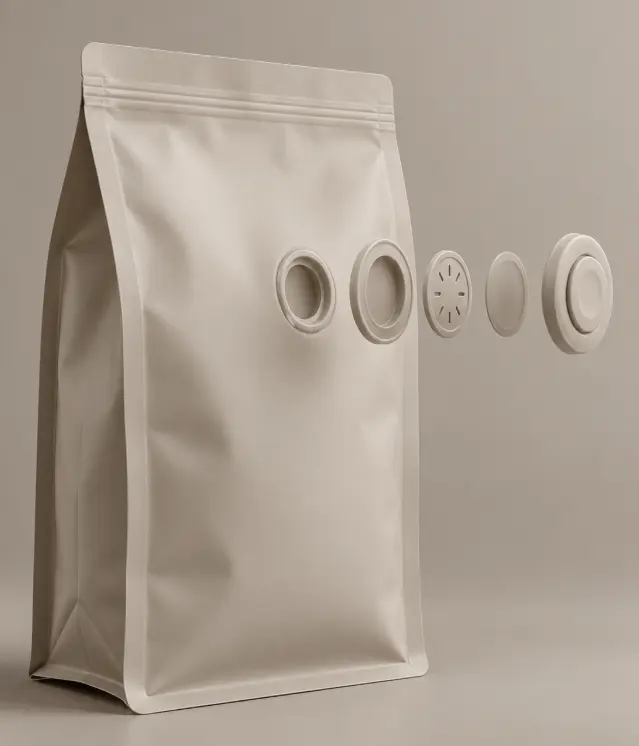
This is the section that matters most for coffee, and it rests on three words in the Regulation that are easy to miss. Article 6(4) requires that the design for recycling criteria cover all packaging components. Annex II Table 4 then names the component explicitly: closures refer to components used to close or seal the packaging, whether rigid or flexible, such as tamper-evident shrink wrap, linings, caps, lids, seals, valves, and the material from which the closure is made can affect both the sortability and the recyclability of the packaging.
A degassing valve is not an accessory outside the assessment. It is inside it, by name. And the reasoning Table 4 gives for why it matters is specific: small packaging components attached to the main packaging body can affect the separability and the recyclability of the packaging, and the components can be lost in the sorting and recycling process.
Put that together with the material basis in Article 6(4) — criteria developed on the basis of the predominant material — and the structural logic becomes clear. If the bag is PE and the valve is a mixed-polymer assembly, the unit contains a second material that the criteria must account for, that cannot be separated by the consumer, and that is small enough to be lost in sorting. The valve does not have to be the largest component to be the one that decides whether the structure is coherent.
This is also why a valve is a different kind of decision from a label. You can delete a label. You cannot delete a degassing valve from a roasted-coffee bag without changing the product — one-way valves exist to let carbon dioxide out while limiting oxygen ingress, and removing one trades a recyclability question for a shelf-life and packaging-integrity question. So the answer is not removal; it is material alignment.
The WICOVALVE® range we supply includes PE mono-material versions, which is the relevant option when the bag itself is a PE dominant structure: the component then sits inside the same material stream as the body rather than alongside it. Where a mixed-material valve is technically necessary, the honest position is that it is a parameter to be declared and assessed, not a problem to be left out of the technical file.
11. Colour and ink recyclability in coffee bags: two parameters brands routinely fail
Coffee packaging aesthetics run in one direction — deep, dark, saturated — and two of the eleven parameters in Table 4 sit directly against that direction. Neither is usually discussed in a recyclability conversation, which is why both are easy points to recover.
On colour, Table 4 states that colours are substances that impart colour to the material, and that heavily dyed materials in paper or plastics can cause problems with regard to sorting and can downgrade the quality of secondary raw materials. The mechanism is straightforward: pigment load changes how a material reads in a sorting line, and heavy pigmentation reduces the value of what comes out. A matt black bag and a light neutral bag are not equivalent inputs to a recycling stream, whatever the polymer underneath.
On ink, the wording is sharper still. Table 4 separates two failure modes: inks with substances of concern hinder recycling, as those packaging units cannot be recycled; printing inks when released can contaminate the recycling stream through the washing water; and inks which are not released can impair the transparency of the recycling stream. That is a genuine bind — ink that washes off contaminates the water, ink that stays on dulls the output — and it is resolved by ink chemistry and coverage rather than by the printing process alone.
Three moves follow that do not require abandoning the brand. Reduce total ink coverage by designing on a lighter substrate rather than flooding a dark base, which lowers pigment load and ink volume at the same time. Keep the ink system free of substances of concern, and get that stated in the technical file rather than assumed. And where the design brief allows it, use digital printing for short runs and version changes, because a process that does not need a plate change also does not lock a dark base into every revision. Our own HP Indigo capability exists for that reason, but the compliance argument stands independently of the equipment: less ink, cleaner chemistry, fewer revisions.
12. PPWR recycled content for coffee packaging: a separate obligation
Recyclability and recycled content are routinely discussed as one subject and they are two different legal obligations with different logic. Recyclability, under Article 6, asks whether the packaging can re-enter a material stream. Recycled content, under Article 7, asks how much post-consumer recycled material is actually inside it. A packaging unit can be excellent at one and poor at the other.
Article 7(1) requires that, by 1 January 2030 or three years from the date of entry into force of the implementing act referred to in Article 7(8), whichever is the latest, any plastic part of packaging placed on the market shall contain a minimum percentage of recycled content recovered from post-consumer plastic waste, per packaging type and format as referred to in Table 1 of Annex II, calculated as an average per manufacturing plant and year. Higher minimum percentages apply from 1 January 2040. The Commission was due to adopt the calculation and verification methodology by 31 December 2026, and from 1 January 2029 the calculation and verification must comply with it.
Three features of that wording carry more weight than the percentages, which are category-specific and should be read from Table 1 rather than quoted second-hand. First, the obligation attaches to the plastic part, not to the packaging unit — so a paper-based carton with a PE barrier layer still has a plastic part with its own target. Second, it is calculated as an average per manufacturing plant and year, which is an accounting question as much as a material question. Third, because it is averaged per plant and year, the traceability of the recycled input becomes auditable data rather than a supplier statement.
That third point is where documentation practice decides the outcome. Recycled content claims need a chain of custody that survives an audit, which in practice means certification under a recognised system and transaction certificates that tie a specific batch of recyclate to a specific production run. In our own operations we work to the GRS and RCS systems and keep in-and-out material balance records for recycled input, because that balance is what a verifier asks for. A PCR percentage on a product page without that backing is a number, not evidence.
13. Compostable coffee packaging under the PPWR: not a universal key
Compostable material is often presented as the way out of the recyclability problem. The Regulation does not treat it that way, and selling it as a general solution creates a compliance risk for the brand that adopts it.
Article 8 works as a derogation from Article 6(1) and is deliberately narrow. Where Member States allow waste with similar biodegradability and compostability properties as bio-waste to be collected together with bio-waste, and appropriate collection and treatment infrastructure exists, they may require that certain packaging be made available on their territory for the first time only if it is compostable — covering formats such as tea bags and coffee or tea system single-serve units, very lightweight plastic carrier bags, sticky labels, and packaging a Member State already required to be compostable before the date of application. Annex III sets the conditions to be considered when mandating a compostable format, and Article 8(6) required the Commission to request updated harmonised standards by 12 February 2026.
The practical reading for a coffee business is a segmentation one. Compostability is mandated for formats where the packaging is disposed of together with the product residue and separation is genuinely impractical — the single-serve unit is the paradigm case. For a 1 kg valve bag of roasted beans, compostable material is not a route out of Article 6; it is a different material choice that must still be assessed under Article 6, and one that carries its own end-of-life dependency on whether the local bio-waste stream actually exists.
There is also a consumer-facing trap worth naming. Compostable does not mean home compostable, and the Regulation treats the two as distinct concepts with separate definitions. Packaging marked compostable communicates industrial composting in controlled conditions, and the labelling provisions require that distinction to be made explicit. A brand that lets compostable be read as throw-it-in-the-garden is buying a reputational liability alongside the material.
14. Is your coffee packaging recyclable? A nine-point PPWR self-check
None of the nine questions below requires the unfinished delegated acts. Each maps to a parameter or condition already written into the Regulation, so each can be answered today against the specification you are buying.
| # | Question | What it tests |
| 1 | Is every material in the unit from the same polymer family, or are there laminated layers of different families? | Material composition (Table 4) |
| 2 | Can the non-dominant material leave the dominant stream, by the consumer or in a processing plant? | Separability; ease of dismantling |
| 3 | Is the degassing valve the same material as the bag body? | Closures and small components, where valves are named |
| 4 | Is the substrate dark and heavily pigmented because the design requires it, or because it is the default? | Colours |
| 5 | Is total ink coverage being reduced, and is the ink system free of substances of concern? | Inks and lacquers |
| 6 | Does the bag empty cleanly and sit fully drained when discarded? | Product residues / ease of emptying |
| 7 | Is the functional layer a coating or a film, and what share of total mass does it represent? | Barriers and coatings; the 5% composite threshold |
| 8 | Is the recycled content in the plastic part traceable to transaction certificates and a mass balance? | Art. 7, including calculation and verification |
| 9 | On the current structure, are you aiming at a band that survives 2038, or accepting Grade C as the end state? | Art. 6(3), grades A or B from 2038 |
15. What YPAK can change — and what we cannot
We are a packaging supplier, so the useful thing to state is the boundary of what we can actually decide, because that is where most supplier claims stop being verifiable.
| We can | We cannot |
| Offer structural options — mono-material PE with an AlOx barrier, reduced-layer composites, paper-based with PFAS-free dispersion coating — and state what each one is made of | Calculate your grade. The delegated acts under Art. 6(4) are not in force, so any grade quoted today is an estimate presented as a fact |
| Match the degassing valve to the bag material, including PE mono-material valve versions, so the unit does not carry an avoidable second material | Issue a grade, a certificate or a PPWR approval. The assessment is the manufacturer’s, expressed in the Annex II grades |
| Select the barrier per SKU against the actual shelf-life and distribution requirement, instead of applying one high-barrier structure across a range | Decide what your national sorting and collection infrastructure can handle, which is Member State specific |
| Supply layer-by-layer material data, component specifications, barrier and degassing test reports, and the standards relied on, as input to your Annex VII file | Replace your technical documentation or your declaration of conformity — those remain with you as the manufacturer |
| Provide recycled content traceability under GRS and RCS with transaction certificates and in-and-out mass balance records | Guarantee that a specific recyclate batch will be available at a specific price in a specific year |
| Reduce pigment load and ink coverage, and support version changes without re-plating through digital printing | Turn a dark brand identity into a light one without your design decision |
If you want a starting point rather than a full review, send the specification you buy today — structure, layer materials and gauges, valve type, and the intended shelf life. The useful output is not a grade, because that cannot be produced yet. It is a ranked list of the parameters where your structure is exposed, and which of them can be closed before the delegated acts land.
16. FAQ: PPWR recyclability grades for coffee packaging
Written by
ypak.coffee
ypak
YPAK PACKAGING GROUP was established in 2011 and formed with 3 companies based on Hongkong, Dongguan and Foshan. We have become one of the largest coffee bag manufacturers in China. We use the best quality WIPF valves from Switzerland to keep your coffee fresh.
Conform to the plastic ban policy imposed to many different countries, we have researched and developed the sustainable packaging bags, such as RECYCLABLE and COMPOSTABLE pouches.
No minimum quantity, no color plates are required with our HP 25K INDIGO DIGITAL PRINTING service.
You are welcome to visit YPAK.
Related Articles
PPWR Recyclability Grades for Coffee Packaging: What Survives 2030, and What Survives 2038
Customized Coffee Packaging Solutions: From Product Ideas to Market-Ready Packaging
Choosing Coffee Packaging Suppliers: Building Reliable Packaging Solutions for Long-Term Growth