

Updated 1 week ago
Coffee Gift Box Packaging: Coffee Gift Box Packaging Ideas.

ypak.coffee
YPAK PACKAGING GROUP was established in 2011 and formed with 3 companies based on Hongkong, Dongguan and Foshan. We have become one of the largest coffee bag manufacturers in China. We use the best quality WIPF valves from Switzerland to keep your coffee fresh.
Conform to the plastic ban policy imposed to many different countries, we have researched and developed the sustainable packaging bags, such as RECYCLABLE and COMPOSTABLE pouches.
No minimum quantity, no color plates are required with our HP 25K INDIGO DIGITAL PRINTING service.
You are welcome to visit YPAK.
coffee gift box packaging ideas
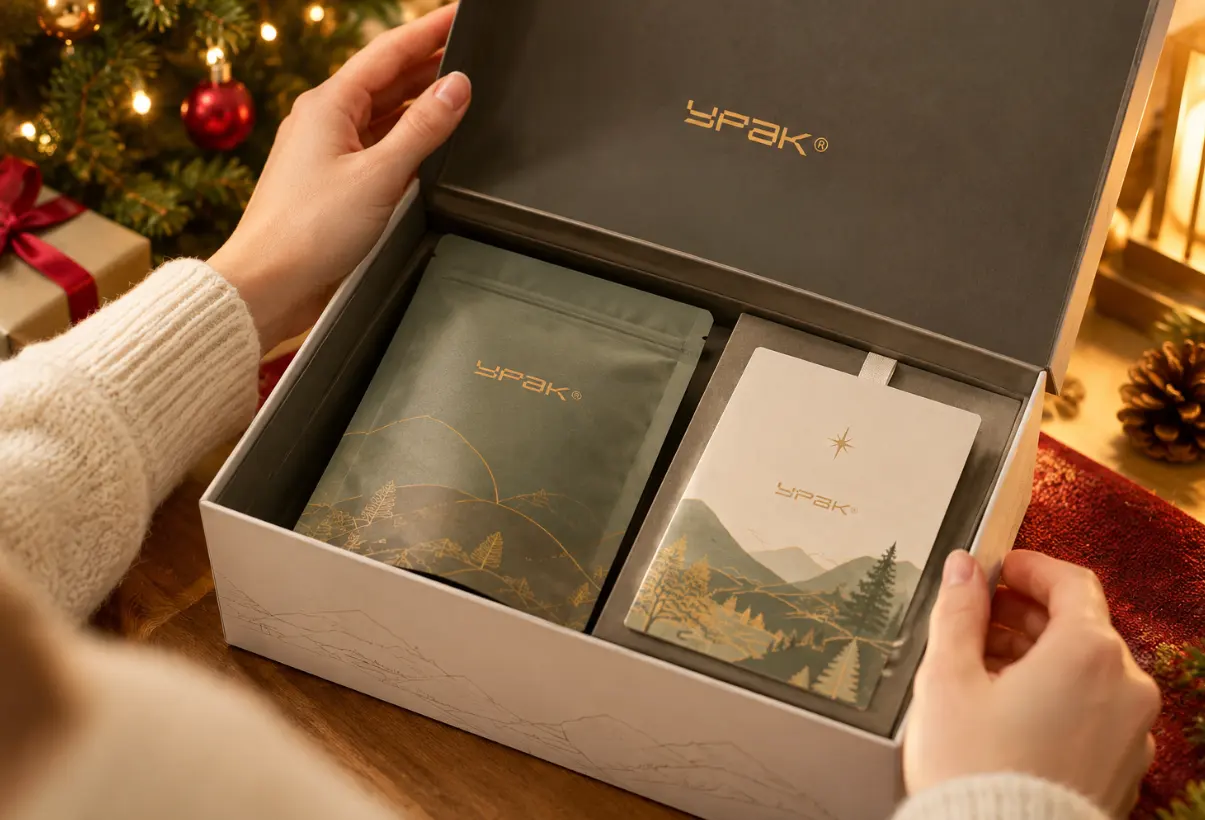
Coffee gift box packaging is a coordinated system that works round already highly-guarded products. Freshness is usually taken care of by the sealed coffee pouch, drip sachet or capsule. The outer box, insert, printed information, closure, and shipping pack must then collaborate to make a presentation, manipulate the movement and arrive at the recipient in the desired state.
The failure of a good sample can be caused by pouch expansion, as well as the lifting of the insert, sleeve binding, or rubbing of surfaces during transportation. With the definition of each layer, a quantifiable job, and a review of the finished pack instead of individual parts, premium results are achieved.
Specialty coffee brands can use this method to tasting collections, seasonal releases, corporate gifts, subscriptions, and retail collections: set the load, route, clearance engineer, test production, and approval document.
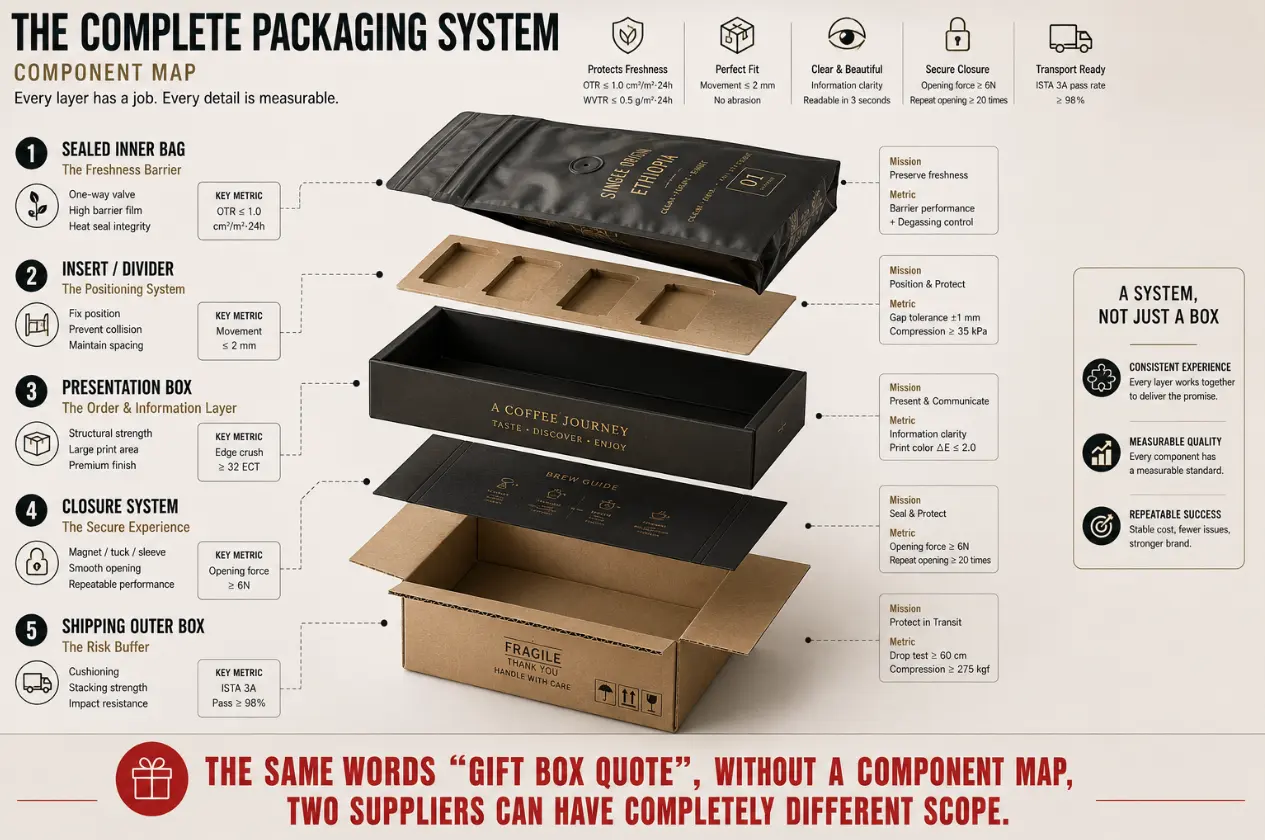
Develop the Complete Packaging System.
A component map should be the starting point of the development. It decides what touches the coffee, locates the products, and transports the graphics, and what distribution is passed. Two suppliers may offer dissimilar scopes when requested to offer a gift box with a similar description but without that map.
Allocate a job to each layer.
The main pack safeguards flavor and aroma. Orientation and spacing is contained in the insert. Presentation box assists in order and communication. Parcel hazards are dealt with by a shipping carton or mailer. In certain structures two jobs might be specification, but it is necessary that which performance is desired in each structure must be specified.
Note packed load.
Note all pouches, sachets, cards, filters, cups or accessory with filled sizes, weight, orientation and permissible variation. Mark places where valves are located and unpressurized edges. Data on products collected by a flexible pack in an empty pack does not give accurate fit.
Select Outer Box according to Distribution route.
Box style is followed by the route and not mood board. A present that is offered during an occasion, a pack and a bundle that are transported through different regions are treated differently. It is possible that the same artwork will need over a single structural solution.
Handover of retail and event.
Folding cartons and paperboard sleeves can be used to achieve large printable spaces and allow them to have a small footprint in storage. More important than the board being too thick is security during the closure, shelf stability, opening easily and the ability to withstand repeated handling. The crammed footprint must also accommodate exhibits and carrying bags.
Direct-to-recipient shipping
The mailer can also be a corrugated mailer to provide presentation and transport protection since the mailer has been tested to the route of use. A presentation case that is hard will most likely need a shipping case and padding. The products should not be colliding with each other in either of the systems, and should not be exerting local loading on valves and seals.
Turn Product Dimensions to Add Clearances.
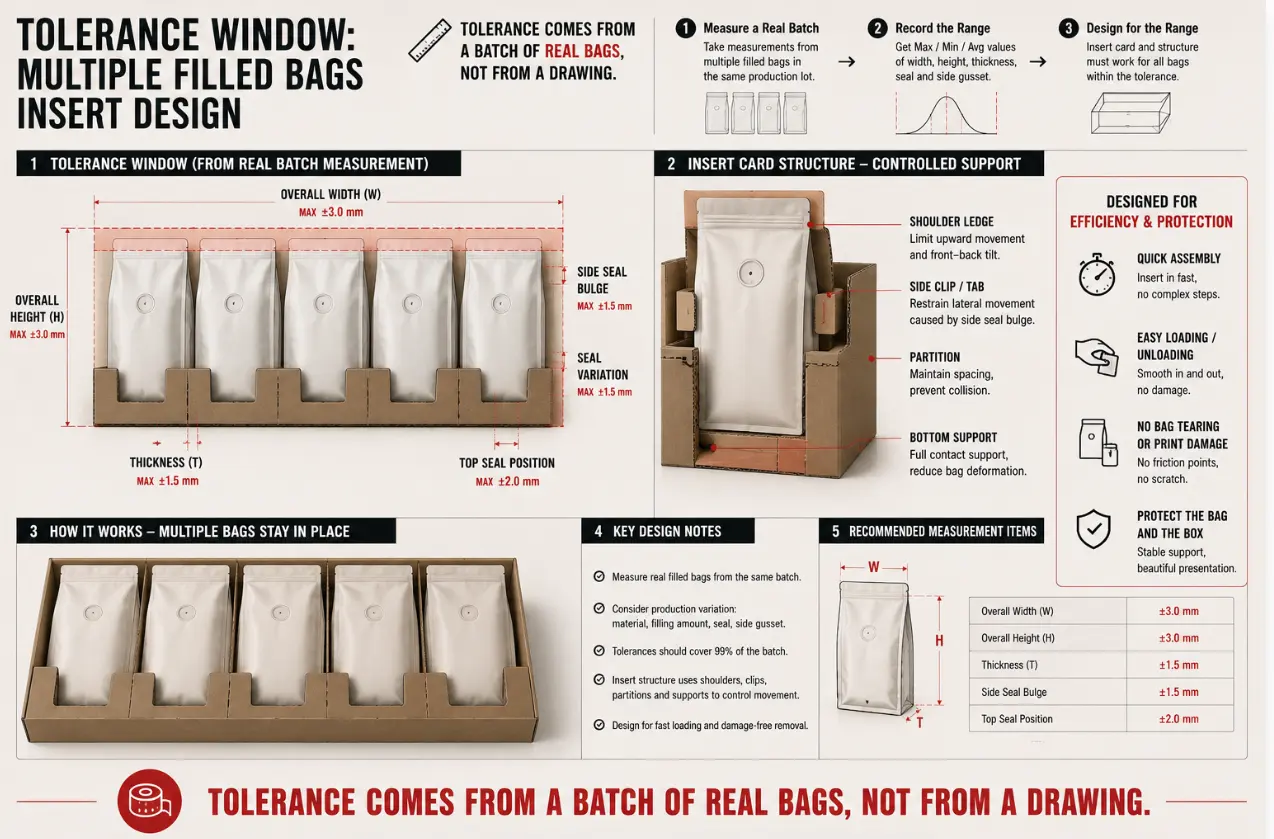
Insert design involves placing non-regular flexible packs in the form of a regular one. It should be capable of carrying products and not force them into the crevices and can be loaded easily and be able to release without tearing the pouch or damaging the printed box.
Do not make a tolerance, make one sample.
Determine a quantity of realistic production that is filled. Specify maximum width, height, thickness, gusset expansion and variation of seal. Be clear enough to permit quick loading and unloading and contain unwanted motion by use of shoulders, tabs, dividers or contact support.
Choose an insert to fit the load.
Light assortment folding paperboard suits, and clean printed presentation. Compression strength is added by corrugated board. Molded fiber is able to create deeper holes whereas rigid board platforms may raise high-end products. The material should be selected considering how the edges will appear, how they will be assembled, where they will be discarded and the capability of the supplier.
Use Packaging Decision Matrix.
The dictate of appearance is blocked in the structural choices by a short comparison. The actual project should be used as a basis to give scores and not a general rating.
| Decision factor | Evidence required | Pass condition | Typical risk |
| Product fit | Sample-filled and tolerance data. | Lifts and carries off easily. | Damage of pouches or valves. |
| Presentation | Packed physical prototype | Touching is in line with hierarchy. | Lift or rotation of product. |
| Production | Timed packing trial | Assemblies of the assembly of target assembly. | Hidden manual correction |
| Distribution | Route-relevant packed test | None of the unacceptable structural and print damages. | Corner crush or rub or opening. |
| Reorder control | Approved master sample and specification. | Supplier has the capability of replicating the same pack. | Movement or floating of artwork or material. |
Structure After Structure Plan and Finishes.
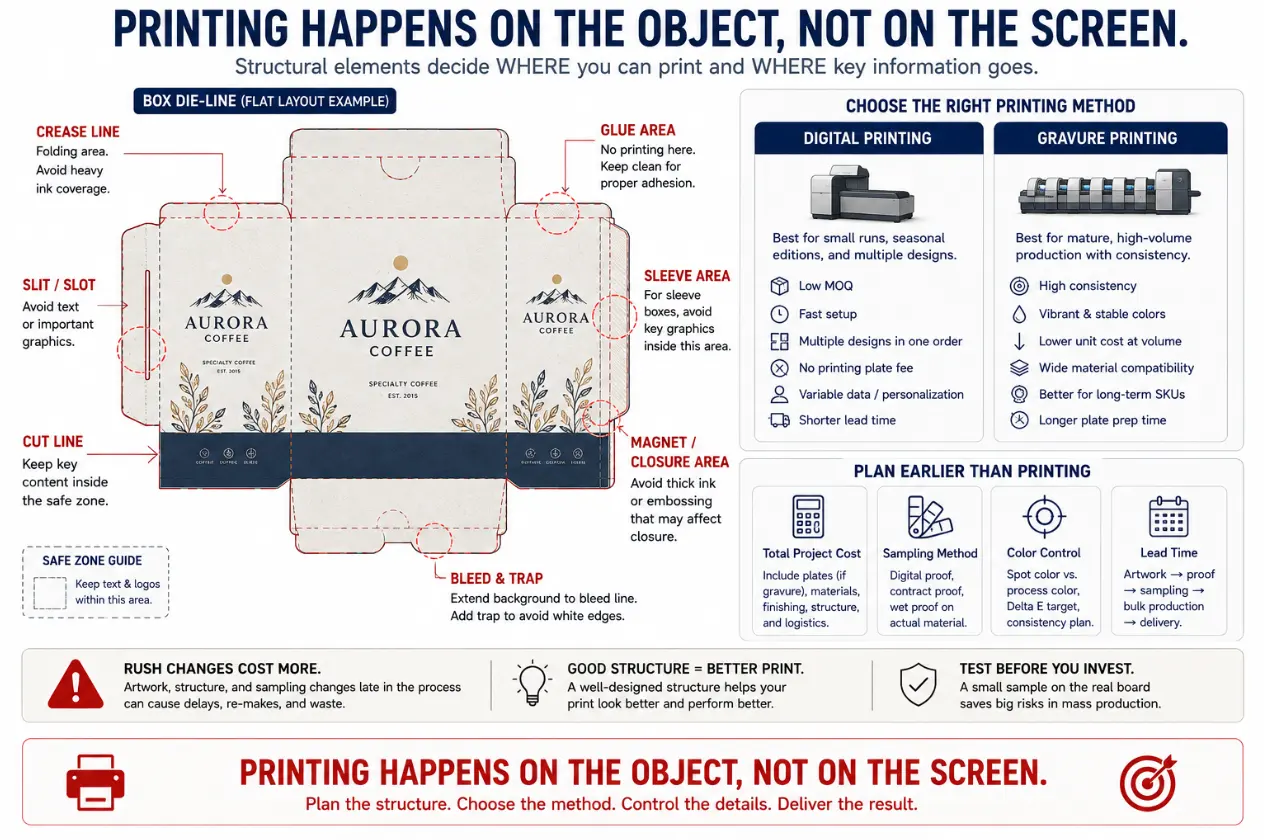
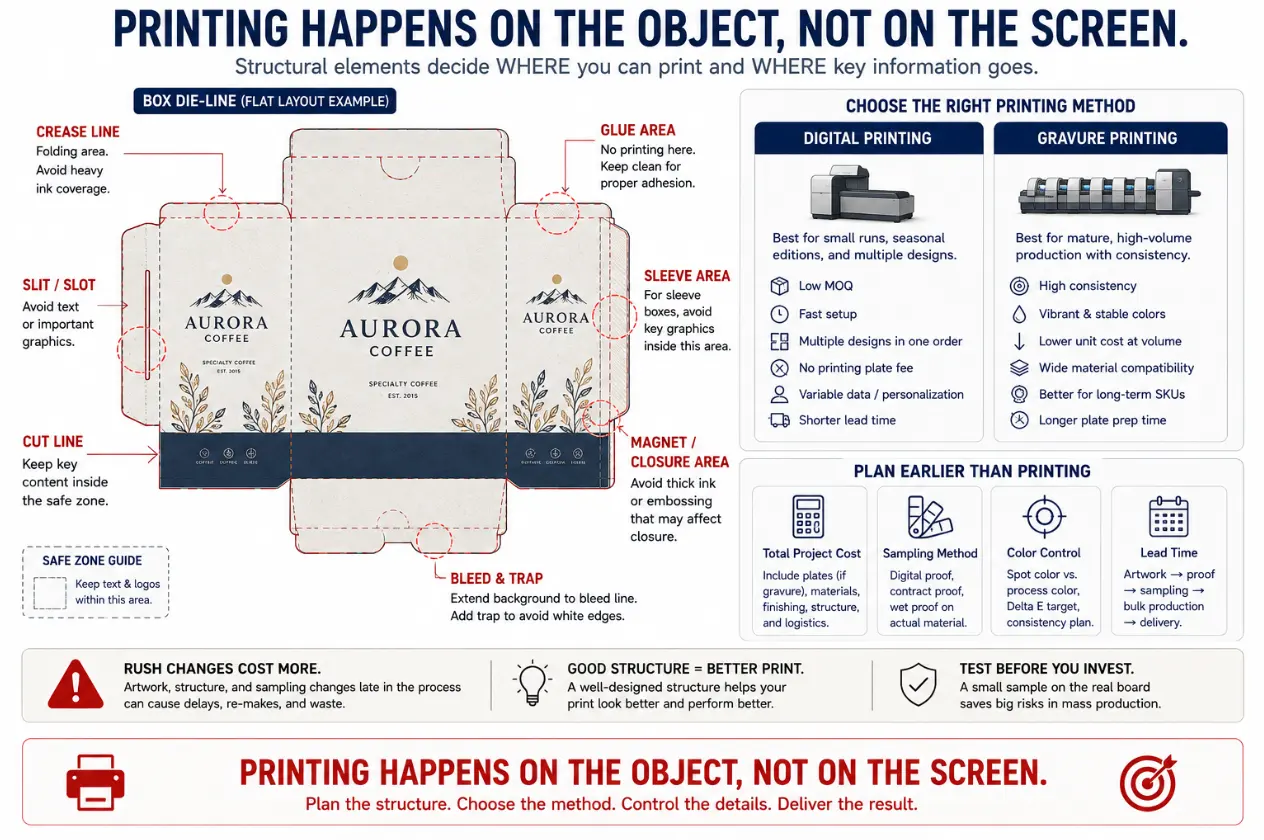
Painting is used on an object (not on a flat screen). Creases, blots of glue, edges of cuts, openings and sleeves all have their bearing upon what can be printed and where essential information is to be found. The selected procedure should also accommodate the quantity of orders, the number of versions, color expectations and reorder pattern.
Corresponding version to version in print.
Digital printing has the capability to print smaller quantities, seasonal artwork and multiple designs due to the lack of cylinder or plate setup. Gravure has the ability to deliver consistency on well-established high volume applications. The buyer needs to take into account the total cost of project, proof method, color control and lead time of production rather than printing labels alone.
Apply finishes where it makes a difference.
Achieving focus can be done using foil, embossing, matte finishes and spot effects, however, all finishes bring approval and production variables. Never use folds and high-rub areas. Check the finish on the chosen board since the texture of the surface, coating and color have an impact on the outcome.
Have Flexibility of information.
The gift programs typically consist of a number of permanent brand segments in addition to coffee information which change by origin, roasting date, season or recipient. The separation of these kinds of information may assist in removing the old inventory and reducing the updates.
Paste permanent material on the box.
Stable brand marks, opening instructions, and overall instructions on how to dispose of the packaging can be incorporated into the main artwork provided they last the length of time the packaging is anticipated to last. The destination market should be checked on the mandatory information and maintained legible following conversion.
Move replaceable content to shuffle moving content.
Pouch labels and cards can be printed with variable coffee and campaign information, the sleeves or digitally printed panels. The packed sample should include their size, the manner in which they are inserted and location so that they do not cover the products, force their way into the packaging and move during delivery.
In the right Order Prototype.
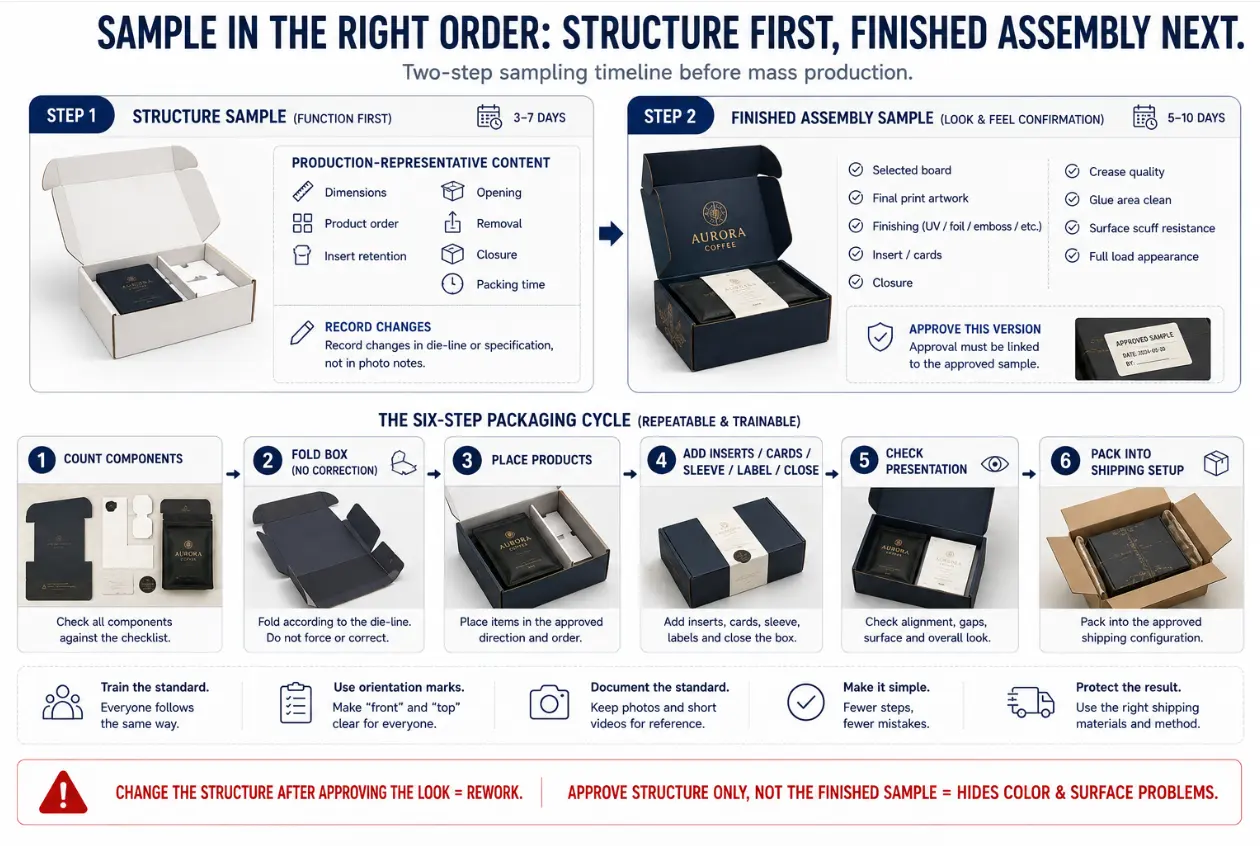
Sampling should be done in each type of risk. Approval of decoration before fit may lead to a new work being expensive to rework, and approval of structure before a completed sample is made may cover up color, crease, and surface problems.
start with a structural sample.
Check production-representative contents: dimensions, product order, insert retention, opening, removal, closure and packing time. Note all alterations on the dieline or specification and not just annotated photographs.
Bless a packed sample, complete.
The second step should entail the intended board, print, finish, insert and closure. Checking, folds, adhesive dots, rubbing the surfaces and appearance of the pack when loaded completely. The approved version of artwork and specification should be linked to an approved sample.
Prove the Packing Operation.
The packaging of gifts boxes containing coffee should be functional at the packing place and a presentation image. Repeatable process minimizes the labor variance and safeguards the visual standard throughout the order.
See a complete cycle.
- Accept and name all the parts of the packaging.
- Fold box and stuff without corrective folds.
- Place the products in the orientation of approval.
- Include cards, sleeves, labels or closures.
- Check presentation and put the completed presentation together in shipping set-up.
Support Sustainability Claims by Component.
The disposal of the complete system is not specified by paper-based appearance. The box, insert, laminate, foil, magnet, window, adhesive and the primary coffee pouch all have the ability to have the materials and collection streams altered. The specification should be made on the real specification and needs of the target market.
Produce a Supplier Brief Ready to use.
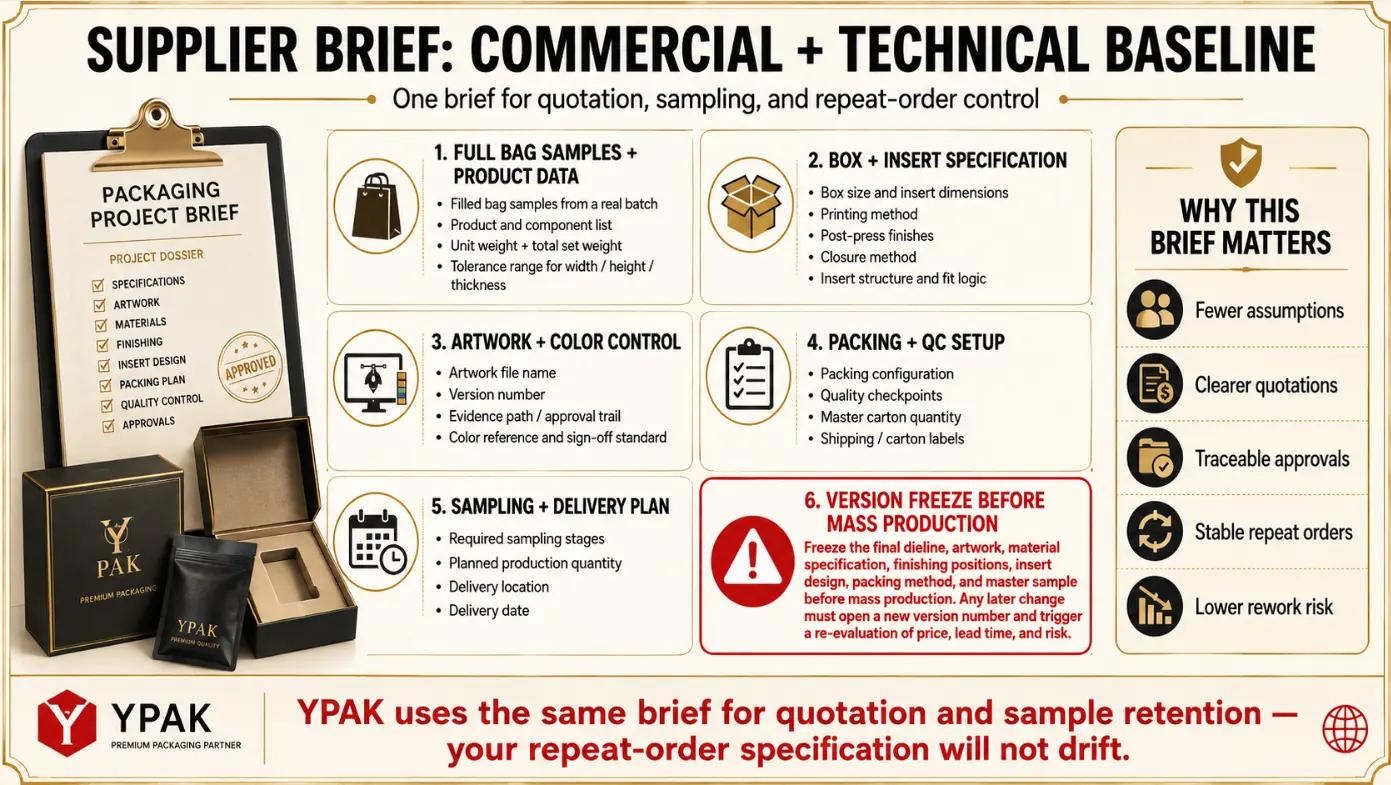
Over and above dimensions and artwork have to be used with similar quotes. The brief should include how the pack is physically packed, how it is processed, who has approved it, evidence, condition of delivery and responsibility of individual component.
Comprising of the commercial and technical baseline.
- Filled sample products, list of components, weights and tolerance range.
- Box and insert sizes, printing, finishes and closures.
- Name of artwork files, number of versions, path of evidence and colour mostings.
- Packing set up, quality inspection, carton number and labeling.
- Sample phases needed, amount of production, place of delivery and delivery date.
Freeze approved version.
Before mass production, check final dieline, artwork, description of materials used, finish locations, insert design, method of packaging and master sample. Any subsequent change should be given a new version reference to enable price, lead time and risk to be re-assessed.
Conclusion
The packaging of coffee gift boxes is achieved through synchronization of primary packs, inserts, presentation structure, printing, packing labor and the distribution protection. Optimal information that is congruent when filled and delivered is most desirable. The idea is turned into an experimental series of prototypes and a full supplier brief, and the repeating-packaging is created, which can be replicated in actual production orders.
FAQ
Written by
ypak.coffee
ypak
YPAK PACKAGING GROUP was established in 2011 and formed with 3 companies based on Hongkong, Dongguan and Foshan. We have become one of the largest coffee bag manufacturers in China. We use the best quality WIPF valves from Switzerland to keep your coffee fresh.
Conform to the plastic ban policy imposed to many different countries, we have researched and developed the sustainable packaging bags, such as RECYCLABLE and COMPOSTABLE pouches.
No minimum quantity, no color plates are required with our HP 25K INDIGO DIGITAL PRINTING service.
You are welcome to visit YPAK.