

Coffee Bag Label Requirements
The requirements of coffee bag labels are critical in the coffee business, be it a small local coffee roaster in Bandung, a small specialty coffee supplier in Indonesia, or an international supplier with online sales. Labeling is not only good marketing but it is also good to be legal, build customer confidence and also enhance your brand in the local and international market.
This guide will detail what a coffee packaging label should contain, the importance of that, and how you can create labels that are both compliant and attractive to consumers.
What Are Coffee Bag Label Requirements?
A coffee bag label is the print or sticker on the coffee packaging that informs the consumer and regulating authorities what it is, who produced it, where it originated, its weight, among other significant information. Although the rules differ according to region like the United States, the European Union, Australia, and some parts of Asia, the vast majority of regulations have common elements.
In areas where food labeling legislation is less stringent, products offered to consumers must comply with the general trade labeling legislation such as the Fair Packaging and Labeling Act (FPLA), in the United States or equivalent legislation elsewhere, which mandates simple transparency to protect the consumer.
Why Accurate Labels Matter
- Legal Compliance & Market Access
Governments enforce product labeling requirements to protect consumers. Non‑compliance can lead to fines, product recalls, banned sales, or slowed customs clearance. - Consumer Confidence
Clear labels help buyers understand what they’re buying, especially when shopping in retail stores or online marketplaces. Information such as origin, roast date, and weight helps buyers make informed decisions. - Brand Storytelling & Transparency
Including origin details, producer names, and flavor profiles serves both practical transparency and marketing. Specialty coffee drinkers increasingly seek traceability and authenticity.
Core Coffee Packaging Label Elements
Below is a breakdown of essential items that should appear on coffee bag labels to meet common regulatory requirements and buyer expectations.
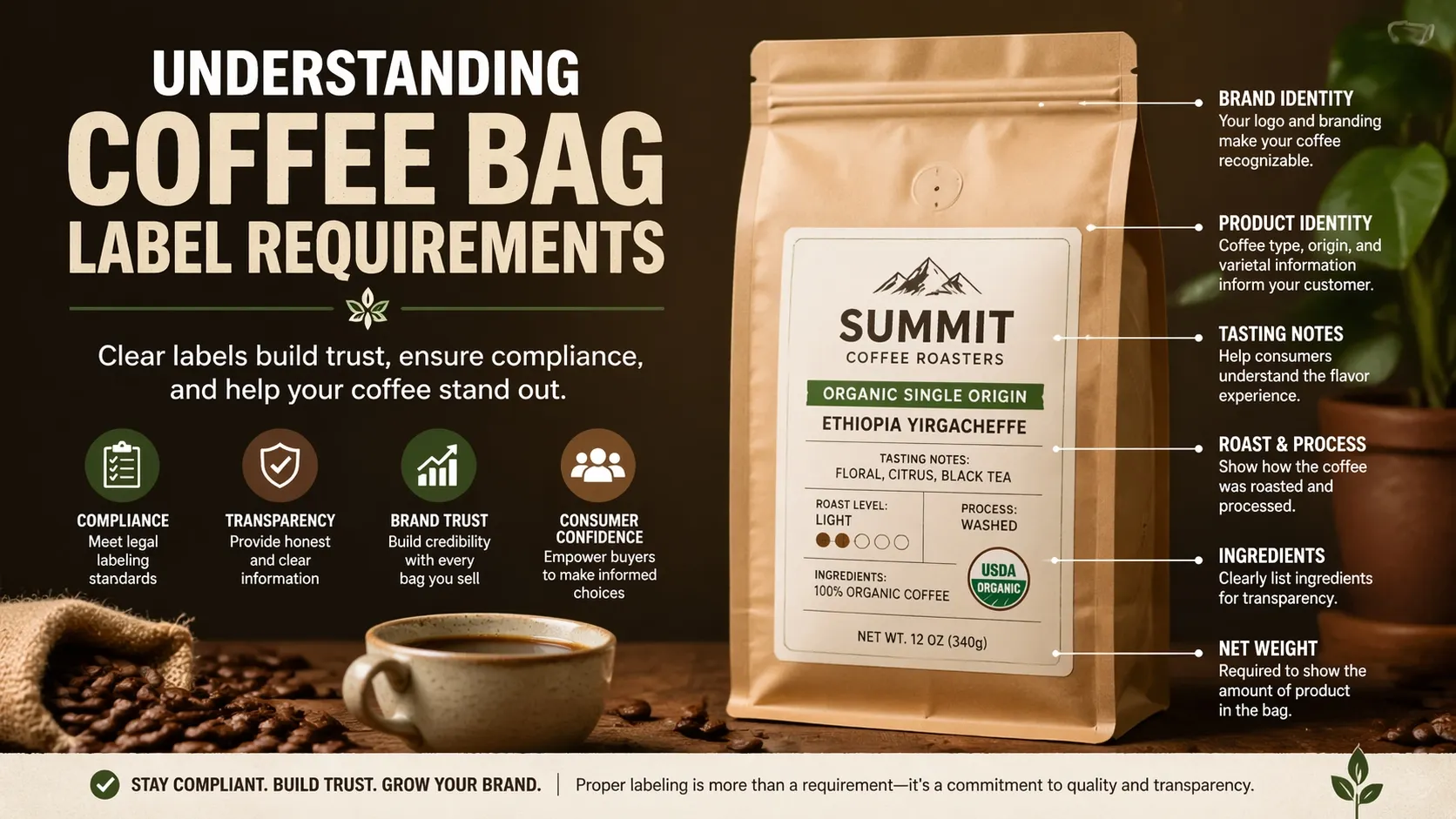
✔ 1. Product Identity
The first requirement on any coffee bag label is a clear statement of what the product is:
- “Whole Bean Coffee”
- “Medium Ground Arabica Coffee”
- “Espresso Blend Coffee”
This must be easy to read and not misleading. Consumers should know immediately what they are buying.
✔ 2. Net Weight
You will be required to show the net weight of coffee in both metric and imperial weight (e.g., 340g /12oz). The majority of the areas demand it on the main display panel of the packaging.
The need is significant on the understanding of the consumer as well as in adherence to the fair packaging laws.
✔ 3. Manufacturer / Roaster Information
The coffee packaging should clearly indicate the name and address (at least the city and contact) of the roaster, importer, or distributor. This traceability is useful in the event that customers require to get in touch with the business, and also it aids the food safety laws.
✔ 4. Country of Origin
The origin of coffee is of great concern to a number of consumers. Not necessarily specified by legislation everywhere, but indicating the place of the beans production (e.g., Product of Ethiopia or 100% Indonesian Arabica) creates value and authenticity.
The labels should also indicate the percentage of origin in some regions in case the product contains beans of various countries.
✔ 5. Roast Date or Best‑By Date
Though not mandatory in all areas, a roast date (or a best-before date) has become a common practice in specialty coffee. It is an indicator of freshness and quality to consumers.
Optional but Valuable Label Information
Adding extras to your coffee packaging label not only enhances marketing but may also improve customer engagement and sales.
🕵️ Flavor Notes & Roast Level
Consumers appreciate information about flavor profiles (e.g., nutty, floral, chocolate notes) and roast level (light, medium, dark). This guides purchasing decisions, especially for specialty coffee drinkers.
🧪 Ingredients List
If your coffee contains added ingredients like flavorings, spices, or sweeteners, you must include a full ingredient list and possibly a Nutrition Facts panel, depending on your market’s food labeling laws.
🔍 Certifications & Claims
Many coffee brands showcase certifications like Organic, Fair Trade, Rainforest Alliance, UTZ, or Bird‑Friendly. These labels appeal to eco‑conscious consumers and often require third‑party certification to be used.
🔗 Barcodes & Batch Codes
Lot/batch codes and barcodes are not legally obligatory, but play an important role in inventory management, retail systems, and traceability. QR codes may also be connected to online resources (such as instructions on how to brew or stories about the place of origin) to enhance customer experience.
Tips for Effective Label Design
Besides ensuring compliance, your label design should reflect your brand and help with search visibility online.
- Use clear, readable fonts
This benefits both shelf visibility and image‑based search results. - Include high‑value keywords in metadata for Amazon or eCommerce sites
Terms like coffee bag label requirements, specialty coffee packaging, organic coffee beans, and Indonesian coffee can improve discovery. - Focus on high‑quality graphics & simple information hierarchy
Keep essential regulatory info visible at first glance and secondary details neatly organized on back panels.
Conclusion: Balance Compliance With Brand Appeal
Knowledge of coffee bag labeling is essential to producers, roasters and sellers, who desire to compete both domestically in Indonesia and internationally. Although the essential legal aspects such as the identity of the product, its net weight and the name of the manufacturer make sure that the product is compliant, the consumer-centered information, such as roast date, flavors, authenticity of origin, and certifications, enhance the brand credibility and sales.
Be it in shelves of West Java or bringing coffee bags to the coffee lovers everywhere around the globe, considerate and compliant labeling of your coffee bags puts your company in the path of success.
Related Articles
Two Gates on the Road to the EU: Reduction by Design and the Documentation Chain for Coffee Packaging

Recyclable Coffee Bags: How to Protect Freshness Without Compromising Sustainability

Your Brand, Perfectly Packaged: The YPAK Guide to Selecting a High-Quality Custom Coffee Bag