

Updated 1 day ago
YPAK at Cafe Show Seoul 2026: Booth D343, COEX, 11–14 November
ypak.coffee
YPAK PACKAGING GROUP was established in 2011 and formed with 3 companies based on Hongkong, Dongguan and Foshan. We have become one of the largest coffee bag manufacturers in China. We use the best quality WIPF valves from Switzerland to keep your coffee fresh.
Conform to the plastic ban policy imposed to many different countries, we have researched and developed the sustainable packaging bags, such as RECYCLABLE and COMPOSTABLE pouches.
No minimum quantity, no color plates are required with our HP 25K INDIGO DIGITAL PRINTING service.
You are welcome to visit YPAK.
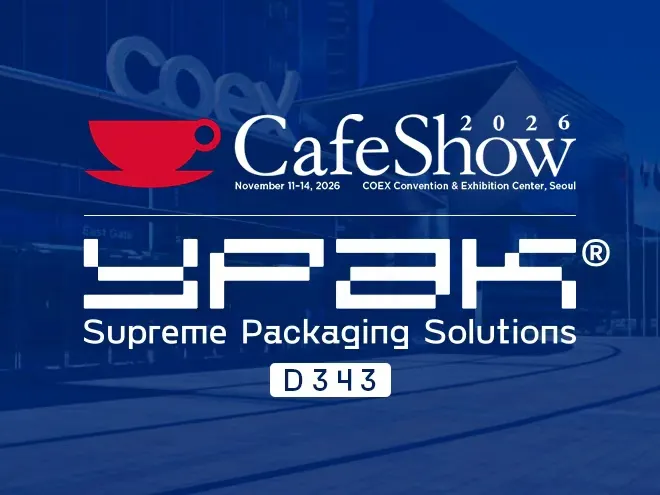
YPAK will be at the 25th Seoul International Cafe Show — Booth D343, COEX, 11–14 November 2026. We are there for one reason: to work through the packaging decisions currently stuck, from recyclable structures and barrier levels to short-run economics and the labelling your export markets will ask for. Bring your current pouch and your most awkward question.
Meet us at Cafe Show Seoul 2026
Cafe Show Seoul is the event the organiser bills as Asia’s No.1 coffee event, and this year it brings 631 exhibitors and 3,903 brands from 35 countries into Halls A to D at COEX — 37,791 square metres of coffee, tea, bakery, equipment and packaging.
One scheduling note worth knowing before you plan the week: the show has moved. It has been held Thursday to Sunday in previous years; for 2026 it runs Wednesday 11 to Saturday 14 November. If you have been planning around the old pattern, the dates in your calendar need changing.
The stand runs as an open table rather than a presentation schedule. Walk up with a pouch, a specification or an artwork file and we will go through it there and then.
The essentials
Taken from the organiser’s official visitor information — worth re-checking against eng.cafeshow.com before you travel.
| Item | Details |
| Event | The 25th Seoul Int’l Cafe Show (Cafe Show Seoul 2026) |
| Dates | 11–14 November 2026, Wednesday to Saturday (4 days) |
| Opening hours | Wed–Fri 10:00–18:00, last entry 17:30. Sat 10:00–16:00, last entry 15:30 |
| Venue | Halls A–D, COEX, Seoul, Korea — 37,791 sq m |
| YPAK booth | D343 |
| Scale (organiser) | 631 exhibitors, 3,903 brands, 35 countries |
| Theme 2026 | Further for coffee |
| Admission | Pre-order 1–8 Nov: USD 17 one-day / USD 33 all-day. On-site 11–14 Nov: USD 19 one-day / USD 37 all-day. Amounts are USD and may shift with exchange rates |
| Registration | Every visitor must register, including pre-order ticket holders — create a buyer account on the official site first |
| Floor plan and exhibitor list | https://eng.cafeshow.com |
| Organiser contact | Tel +82 2-6000-6698 · info@cafeshow.com |
One practical point: the pre-order window closes on 8 November, three days before the doors open. After that you are buying at the on-site rate — about 12% more on a one-day pass, and the same on an all-day pass.
Four questions we hear most from Korean coffee brands
Short runs and rotating lots: where plate cost actually sits
A roaster working through single-origin lots changes artwork far more often than the packaging itself changes. That turns a print-method question into an economics question: gravure rewards volume and punishes every revision, while digital printing removes the plate cost and moves the cost into the unit price. We will look at your lot cadence — how many SKUs, how often the artwork changes, what minimum quantity you can actually store — and show where the crossover sits for your format.
Drip bags and stick formats: what changes in the structure
Drip bags and stick formats carry a different set of constraints from bean pouches: the filter medium has to sit inside the same sealed envelope, the seal has to hold against a thinner web, and the barrier requirement is driven by how long the portion sits before it is opened rather than by degassing. We will go through the paper and filter options, where the seal window narrows, and what nitrogen flushing changes — including where it does not.
The Korean summer: humidity is the real barrier question
Korea’s summer is hot and humid for weeks at a time, and the rainy season is long enough that storage conditions, not the roastery, end up setting the shelf life. That changes which layers earn their place. We will go through your current structure and identify where moisture barrier can come out without losing shelf life — and where taking it out would be a false saving.
Lots that leave Korea: a second labelling system
Korea runs its own recycling-separation labelling system, and it is not the EU’s harmonised label. A pouch printed for Seoul does not automatically satisfy Brussels, and the reverse is also true — the two mark different things in different formats, and an artwork revision that satisfies one can still fail the other. If part of your volume ships to Europe or North America, bring the market split and we will mark, on your own dieline, where each requirement falls.
If your lots reach Europe, the rulebook has already changed
The Packaging and Packaging Waste Regulation, (EU) 2025/40, has applied since 12 August 2026, and the PFAS limits for food-contact packaging took effect on the same day. That is not a future deadline — it is the current state of the market, and it is why some specifications that were fine two years ago now need a conversation.
Most of the uncertainty is not whether the rules exist, but which rule attaches to which piece of packaging. Two examples catch people out.
- Empty space. For sales packaging — the retail coffee bag itself — empty space must be reduced to the minimum necessary for functionality from 12 February 2028, with no fixed percentage set. The 50% maximum ratio applies to grouped, transport and e-commerce packaging from 1 January 2030, or three years after the implementing act setting the calculation method, whichever is later. Two different rules, two different dates, routinely confused with each other.
- Labelling. The harmonised label showing material composition applies from 12 August 2028, or 24 months after the relevant implementing acts enter into force, whichever is later. The material identification codes under Decision 97/129/EC are repealed from 12 August 2028 and folded into that implementing act. This is an artwork question long before it is a compliance question — which is why it belongs in this year’s revision, not the next one.
There is a harder date behind those. Recyclability grades A, B and C take effect from 1 January 2030 — or 24 months after the delegated acts that set the design-for-recycling criteria, whichever is later — and from 2038 only packaging in grades A or B may be placed on the market. A structure specified today will still be in the market when that second date arrives.
Bring your market list and your current specification. We are not your legal advisers, but we can tell you exactly what your packaging is made of, and what each material choice implies for the obligations you are asking about.
What to bring
One item is enough to start. Bring whatever of the following you have.
| Bring with you | What we will do with it |
| A current pouch or film sample | Open it, read the structure layer by layer, and map it against the recycling, barrier and sealing options available to you |
| Your film structure specification | Identify where layers, coating or thickness can come out without losing shelf life — and where they cannot |
| Artwork or dieline file | Mark, on your own file, where the 2028 identification and digital carrier space can be reserved in the same revision |
| Your market split | Flag where Korean requirements and destination-market requirements pull the artwork in different directions |
| Lot cadence and volume plan | Work out whether digital or gravure is the cheaper route at your revision frequency, not at your annual tonnage |
| Your freshness target | Set barrier and valve requirements against a number — shelf-life months, opening format — instead of a preference |
One supplier, every touchpoint
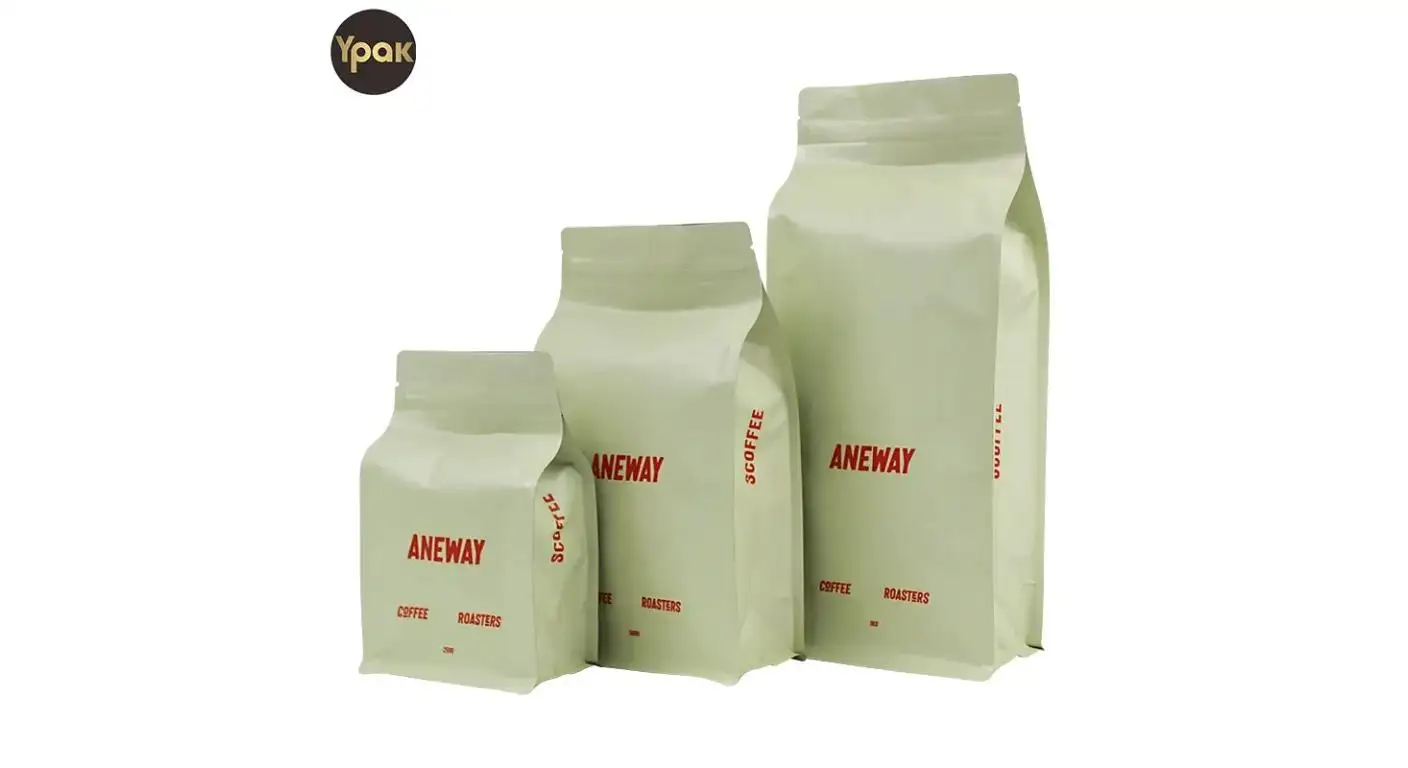
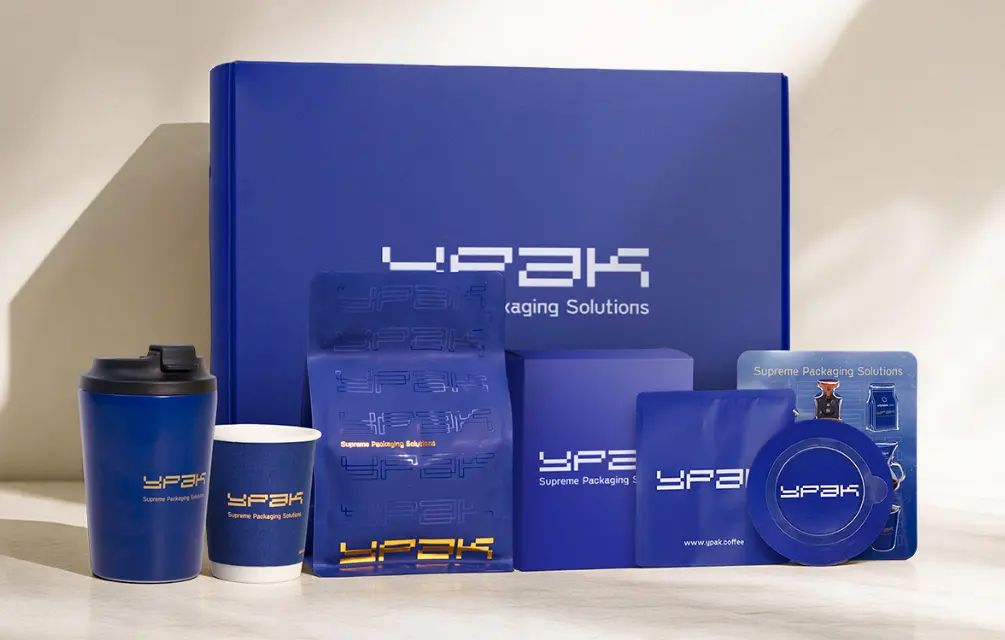
YPAK produces the full set a coffee brand needs: valve and flat bottom coffee bags, side gusset pouches, drip bags and hanging ear bags, filter paper, folding cartons and rigid gift boxes, and drinking cups. Production is certified to BRCGS and ISO 22000.
On materials we work with PFAS-free coating, water-based and PLA lamination, mono-material structures with high-barrier coating for recyclability, and post-consumer recycled content supported by certified chain-of-custody documentation.
The benefit of buying the set from one place is not the price list. It is that the bag, the carton, the drip bag and the cup share one specification logic and one artwork approval cycle. When labelling rules move in two markets at once, that is the difference between one revision and four.
Let us work it through in Seoul
So what is the packaging question you have been putting off? A structure that will not recycle where you sell, a barrier that does not hold through the summer, artwork that has to be redone for a second market, a print method that punishes every revision — most of these are cheaper to fix before the next print run than after it.
If you would like us to prepare in advance, send a short note with your market split and your current specification, and we will have the relevant samples and figures ready on the stand. Booth D343, 11–14 November — or reach us any time at Email: Sam@ypak.coffee.
Two things worth knowing before you travel
We only sell inside Korea. Is the stand still relevant to us?
Yes. Short-run economics, moisture barrier, sealing reliability and artwork turnaround are commercial questions in every market. The PPWR discussion is one part of what we can cover, not the whole of it.
What if I only have a few minutes?
One sample and one question is enough. Most of the useful conversations at a show start exactly that way and then run longer than planned.
Written by
ypak.coffee
ypak
YPAK PACKAGING GROUP was established in 2011 and formed with 3 companies based on Hongkong, Dongguan and Foshan. We have become one of the largest coffee bag manufacturers in China. We use the best quality WIPF valves from Switzerland to keep your coffee fresh.
Conform to the plastic ban policy imposed to many different countries, we have researched and developed the sustainable packaging bags, such as RECYCLABLE and COMPOSTABLE pouches.
No minimum quantity, no color plates are required with our HP 25K INDIGO DIGITAL PRINTING service.
You are welcome to visit YPAK.
Related Articles
YPAK at Cafe Show Seoul 2026: Booth D343, COEX, 11–14 November
YPAK at World of Coffee Panama 2026: Coffee Packaging for Short Runs and EU-Bound Lots
PPWR Recyclability Grades for Coffee Packaging: What Survives 2030, and What Survives 2038