

Updated 3 months ago
Stand Up Coffee Bags: Judge the Pouch After You Fill It

ypak.coffee
YPAK PACKAGING GROUP was established in 2011 and formed with 3 companies based on Hongkong, Dongguan and Foshan. We have become one of the largest coffee bag manufacturers in China. We use the best quality WIPF valves from Switzerland to keep your coffee fresh.
Conform to the plastic ban policy imposed to many different countries, we have researched and developed the sustainable packaging bags, such as RECYCLABLE and COMPOSTABLE pouches.
No minimum quantity, no color plates are required with our HP 25K INDIGO DIGITAL PRINTING service.
You are welcome to visit YPAK.

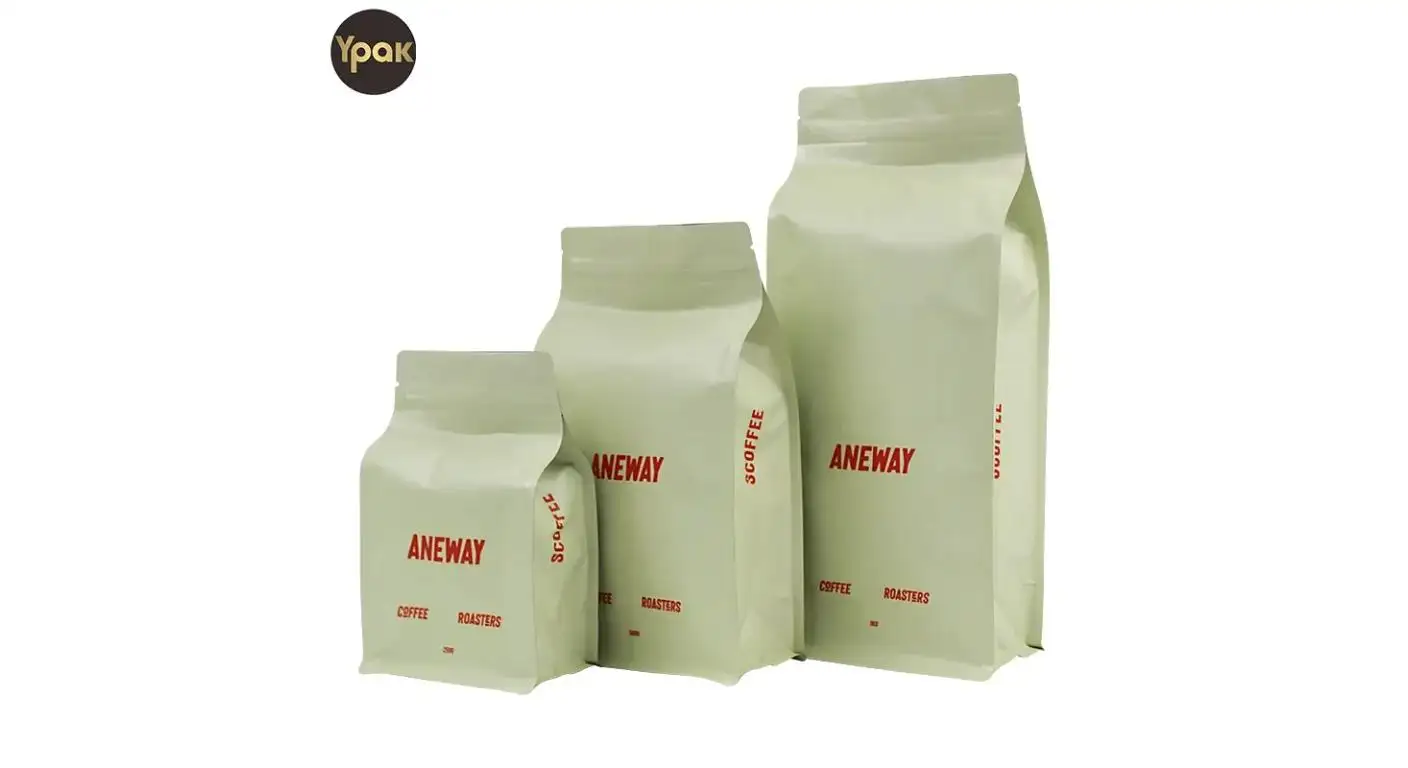
stand up coffee bags
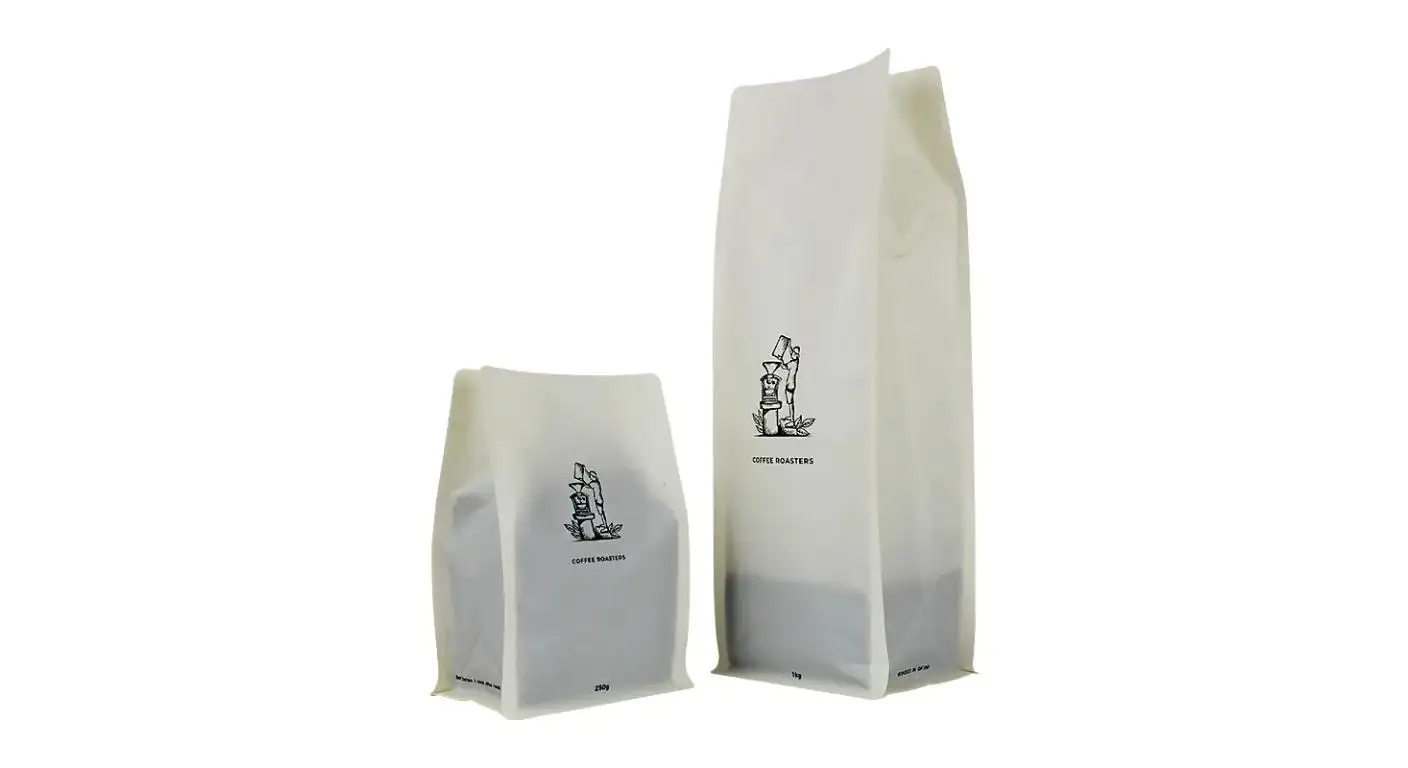
The stand up pouch will tell you much less if it's empty.
It is flat. Easy to photograph. Easy to measure.
250 grams of coffee are put in there, and now it's a different package. It opens at the bottom, the front panel opens, the zipper is under tension and the bag consumes actual space within a shipping carton.
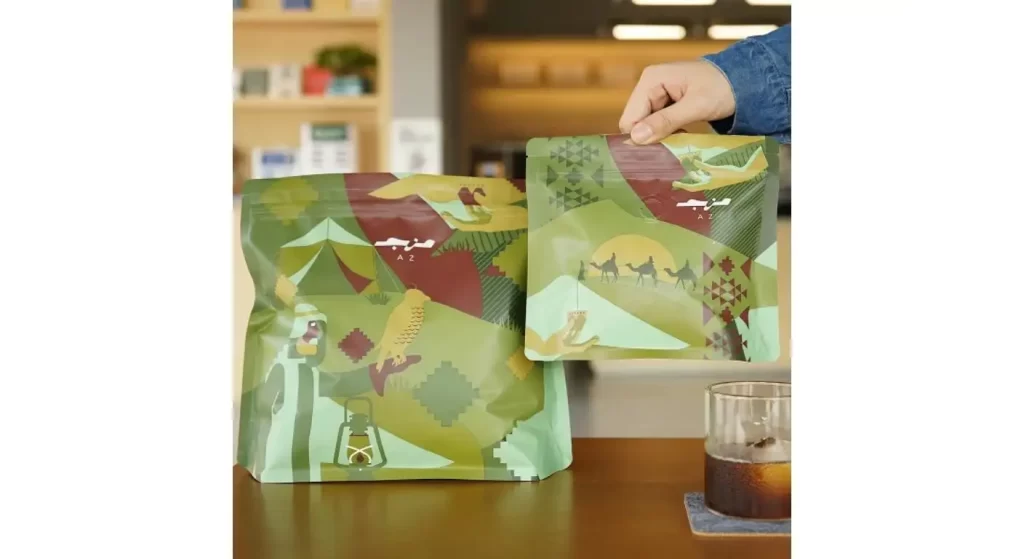
This is where stand up coffee bags should be judged.
Not included on the sample table.
Filled.
A Stand Up Pouch is Designed In 3D
The bottom gusset works the majority of the time after the product comes in the bag.
The pouch opens up and gives it depth, thereby providing the support to stand. This is a simple idea but it also alters the front panel and silhouette.
This is why artwork that fits around an absolutely level dieline may seem a bit different when the pouch is filled.
If you're still deciding on the basic format of your bags, YPAK's Build Your Coffee Bag tool can be useful to set up the format before artwork is created.
Consider the shape filled shape as the actual package.
The flat file is just the way it's created.
Avoid sizing the bag by grams only!
The phrase 250g coffee bag seems to be a full specification.
It isn't.
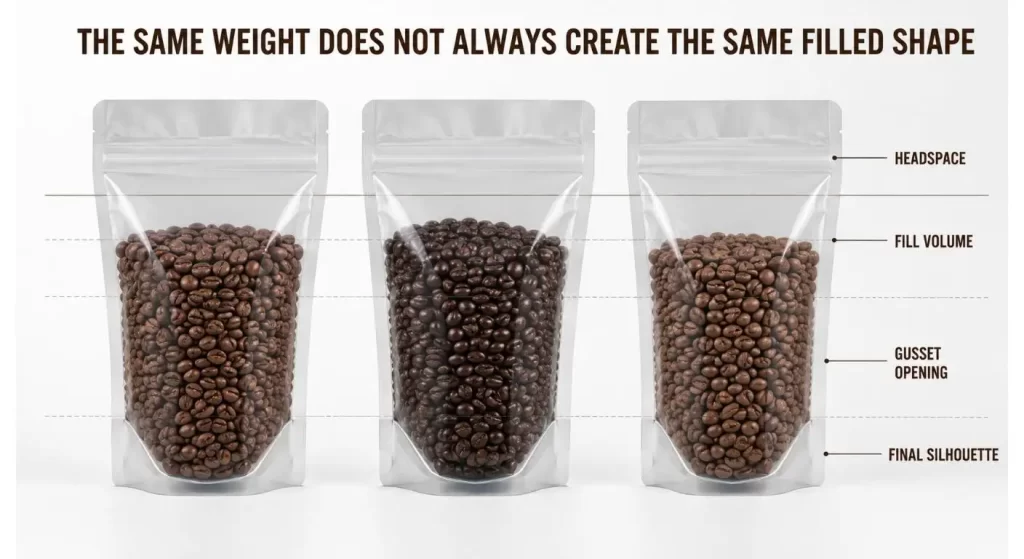
Not all coffees take up the same amount of space. A roast's profile, bean size and product form may affect how a certain weight will fit into a pouch.
This is because two roasters may want to have slightly different dimensions when ordering the same nominal weight.
Too much headspace and the bag will appear under-filled. If it is too tight and filling, sealing and closing the zipper will less comfortable.
The Flat Bottom Bags vs Stand Up Pouches comparison also identifies the differences in structure and their impact on the capacity of the bags and shelf behavior in YPAK.
Utilize the actual coffee for dimensions.
Not rice. Not plastic pellets. Coffee.
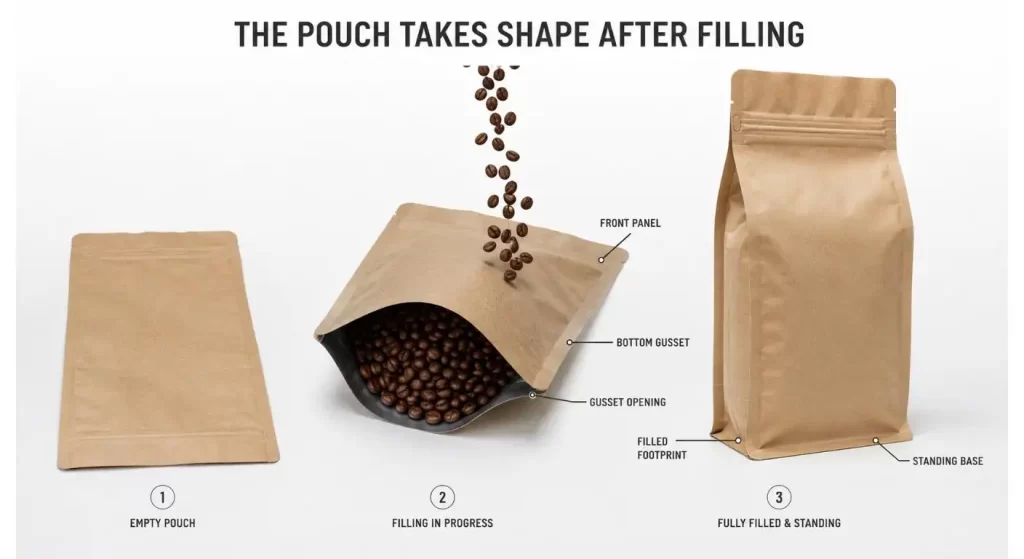
There is more to the Bottom Gusset Controls than just standing.
A stand up pouch must have enough product to open the bottom of the pouch.
That's why fill level is a part of the presentation.
The pouch that seems to be stable at a certain fill level can be different if it is the same structure for a smaller SKU. This is relevant when brands attempt to utilise a single bag dimension in multiple products just to minimise the range of packaging in the warehouse.
Sometimes that works.
Sometimes the smallest SKU lives his or her whole life leaning up against the bag beside him/her.
Fill all intended SKUs and then line them up prior to standardizing a size.
A shelf will provide you with the answer more quickly than a spreadsheet.
| Filled-Bag Check | What to Observe | Why It Matters |
| Fill Level | Too empty, balanced or overfilled | Changes shelf appearance |
| Bottom Gusset | Fully and evenly opened | Influences standing stability |
| Front Panel | Wrinkles or excessive curvature | Affects artwork presentation |
| Headspace | Room above the coffee | Supports sealing and closure |
| Bag Width | Final filled footprint | Affects shelf and carton space |
| Overall Shape | Consistent across samples | Important for repeat production |
Get the Zipper and Valve in the Design Conversation Early
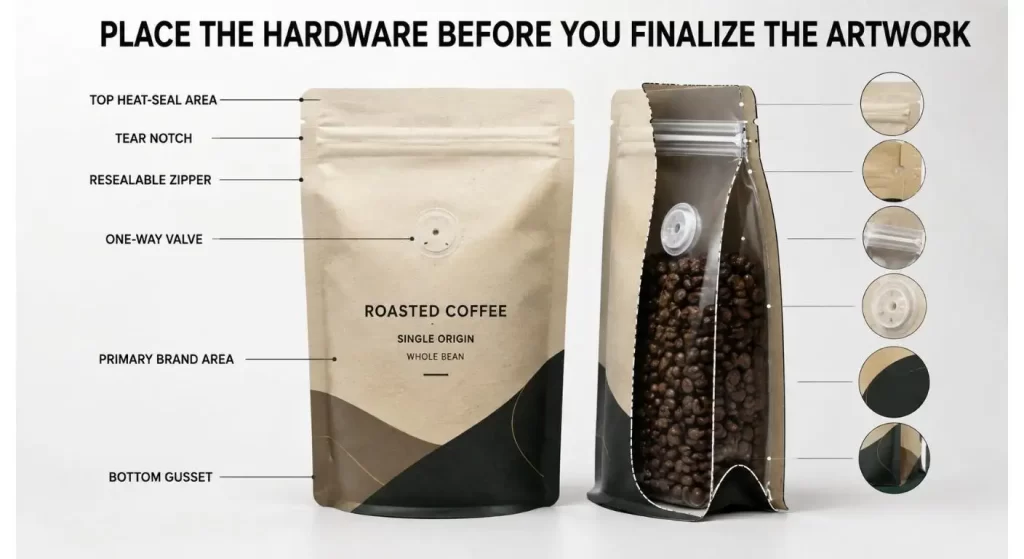
The fresh coffee packaging has working areas.
There should be space at the top for sealing. After opening the zipper must be easy to get to. The degassing valve is part of the panel and can not be visually defeated with the brand mark or important information.
The Stand Up Pouch Coffee Bags With Valve demonstrates YPAK's innovative approach to combining a resealable closure, valve and uniquely shaped print into a stand up pack.
The basic guideline is:
Mount the equipment first.Install equipment first.
Then design around it to create the artwork.
The ability to reopen after a first use is important.
First Purchases are won by Shelf Appearance.
From then on the zipper begins to function.
When consumers repeatedly open a bag over the course of days, closure quality becomes a part of the consumer experience. The zipper should be simple to find, simple to unzip and must have a good amount of material over it for easy handling.
It's especially important with home use coffee packs where the whole pack isn't used at once.
Resealing is the subject of YPAK's guide to Resealable Coffee Bag Packaging, not just a piece of fancy.
An effective closure is unnoticed.
One of those is recalled each morning that is frustrating.
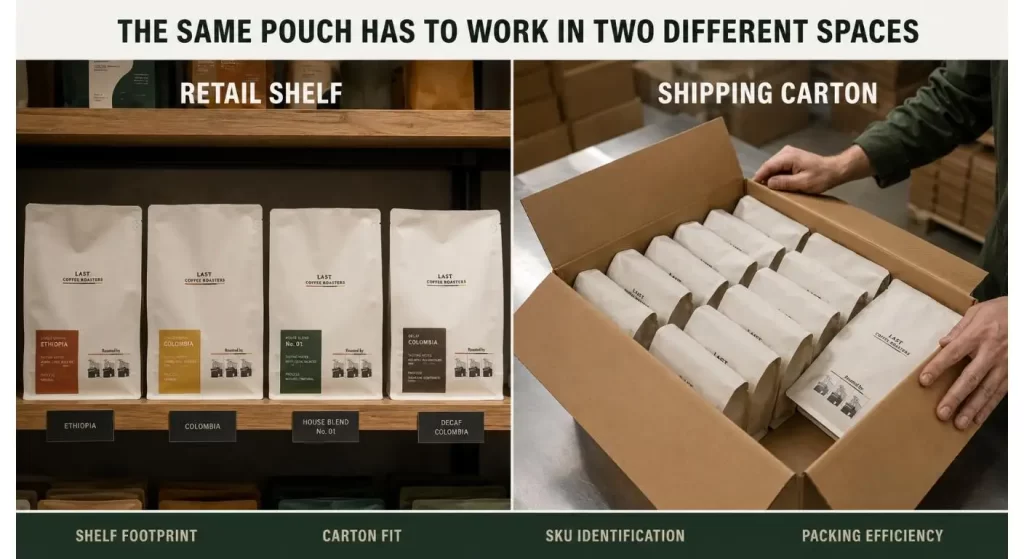
The Retail Shelf and the Shipping Carton have different requirements.
The pouch has to be stable and have a clean front face when on shelf.
When packed inside a carton, it must be able to pack efficiently.
Those two requirements have the potential of working against each other.
Very wide pouches can have a strong shelf presence and affect carton utilization. Long narrow formats can photograph great on the web but act differently when it turns out there are a number of filled packages to be transported.
This is even more important for those e-commerce brands where users might view the product online first before seeing it on a shelf.
Test both environments.
Place 10 completed bags side by side.Place 10 bags finished side by side.
Place in the carton you will send them in.
Apply the One-Structure / Many SKU approach, using the same structure without making all the SKUs appear the same.
Stand-up pouches are well suited for brands that have multiple coffees.
Artwork may vary without the physical structure changing, such as when the artwork is of different origin or roasted or seasoned.
That way it will fill and pack up the same way, but with a different front panel.
Digital Print Coffee Bags might also be considered for roasters that make many releases, or have a series of designs that are released in smaller quantities.
This is where the use of standardization is helpful.
Make standardize boring pieces.
Allow the coffee to transform the intriguing ones.
Check that the bag is set up in the way that customers will find it.
Run one last test prior to mass production.
Stuff it with real coffee.
Seal it.
Allow to rest overnight. Open the zipper. Close it again. Put it on a shelf. Take a picture of it from your online store's point of view. Pack some of the filled packs into the shipping carton.
If the pouch is still as you expected and it is still functioning properly, then you have learned much more than you could have gotten from an empty sample.
That's the one to approve!
| RFQ Item | Information to Provide |
| Coffee Product | Whole bean or ground |
| Fill Weight | Required grams / ounces |
| Bag Dimensions | Standard or custom size |
| Material | Barrier / recyclable / compostable / PCR direction |
| Closure | Zipper or other requirement |
| Valve | Required / not required |
| Printing | Number of artworks / SKUs |
| Sales Channel | Retail, café, subscription or e-commerce |
Conclusion
Stand up coffee bags don't necessarily qualify as good coffee bags.
They must stand to the right level of fill, be correctly sized for the actual product and not consume too much space for the zipper and valve and be packed appropriately for the sales environment.
Therefore rather than asking:
What size would have 250 grams of pasta in the pouch?
Ask:
What is the volume or capacity of 250 grams of coffee in this pouch?
The minor change of the question generally results in a significant improvement of the package.
FAQs
Q1. What are Stand up Coffee Bags?
They are flexible pouches with a bottom gusset which is opened when filled so as to form a base upon which the package can stand.
Q2. May have a zipper and valve on can stand up coffee bags?
Yes. Many coffee pouch designs include resealable zippers and/or one-way degassing valves. Their locations need to be verified prior to artwork approval.
Q3. What is the most suitable size for stand up pouches for coffee?
Begin with desired fill weight; test roasted coffee. The only weight used to refer to is the nominal weight, which does not indicate the final appearance or volume.
Q4. Can stand up coffee bags be used for multiple coffee SKUs?
Yes. Brands can retain one structural system and change in the artwork and/or controlled SKU information for different origins, blends and seasonal releases.
Q5. Before ordering stand up coffee bags in bulk, which test should I take?
Inspect for filled appearance, standing stability, zipper access, valve positioning, sealing area, shelf display and cartons for shipping.
Written by
ypak.coffee
ypak
YPAK PACKAGING GROUP was established in 2011 and formed with 3 companies based on Hongkong, Dongguan and Foshan. We have become one of the largest coffee bag manufacturers in China. We use the best quality WIPF valves from Switzerland to keep your coffee fresh.
Conform to the plastic ban policy imposed to many different countries, we have researched and developed the sustainable packaging bags, such as RECYCLABLE and COMPOSTABLE pouches.
No minimum quantity, no color plates are required with our HP 25K INDIGO DIGITAL PRINTING service.
You are welcome to visit YPAK.
Related Articles
YPAK at World of Coffee Panama 2026: Coffee Packaging for Short Runs and EU-Bound Lots

PPWR Recyclability Grades for Coffee Packaging: What Survives 2030, and What Survives 2038
Customized Coffee Packaging Solutions: From Product Ideas to Market-Ready Packaging