

Updated 2 months ago
Recyclable Coffee Packaging: How European Brands Switched Before PPWR

ypak.coffee
YPAK PACKAGING GROUP was established in 2011 and formed with 3 companies based on Hongkong, Dongguan and Foshan. We have become one of the largest coffee bag manufacturers in China. We use the best quality WIPF valves from Switzerland to keep your coffee fresh.
Conform to the plastic ban policy imposed to many different countries, we have researched and developed the sustainable packaging bags, such as RECYCLABLE and COMPOSTABLE pouches.
No minimum quantity, no color plates are required with our HP 25K INDIGO DIGITAL PRINTING service.
You are welcome to visit YPAK.
PPWR compliant coffee packaging
Introduction: The PPWR Compliance Clock — Recyclable Coffee Packaging Is Now Mandatory
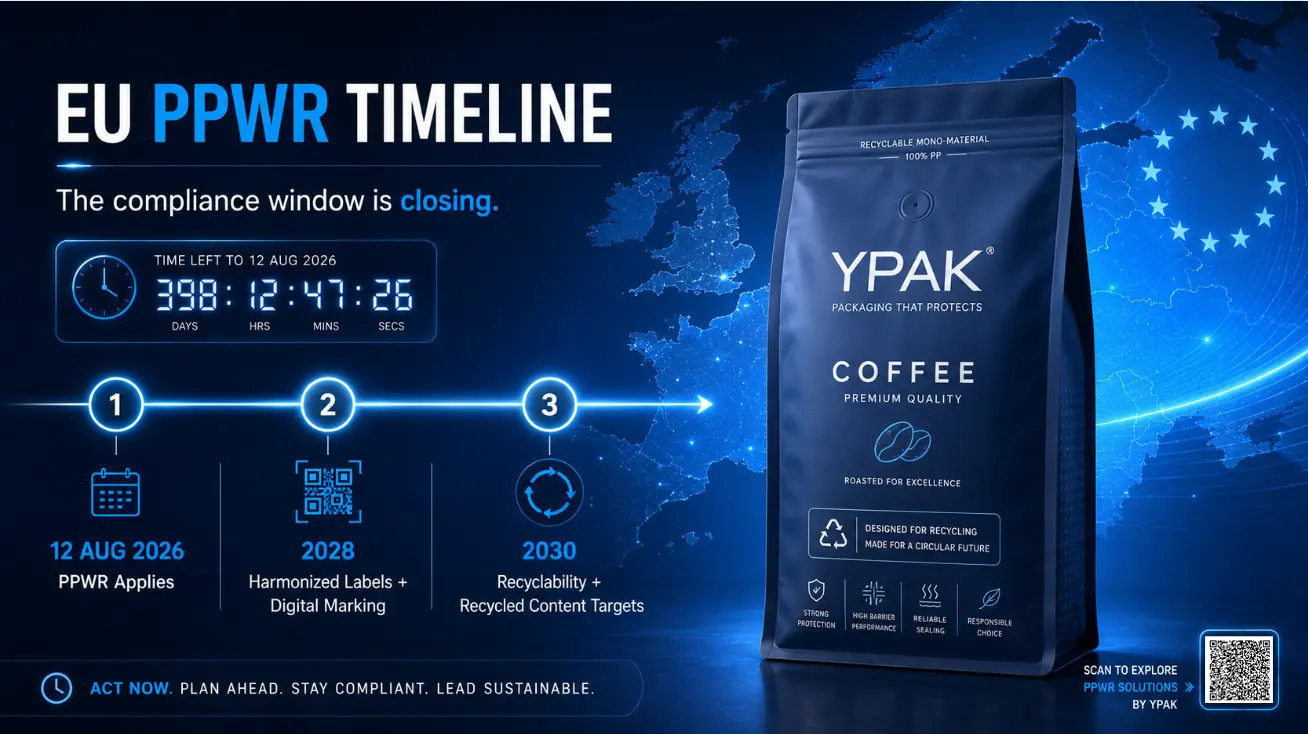
On August 12, 2026, the EU Packaging and Packaging Waste Regulation (PPWR) became applicable across all 27 member states. From this date, "recyclable" is no longer a voluntary industry slogan — it is a legal requirement under Article 6: every package placed on the EU market must be designed so that its materials can be sorted, reprocessed, and recycled.
For the coffee industry, the impact is direct and immediate. Most coffee bags on the market today are still multi-layer laminates of kraft paper, aluminum foil, and PE. They deliver excellent barrier performance.But the layers cannot be separated in standard recycling facilities, which makes the whole package non-recyclable under PPWR's Design for Recycling framework. With the harmonized recycling label already rolling out and digital marking (QR codes) scheduled for 2027, European roasters are no longer asking "should we switch?" — they are asking "how do we switch, what do we switch first, and will the barrier performance hold?"
This article answers those questions through three real European transitions: a century-old specialty brand that completed a three-generation packaging evolution, a Nordic market leader that switched in two deliberate steps, and a regional brand that turned compliance into a retail advantage. By the end, you will have a five-step switch framework you can replicate, an OTR/WVTR barrier comparison table between old and new structures, and a lightweight action plan for mid-size roasters.
Case 1: wildkaffee —— Three Generations of Recyclable Coffee Packaging
Let's start with wildkaffee, one of YPAK's long-term partners. The brand carries a rare double identity: a Bavarian roasting family from Garmisch-Partenkirchen with roots dating back to 1892, and — through its Austrian company, Wildkaffee Austria — the home of Martin Wölfl, the 2024 World Brewers Cup Champion, who defeated 41 filter coffee competitors in Chicago with a 17-gram, 270-milliliter, 2:20 recipe and a final-round score of 481 points.
Yet for a brand with championship-level obsession over flavor, the packaging strategy has been remarkably pragmatic: three generations of coffee bags that complete a full transition from conventional laminate to recyclable structure, and finally to recyclable packaging with premium finishes.
Generation 1: Kraft paper + aluminum foil. This is the most common conventional structure in European specialty coffee. Kraft paper delivers the artisanal look that roasters love, while the foil layer provides near-total barrier protection — for many roasters, "visible barrier" is a source of reassurance. The problem: foil, paper, and PE cannot be separated at the recycling stage. Under PPWR's recyclability grading, this structure falls into the "hard-to-recycle" tier. It is not a mistake — it simply belongs to a previous era.
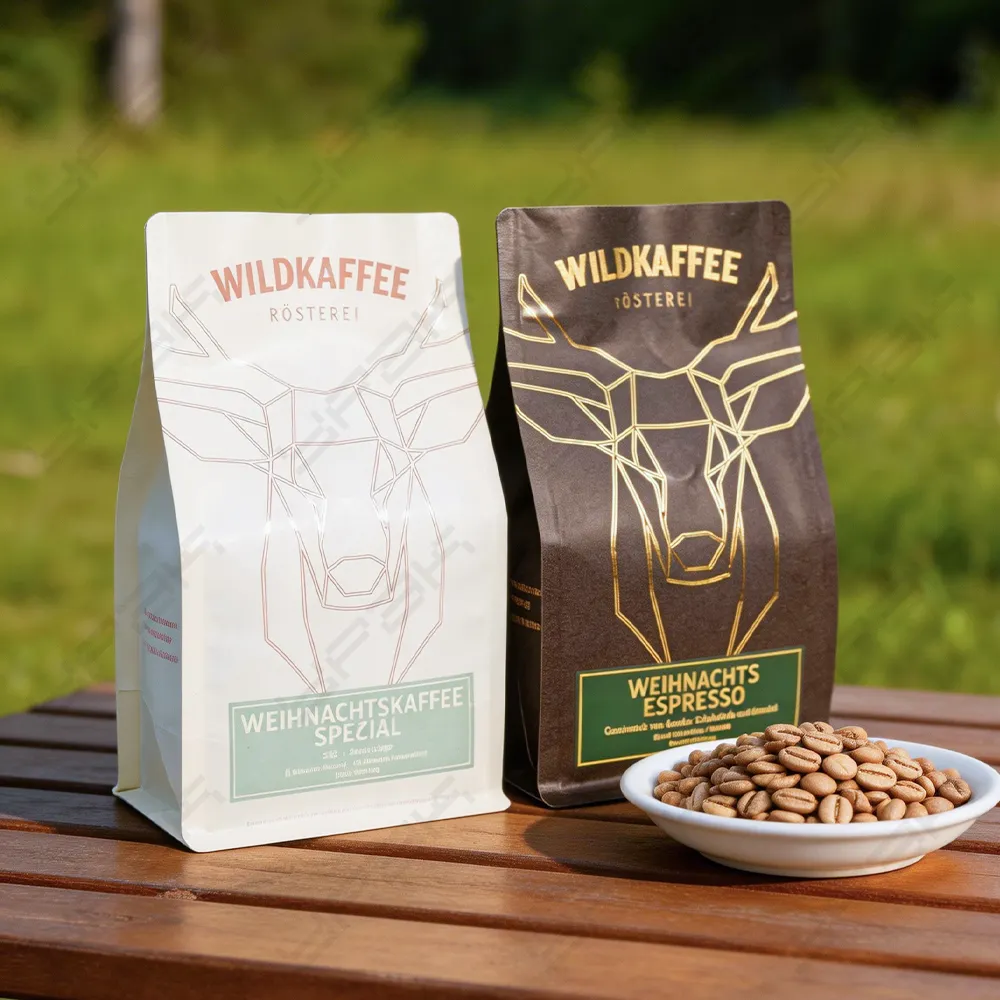
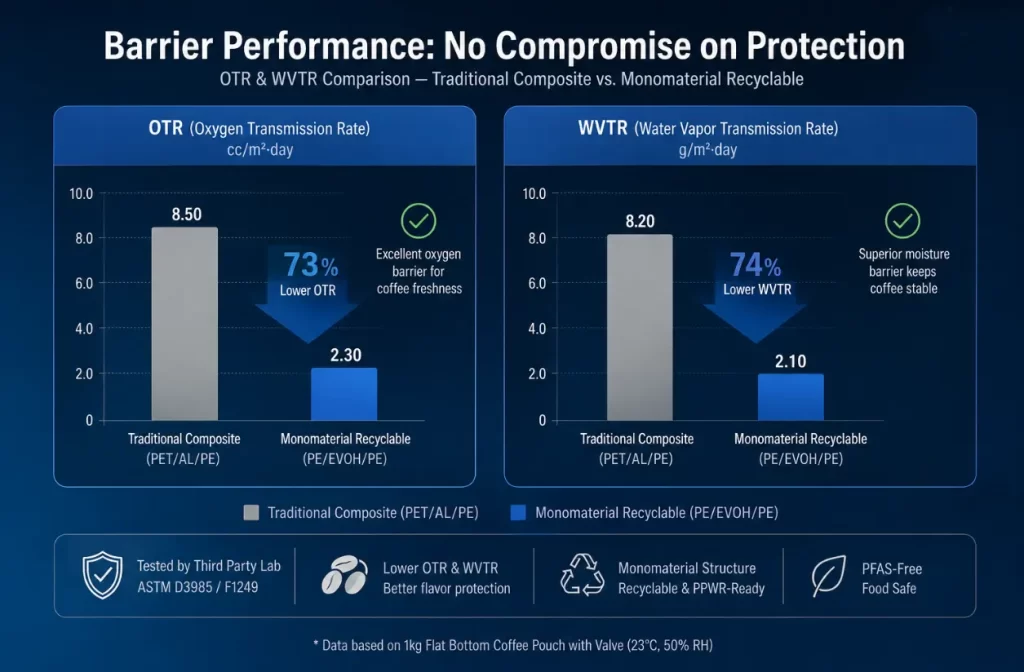
Generation 2: Recyclable mono-material structure. As the August 12 deadline approached, wildkaffee switched its core coffee bags to a recyclable mono-material structure. To understand this shift, it helps to see how it differs from a conventional laminate at the structural level. A traditional bag is made of paper, foil, and PE bonded together — at recycling.Every layer must be physically separated, which standard sorting equipment cannot achieve. A mono-material bag, by contrast, uses a single polymer base across the entire pouch: one PE layer carries the barrier, heat-seal, and stiffness, while high-performance coating technology holds oxygen transmission rate (OTR) at ≤5 cc/m²/24hrs and water vapor transmission rate (WVTR) at ≤0.5 g/m²/24hrs — the same protection range as foil laminates, but the entire bag can enter the PE recycling stream as one piece, with no delamination required. Mono-material structures also heat-seal more reliably: same-material-to-same-material sealing reduces the risk of layer separation compared with dissimilar laminates — a hidden quality win on high-speed filling lines.
The critical point of this step is not "swapping materials" but "proving with measured data that freshness holds." Every stage of wildkaffee's switch was validated by OTR/WVTR comparisons between old and new structures under the same test standard — never judged by thickness or feel.
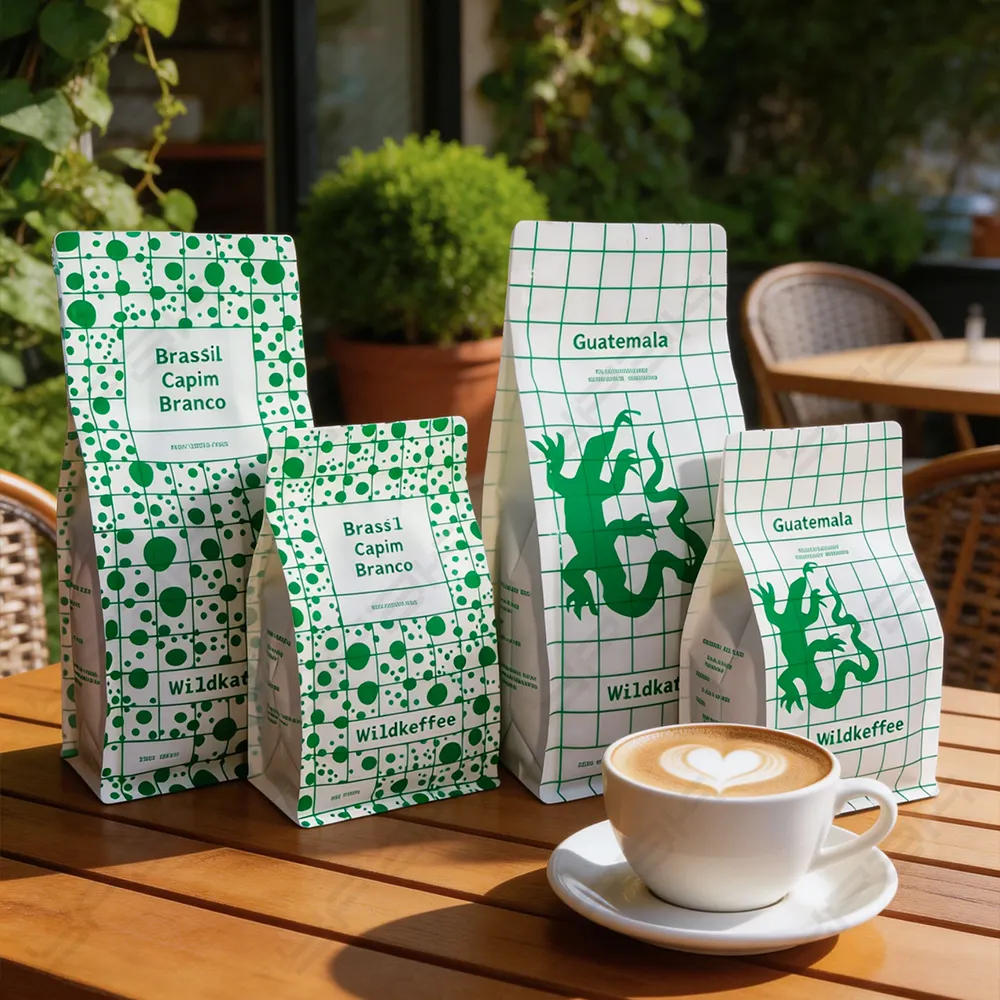
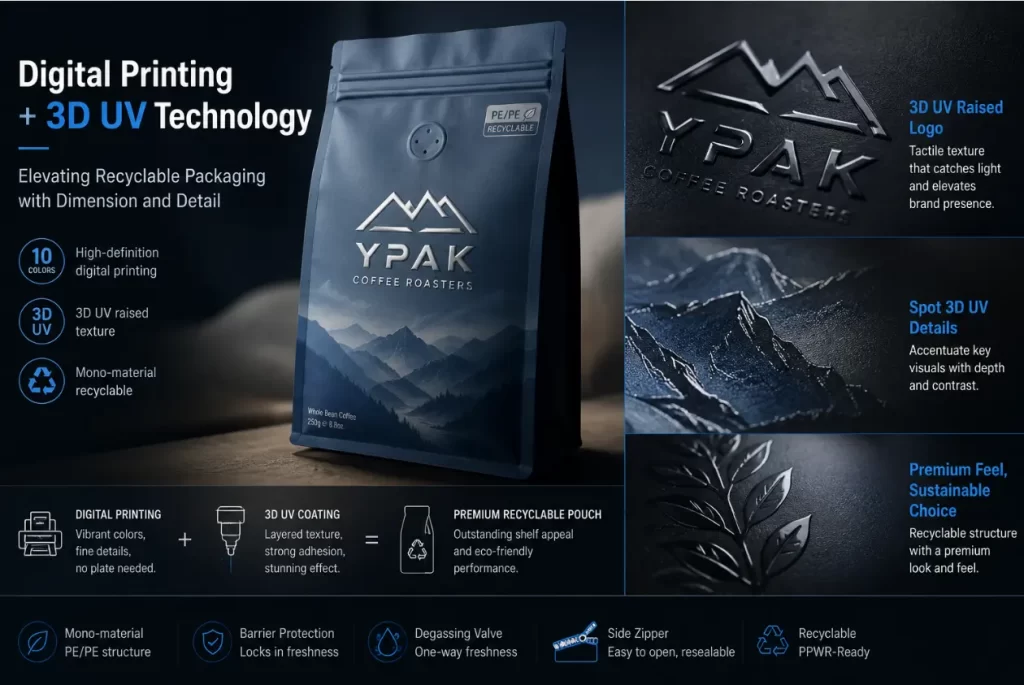
Generation 3: Recyclable + 3D UV. After achieving compliance, wildkaffee did not stop at the "recyclable" pass line. The next step was adding 3D UV finishing: on digitally printed bag surfaces, the logo and core graphics gain a tactile, embossed relief effect. 3D UV is a physical print-surface layer — it does not change the mono-material recyclability of the bag. For the first time, compliance and premium aesthetics coexist on the same sustainable coffee bag.
These three generations carry the central message of this article: switching to recyclable packaging is not a single action — it is a path you can walk in steps. Generation 1 protects flavor and brand identity, Generation 2 balances compliance and freshness, Generation 3 turns compliance into a brand asset.
Case 2: Löfbergs — The Two-Step Transition
If wildkaffee represents the gradual three-step path of a specialty brand, Löfbergs demonstrates how a large-scale operator completes the switch in two deliberate steps.
Löfbergs is one of the largest coffee roasters in the Nordic region, with extensive retail distribution and high packaging volume — its switching costs and inventory risks are far greater than those of a specialty brand. Its path:
Step 1: Change the material origin. While keeping the existing structural logic, Löfbergs first replaced fossil-based feedstock with bio-based PE to reduce carbon footprint — this stage answers "where does the material come from," and makes the packaging's carbon footprint immediately quantifiable and publicly disclosable.
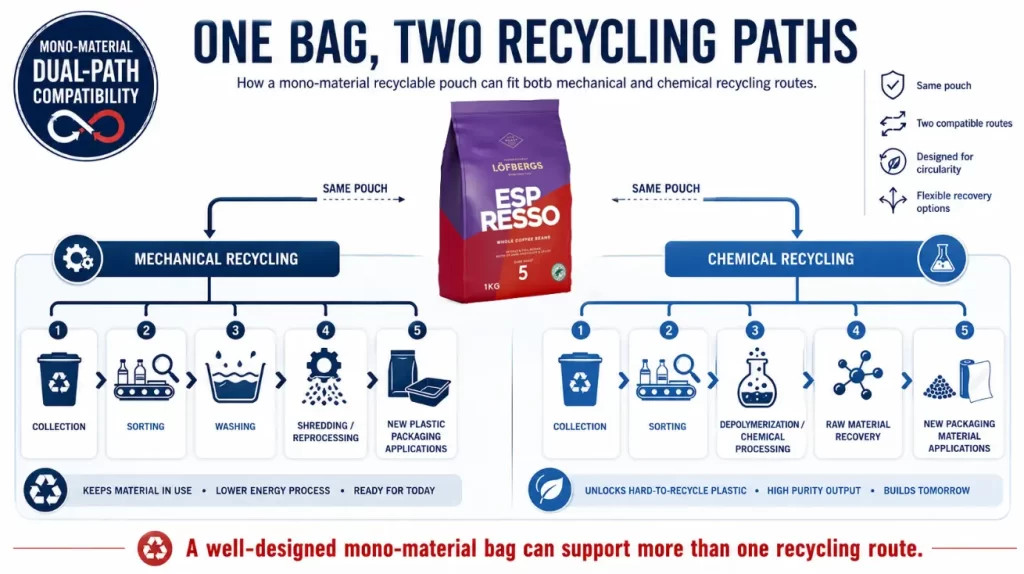
Step 2: Change the structural logic. Working with its packaging supplier, Löfbergs introduced the AmPrima Recycle-Ready mono-material solution: a single-polymer structure compatible with both mechanical and chemical recycling. These two routes deserve a closer look:
- Mechanical recycling washes, shreds, melts, and re-pelletizes used packaging into recycled material. It is mature, energy-efficient, and the mainstream of the EU recycling system. For mono-material packaging, the entire bag enters this line without delamination.
- Chemical recycling breaks polymers down to monomers or feedstock at the molecular level and re-polymerizes them. Its advantage: it can handle plastics that mechanical recycling cannot — contaminated or degraded material — and the output approaches virgin quality. The trade-off is significantly higher energy consumption and cost.
A mono-material structure is "dual-path compatible" precisely because its molecular composition is uniform: whether sorting physically or depolymerizing chemically, there is no "separate the different materials" problem to solve first. According to the supplier's (Amcor's) publicly disclosed case study, the new packaging cut carbon footprint by roughly 55% compared with standard coffee packaging, without compromising flavor and aroma retention.
The lesson from Löfbergs: large enterprises do not need to do everything at once. Complete feedstock decarbonization first, then structural recyclability — each step has its own business rationale, and each step hands downstream retailers verifiable compliance evidence.
Case 3: Kjeldsberg — Retail-Led Compliance
Kjeldsberg is a regional Norwegian brand, positioned between market leaders and specialty roasters. In Nordic markets, retail channels typically respond to packaging sustainability requirements ahead of legislation — large supermarket chains begin asking "can this bag be recycled, are the labels in place.Do you have compliance declarations" as part of their supplier gatekeeping.
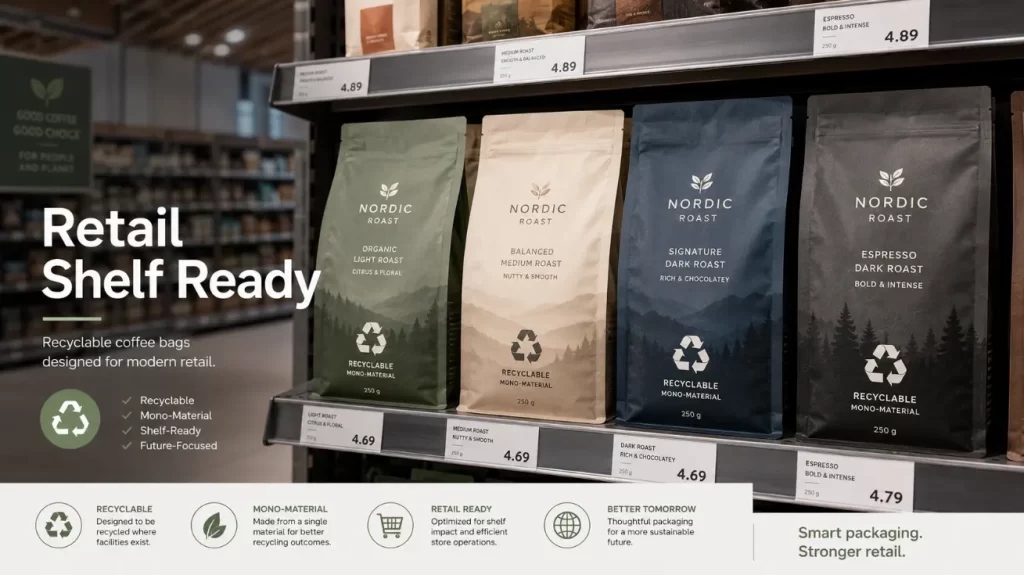
When buyers start asking these questions, a regional brand that cannot answer loses more than an order — it loses the shelf position. Kjeldsberg's response was to switch directly to recyclable mono-material coffee packaging, making "recycle-ready" the key that opens retail doors, and turning compliance into a differentiator in shelf-access negotiations.
The takeaway for mid-size roasters: do not wait for the regulation to force you — let channel requirements become the trigger for switching early. While competitors are still evaluating, you have already printed "recyclable" on the bag and into your product documentation — that is a tangible gap on the retail negotiation table.
The Five-Step Switch Framework
Across the three cases, the paths differ but the underlying method is identical. It can be distilled into five steps:
- Packaging audit. Inventory every bag format — material structure, barrier performance, and components (valves, zippers, stickers) — and grade each against PPWR recyclability requirements. Which packages are already recyclable, and where does each one fail?
- Material selection. Choose replacement structures by SKU volume and freshness requirements. High-volume SKUs should switch to mono-material recyclable structures first; products needing stronger barriers or longer shelf life can evaluate coating-enhanced solutions.
- Barrier validation. Let measured data speak. OTR and WVTR must be compared between old and new structures under the same test standard — never judged by thickness or feel. This is the step most likely to fail, and the first one buyers will challenge.
- Label compliance. Update recycling labels, material codes, and disposal instructions in parallel, matching the mandatory information requirements of target markets, and reserve space for the 2027 digital marking (QR codes).
- Supply chain documentation. Build a traceable compliance file chain — Declaration of Compliance (DoC), recycled-content evidence (such as TC transaction certificates under GRS certification) — so every batch's environmental claims are verifiable.
The order matters: you cannot choose a replacement until you know where you stand; you cannot claim "recyclable" publicly until barrier data proves freshness holds.
Barrier Reality Check: OTR/WVTR Comparison
The most common buyer question: "Will my coffee lose freshness in recyclable packaging?"
The answer: it depends on how you switch. Using the three-generation structure as an example, here is the freshness account:
| Structure | Barrier Performance | Recyclability | Key Risk |
| Kraft + foil (Gen 1) | Near-total barrier | Non-recyclable (laminates cannot be separated) | Regulatory obsolescence, retail exclusion |
| Mono-material recyclable (Gen 2) | OTR ≤5 / WVTR ≤0.5, same range as laminates | Recyclable (single PE stream) | Requires measured-data proof |
| Recyclable + 3D UV (Gen 3) | Same as above, tactile print layer added | Recyclable (finishing does not alter material properties) | Finish areas must avoid crease and seal zones |
This table proves two things. First, modern mono-material structures can deliver barrier performance at the same level as conventional laminates — provided coating technology and material formulation are matched. Second, recyclability and brand finishing do not conflict.Surface finishes such as 3D UV and digital printing do not change the bag's mono-material property, as long as finish zones are designed into the structure from the start.
Sustainable Coffee Packaging Without Sacrificing Design: 3D UV
wildkaffee's third generation shows that the ceiling for brand aesthetics is actually higher after compliance.
Layering premium finishes on recyclable bags requires several technical conditions:
- Finish layers stay out of the structure. 3D UV is a cured surface layer applied after printing, separated from the barrier and seal layers — it does not break the mono-material recyclability.
- Digital printing matches small runs. 3D UV typically pairs with digital printing, supporting high-density visuals at low-to-mid minimum order quantities — ideal for multi-SKU specialty brands.
- Finish positions must be designed. Embossed UV should avoid crease lines, seal edges, and valve zones — these areas are flexed during use, and a raised layer may crack or compromise the seal.
For roasters, this means "recyclable" is no longer a choice between compliance and aesthetics: secure compliance first, then premium finishing, and finally brand premium.
Three Hidden Pitfalls in the Switch
Beyond the three cases, we have seen too many brands step into the same traps:
- Judging by thickness, not measured barrier. Two bags can both be 90 microns with very different freshness performance. Thickness is material usage, not barrier outcome — always run OTR/WVTR comparisons between old and new structures under the same standard. That data will become your sales story.
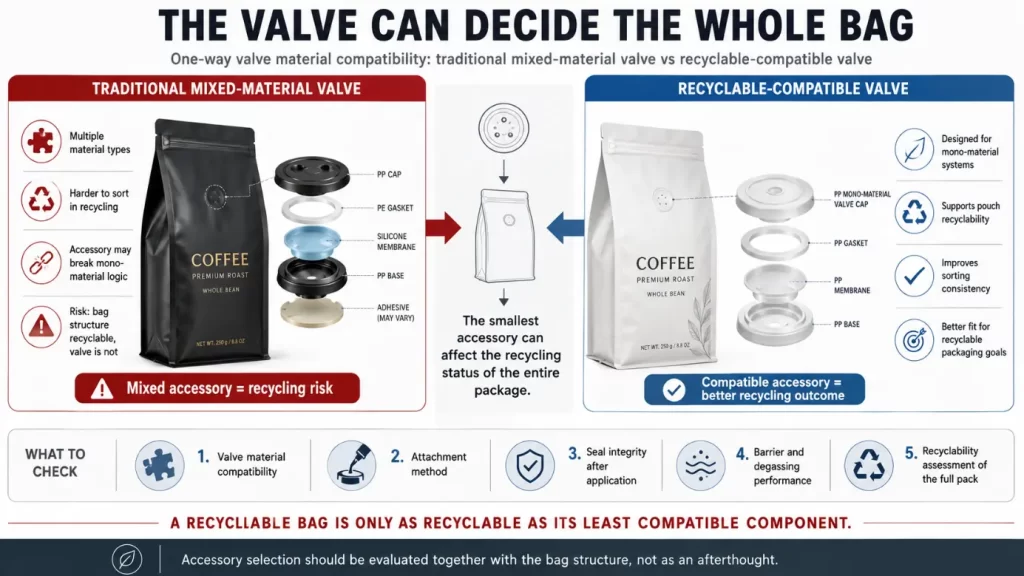
- Recyclability claims that do not match the actual product. The bag body may be mono-material, but if the valve, zipper, or label uses other materials, the entire package still cannot enter the recycling stream — or the bag is recyclable but carries mismatched labeling. Recyclability applies to the whole package, not the main material.
- Components that drag the whole bag out of the recycling stream. The one-way degassing valve is essential for coffee bags, but traditional valves are often made of mixed materials. When selecting a valve, verify its material compatibility with the bag's recyclability, and adjust valve size or structure if needed — this is the most overlooked detail in "recyclable coffee packaging."
A Lightweight Roadmap for Mid-Size Roasters
Not every brand has wildkaffee's three-year runway or Löfbergs' purchasing power. Mid-size roasters can start here:
- Switch high-volume SKUs first, not the full range. Move core coffee formats to recyclable structures and let low-volume or seasonal SKUs transition with existing stock — reducing the capital and risk pressure of a one-time overhaul.
- Put measured data first. Ask your packaging supplier for OTR/WVTR test reports and write "freshness holds" into your own product documentation — this locks in B2B buyers more effectively than any marketing phrase.
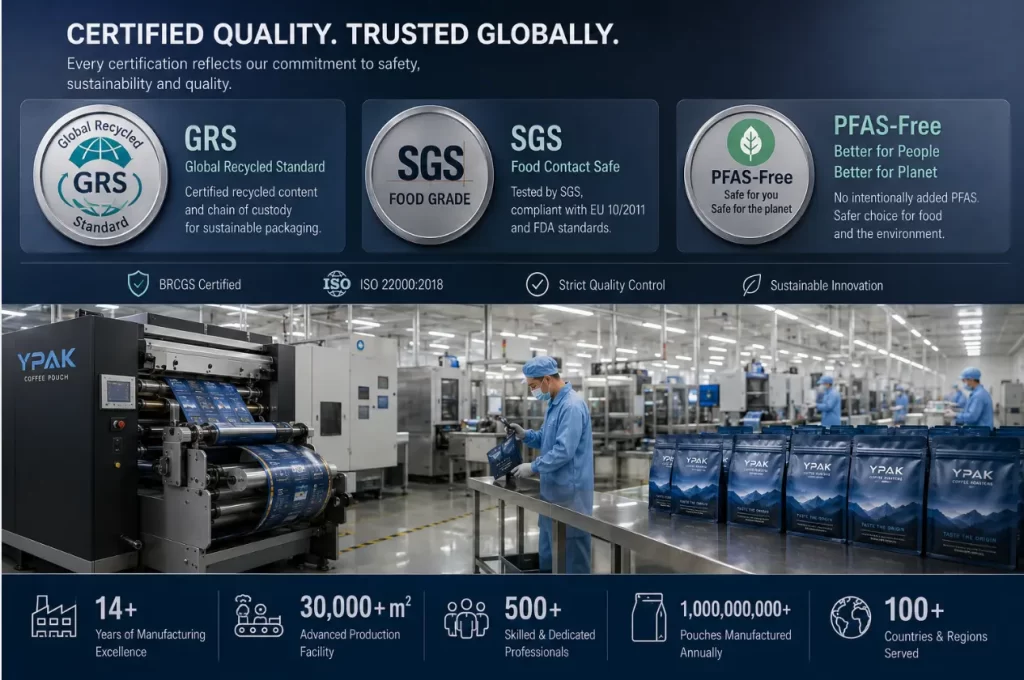
- Turn certification files into sales assets. PFAS test reports, GRS certification, recyclable structure declarations, and DoC documents should be offered proactively at the inquiry stage — converting compliance from a "required answer" into a "differentiator."
- Reserve space for 2027. When designing bags now, leave zones for the digital marking (QR code) and the harmonized recycling label to avoid a second redesign next year.
Why European Brands Work with YPAK
By now you may be asking: who actually manufactures the mono-material recyclable structures and 3D UV finishes described above? The answer — the same manufacturing capability, and it is what YPAK does every day.
- Certified foundation. YPAK holds GRS (Global Recycled Standard) certification, SGS food-contact testing, and PFAS-Free test reports — every claim of "recyclable," "food-grade," and "PFAS-free" is backed by third-party documentation that can enter your compliance file chain directly.
- Measured data. Factory testing of our recyclable structure records OTR ≤5 cc/m²/24hrs and WVTR ≤0.5 g/m²/24hrs — the same freshness range as foil laminates. Test reports are available with samples.
- Finishing capability. HP Indigo digital printing combined with 3D UV finishing delivers the Generation-3 brand upgrade that wildkaffee achieved, at low-to-mid MOQs, without breaking mono-material recyclability.
- Component integration. Valves, zippers, and labels are co-designed with the bag material so the whole package — not just the bag body — meets recyclability requirements. This is where "recyclable" truly holds.
Our experience serving European coffee brands comes from the real projects above and from line-by-line compliance practice with the PPWR. Compliance audit, sample comparison, and documentation delivery — every step can be validated before you commit.
Conclusion: The Compliance Switch Is a Brand Upgrade
Back to the opening question: how do European brands complete their sustainable packaging transition? The answer — they treat it as a path walked in steps, not a risky start-from-scratch overhaul.
wildkaffee proved the complete route from "conventional → recyclable → recyclable with premium finish" across three bag generations; Löfbergs proved large enterprises can switch in two steps.Kjeldsberg proved channel requirements can be turned into switching momentum.
For roasters still evaluating, the gap is not "whether to switch" — it is "what one extra step you take beyond your competitors." That step may be measured data, certification files, or simply a 3D UV logo. But it is exactly the step that turns compliance into a brand upgrade.
If you are evaluating recyclable coffee packaging options, we offer three free support items: 1) a compliance audit of your existing bag formats, graded line by line against PPWR recyclability requirements; 2) an OTR/WVTR measured comparison report for the new structure; 3) a recyclable structure sample including valve compatibility. Send us your bag specifications or samples to get started.
FAQ — 5 Questions Roasters Ask About Recyclable Coffee Packaging
Written by
ypak.coffee
ypak
YPAK PACKAGING GROUP was established in 2011 and formed with 3 companies based on Hongkong, Dongguan and Foshan. We have become one of the largest coffee bag manufacturers in China. We use the best quality WIPF valves from Switzerland to keep your coffee fresh.
Conform to the plastic ban policy imposed to many different countries, we have researched and developed the sustainable packaging bags, such as RECYCLABLE and COMPOSTABLE pouches.
No minimum quantity, no color plates are required with our HP 25K INDIGO DIGITAL PRINTING service.
You are welcome to visit YPAK.
Related Articles
YPAK at World of Coffee Panama 2026: Coffee Packaging for Short Runs and EU-Bound Lots
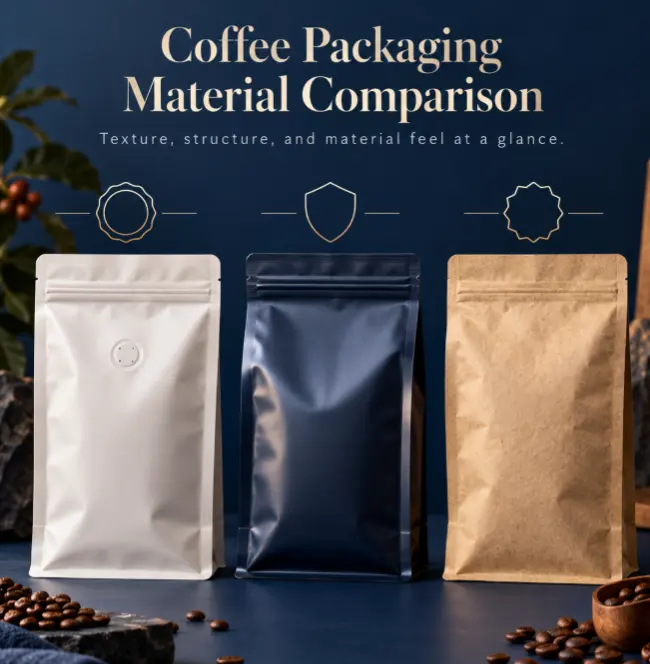
PPWR Recyclability Grades for Coffee Packaging: What Survives 2030, and What Survives 2038
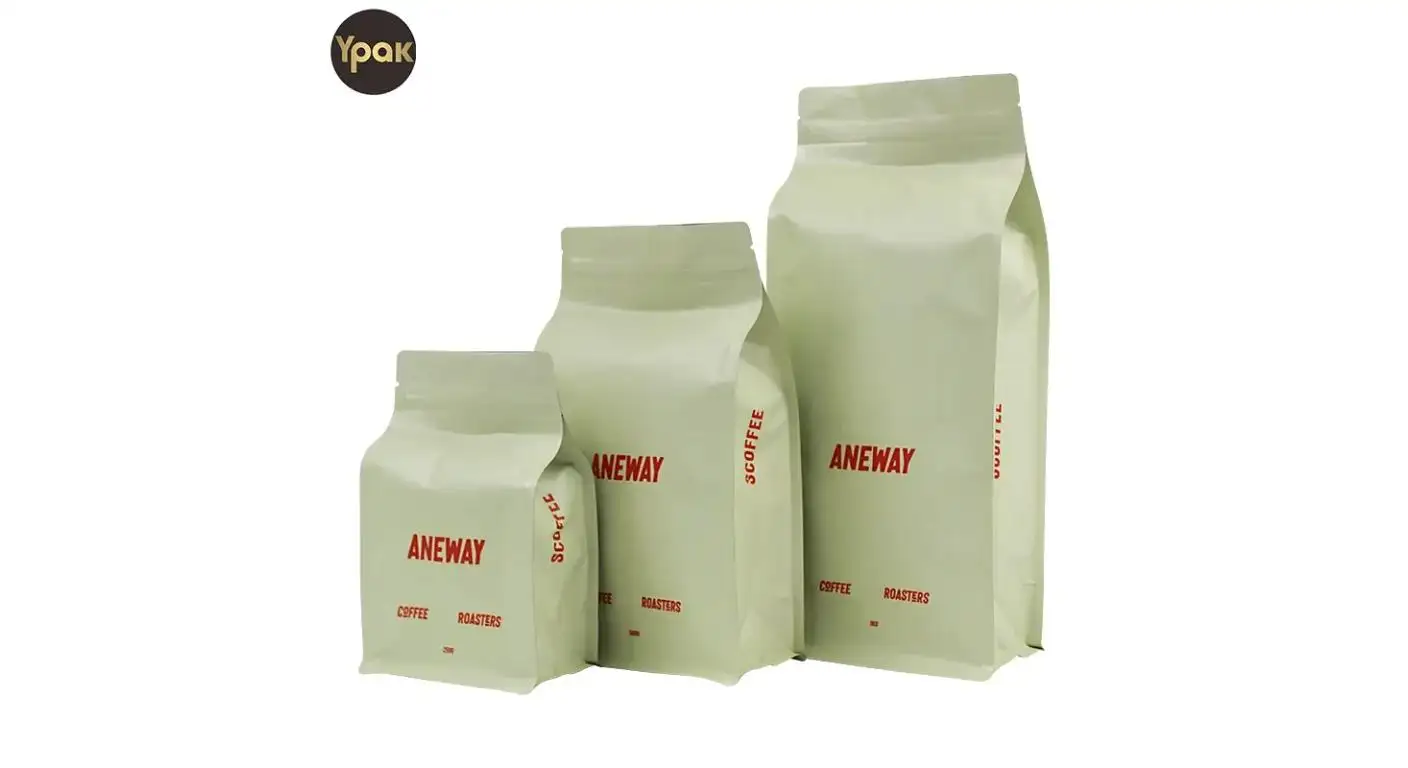
Customized Coffee Packaging Solutions: From Product Ideas to Market-Ready Packaging