

Updated 3 months ago
Coffee Carton Box: combination of materials, strength and food safety.

ypak.coffee
YPAK PACKAGING GROUP was established in 2011 and formed with 3 companies based on Hongkong, Dongguan and Foshan. We have become one of the largest coffee bag manufacturers in China. We use the best quality WIPF valves from Switzerland to keep your coffee fresh.
Conform to the plastic ban policy imposed to many different countries, we have researched and developed the sustainable packaging bags, such as RECYCLABLE and COMPOSTABLE pouches.
No minimum quantity, no color plates are required with our HP 25K INDIGO DIGITAL PRINTING service.
You are welcome to visit YPAK.

Coffee Cardboard Boxes
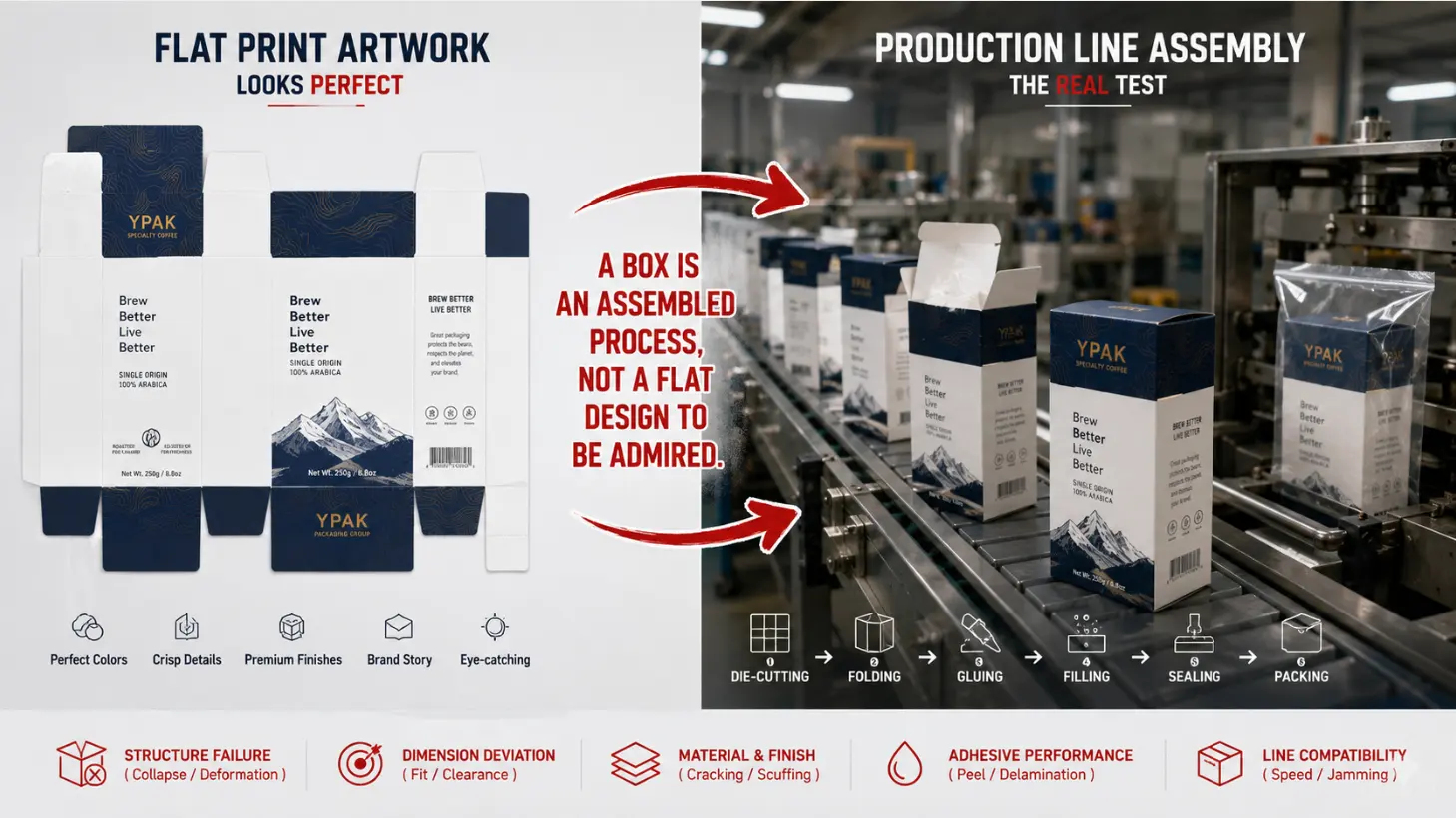
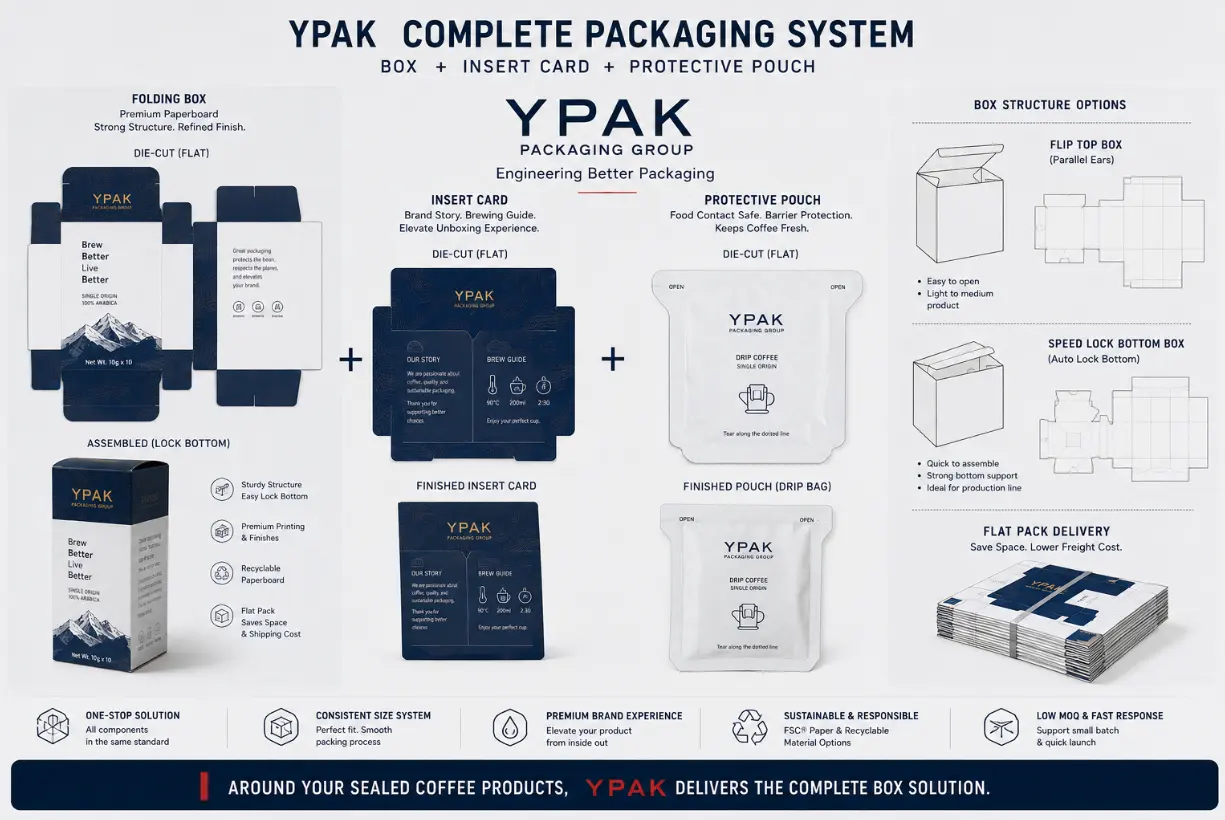
A coffee carton box typically is a folded print folding carton box that is typically supplied in a flat format and is folded in the process of filling. It could contain a closed coffee pack, pack drip sachets or make a small retail package. Its trade benefit is an efficient memory storage and large size printable panels, but this benefit hinges on an effective crease-lock, glued joins and packing procedures.
The carton ought to be made as converting and assembly process and not as flat artwork. The paperboard will have to pass through printing, die-cutting, folding and gluing and then travel to the coffee brand. Details in the choices taken on the dieline would either allow the final pack to be shaped within a matter of minutes or it could be shaped with constant hand intervention.
This guide outlines how consumers can evaluate carton designs, the behavior of paperboard, structural sample and mass-production control of specialty coffee products.
Determine the Packing Role of the Carton.
The initial question is not what the finish to be is. It is the entry that the carton is going to have towards the packing process.
Manual Formation
Carts, loading coffee and closing the flaps can be done by a person. The building ought to feature natural opening and be square with no overstrain. Multifaceted locks may prove costly because each unit will have to be handled.
Semi-Automatic Packing
Cartons that are used with forming or closing machines should be of a similar size, crease and glue location. Ahead of accepting the dieline, disclose the limitations of the machine to the supplier.
Supply beforehand or Pre-Assembled Supply
There are those buildings that come with fixed parts or ready bottoms baked. They can decrease packing time and increase converting cost and even shipping volume. Compare the labour value saved to the unit added cost.
Find Style to Match to the Product.
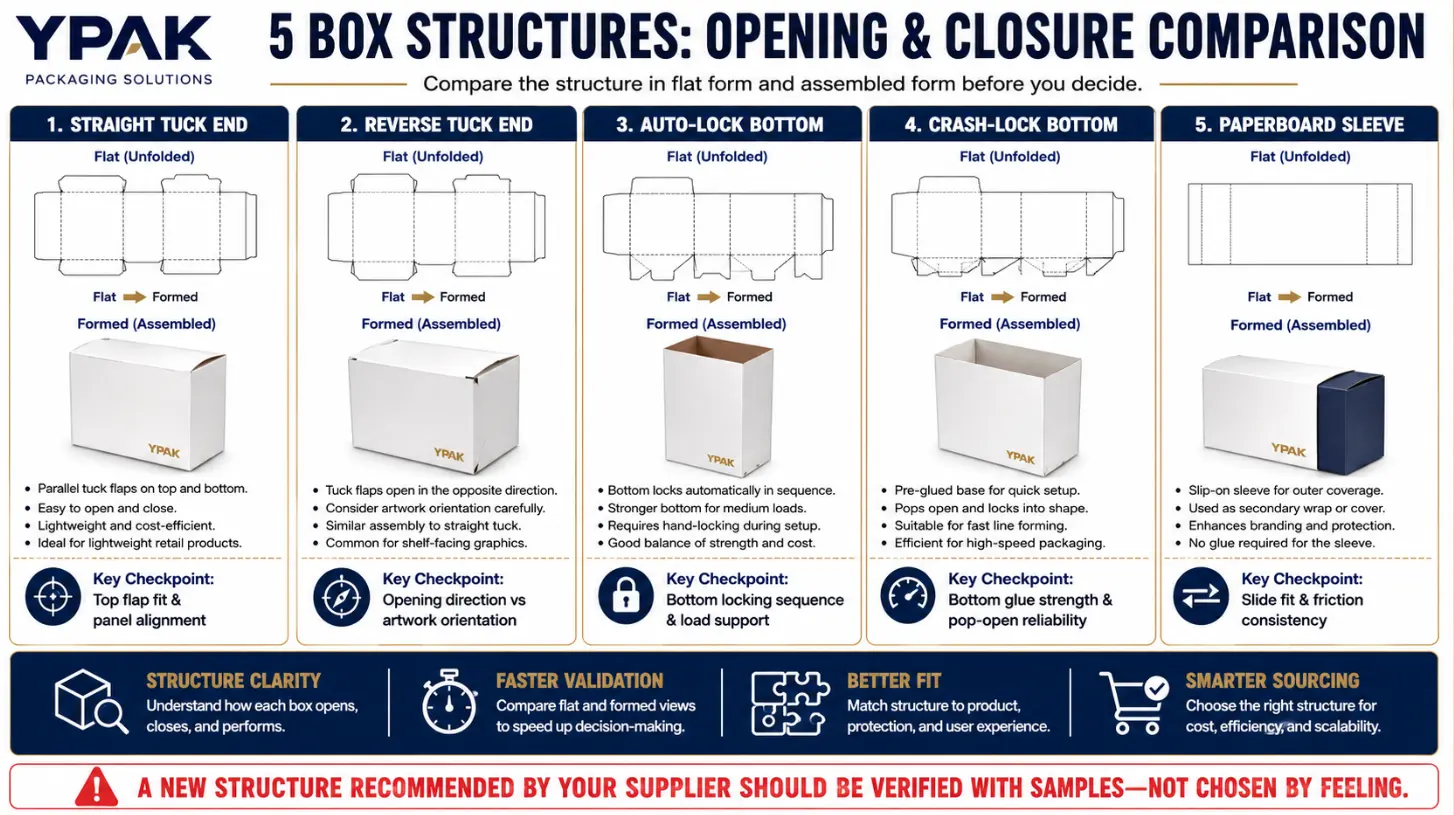
The carton styles address various loading and closing needs.
| Carton style | Critical check | Useful application |
| Parallel tuck flaps | Product clearance and retention of flaps and tuck ends | Light retail packs |
| Reverse tuck end | Opening direction and artwork orientation | Products requiring an efficient sheet design |
| Snap-lock bottom | Proper manual locking sequence | Moderate loads that require more support |
| Crash-lock bottom | Strength of glue and bottom opening | Faster volume forming with low accumulation |
| Paperboard sleeve | Sliding clearance and retention | Branding layer around a secondary pack |
Supplier can suggest another structure that will be used after the actual product and method of packing have been examined. Test that suggestion using samples instead of just picking it.
Fill up the Dieline with Full Samples.
Flat coffee bag is not a filled product. The whole bean, ground coffee and drip sachets form various shapes.
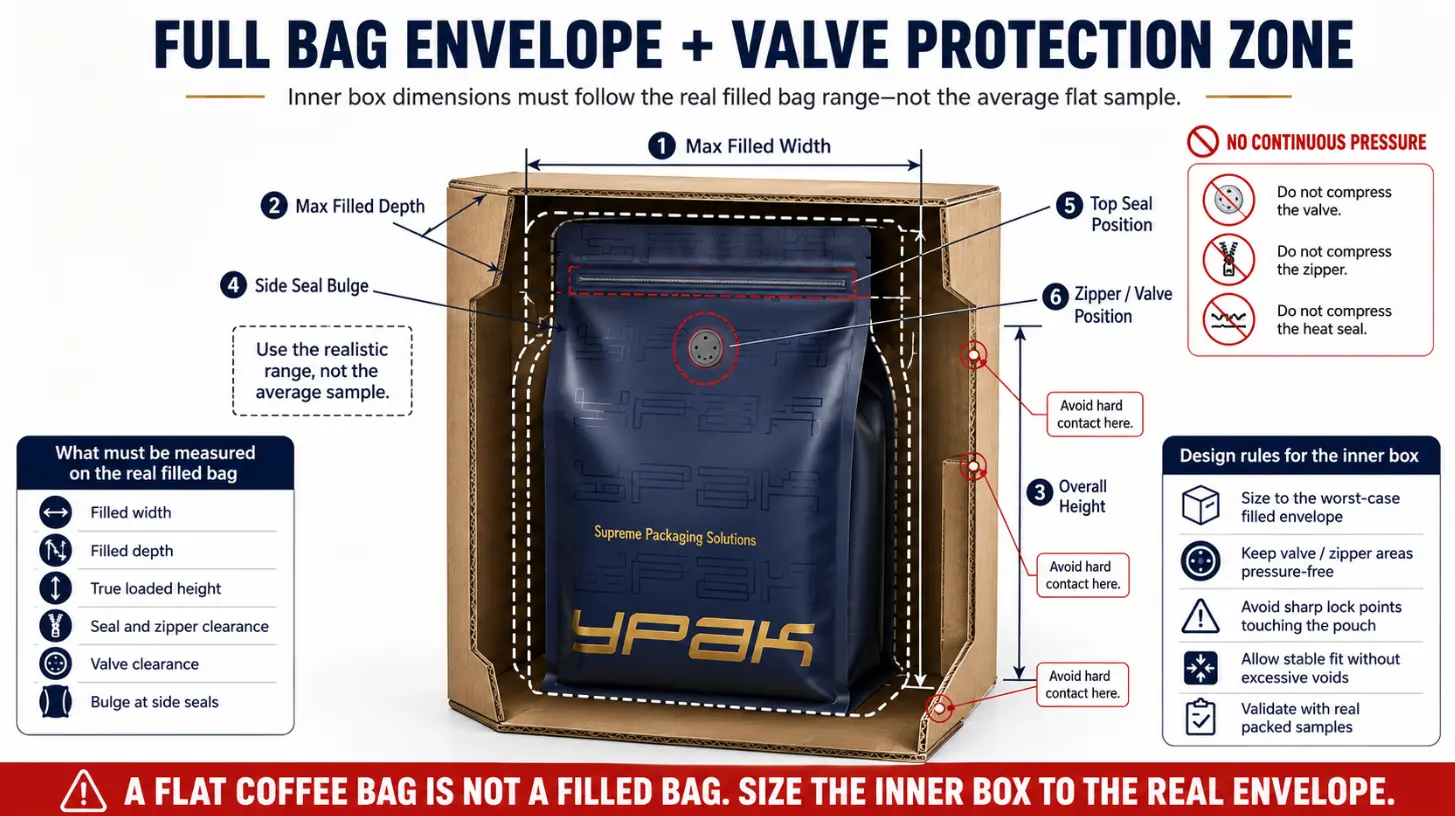
Construct Dimension Envelope.
Measure some typical units of production and note:
• Maximum filled width • Maximum filled depth • Total height • Gusset expansion • Top-seal position • Location of zipper or valve.
The internal dimensions of the carton must fit in the realistic range and not the average sample.
Clearance which is Sensitive to the reserves.
Do not provide consistent pressure on a one-way valve, zipper or heat seal. An extreme point of a folded edge or lock cannot be a hard point of contact with the coffee pouch.
Removal of Check by customer.
When the carton is opened the product must be easy to remove. Fit too snugly can appear to be controlled yet provide a frustrating experience of opening.
Know Paperboard Direction.
Paperboard is directional. The fibers that are formed in papermaking have effects on stiffness, folding and curl.
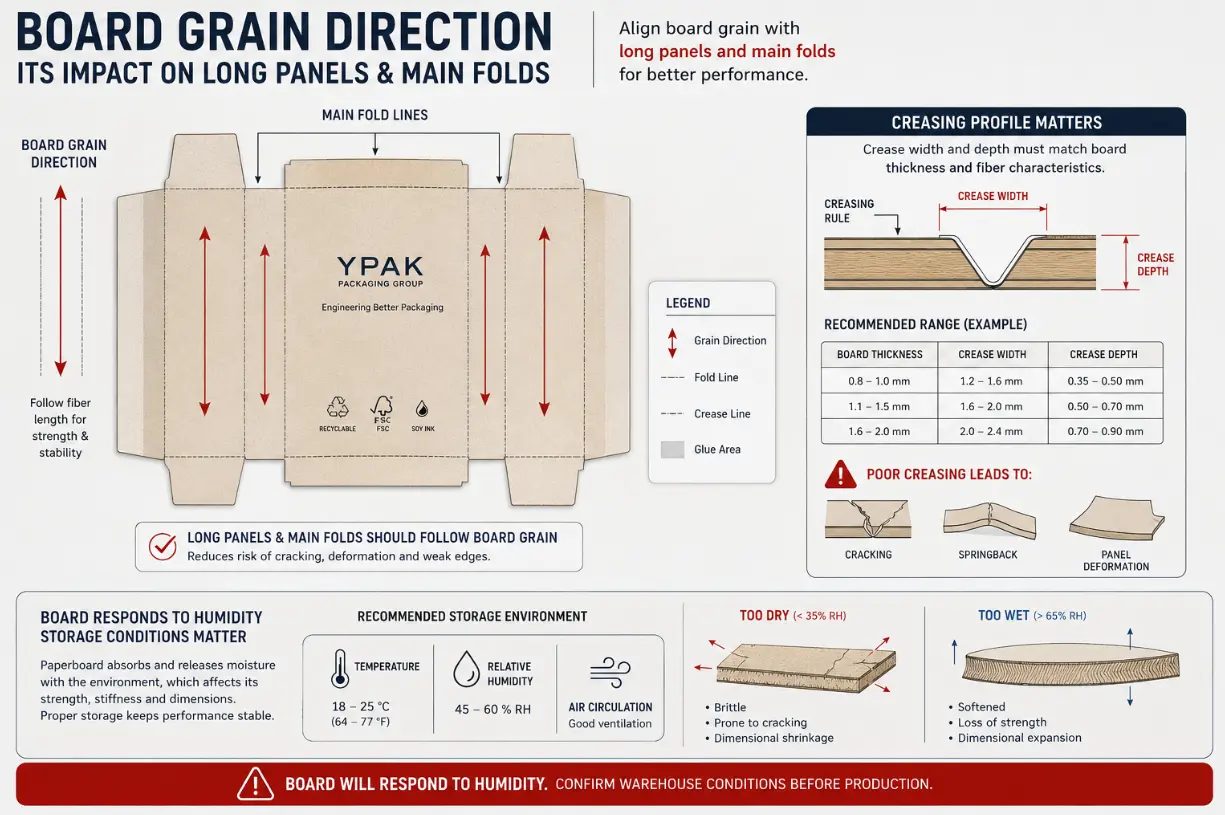
Major Folds and Grain.
When placing long panels and other important folds one should take into account grain direction. The converter has the ability to suggest orientation depending on the carton geometry and board selected.
Crease Quality
The board is able to fold by compressing and redirecting it with the help of a crease. The depth and width must be appropriate to board thickness and fiber action. Creaking may occur as a result of poor creasing, spring-back or misshapen panels.
Storage and Moisture.
Paperboard is able to react to humidity during the storage and production. Confirming when the conditions in the warehouse and reasonable acclimatization where dimensional consistency matters.
Test Locking System.
A successful closure is where the closure is stable in normal use, and can normally be opened.
Employ a closure trial:
1. Make cartons of various positions of samples. 2. Fill the weight of the product. 3. Seal all openings with proposed sequence. 4. Use usual handling and stacking. 5. Take the top off the carton like a customer would. 6. Documented issued tabs, ripped edges or problems that are hard to do.
Tuck Flap Performance.
Friction and side-wall stiffness are in tandem with the tuck dimensions. A tab can also be lipt off in case the item in the packaging makes the carton lower.
Bottom Security
Packing and shelf handling of the product are done by the bottom. Snap-lock test bottoms with the actual load and not just a plain mock-up bottoms only.
Control Areas of Glue.
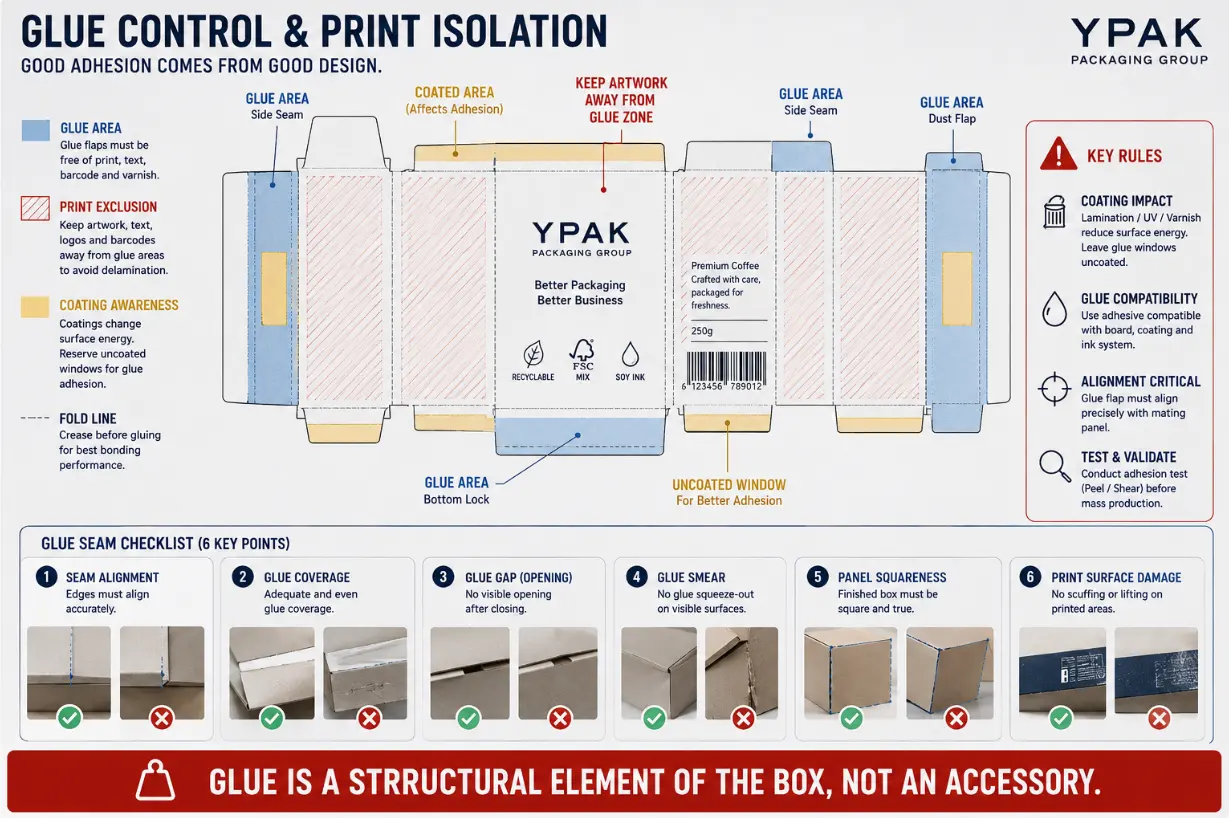
Glue is a very strong building part. Carton consistency depends on its location, size and bonding area.
Glue-Flap Geometry
The bonding area of the glue flap must be sufficient without disrupting the squareness of the carton. Art and the necessary text must be kept out of glue areas.
Coating on Finished Surfaces.
Adhesion can be modified by coating, varnishes and lamination. Establish location of glue free windows or surface treatment that would guarantee a good bond.
Test visually Check Seams.
Sampling should include:
• Seam alignment • Glue coverage • Open seams • Excess adhesive • Panel squareness • Destruction of printed surface.
Keep Food and Secondary Packaging Separate.
Majority of cartons contain the sealed coffee pouches or sachets. The barrier against oxygen and moisture is commonly offered by the major package and presentation and organization are offered by the carton.
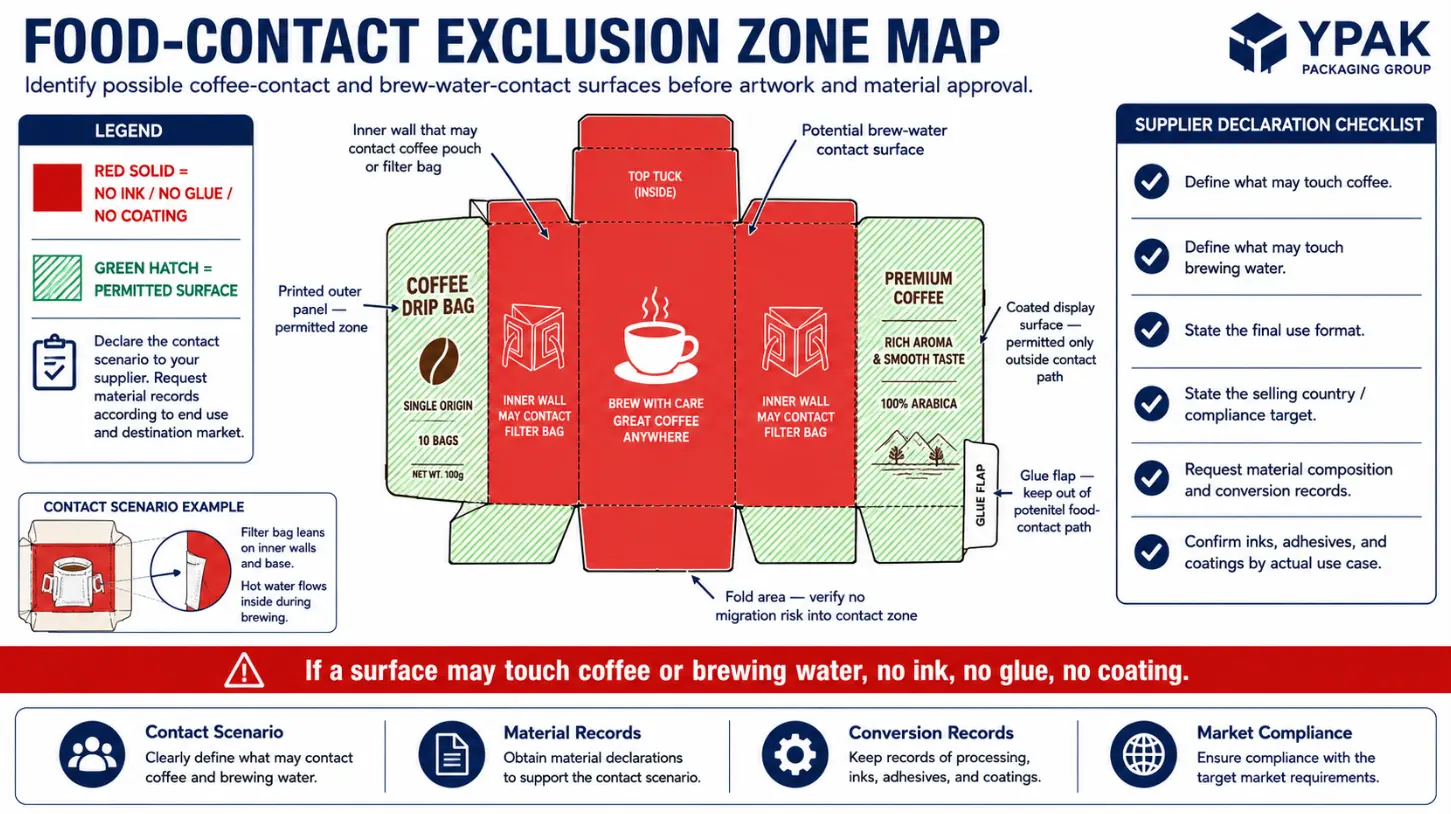
State the Contact Scenario.
Indicate to the supplier whether or not the carton may be touched by any filter and/or any other exposed component or food-contact surface. Order material records (by the end use and country sold).
Map Ink and Stick.
Marking surfaces where ink, coating and glue is allowed. Do not pour to any part that may get in touch with coffee or brewing water.
Planning Artwork to be converted.
Artwork ought to be according to the approved format. Completion of graphics earlier than the dieline may result in the creation of misaligned panels, and unsafe text locations.
Develop Panel Ownership.
Each panel visible ought to have a definite function:
• Brand/ product recognition. • Coffee details • Brewing information • barcode and mandatory statements. • Opening instructions Variable labels or lot codes.
uard Technical Zones.
Store valuable material out of creases, cuts, locks, glue flaps and corners which are not visible during the time of assembly. Look at the carton in flat and formed perspectives.
Approve Color on Paperboard.
Recycled surfaces, white coated board and kraft board give various outcomes. Physical reference should be used when cartons have to co-ordinate with coffee pouches or labels.
Conduct a Packing-Line Trial.
The product can be fitted into a structural sample and it can fail to work on day-to-day packing.
Request the target crew to perform a batch under control and document:
• Formation time • Loading time • Closure time • Misfolded panels • Released locks • Product orientation errors • Re-work and rejected work units.
Note what moves have to be explained. The repetition should contain a structure that expresses its assembly orientation by the use of its form.
Examine Production Cartons.
Production against approved sample is the only way the approved sample can be useful.
| Inspection area | Common evidence to check |
| Structure | Approved flat and formed samples; clean folds without unacceptable cracks; correct edges, slots, tabs, and locks |
| Gluing | Aligned and consistent seams; sufficient glue coverage; no open seams |
| Printing | Correct content, placement, and color reference; no damage to printed surfaces |
| Packing | Correct quantity, positioning, orientation, and wrapping |
They should agree inspection frequency and acceptance limits prior to production.
Computing the Operational Cost.
Packing and logistics should be included to the unit quotation.
Include:
• Structural samples and tooling. • Paperboard and printing • Special finishes, and gluing. • Assembly labor • storing of flat cartons. • Master-case efficiency • Waste and rework
YPAK offers customized sets of drip coffee paper boxes that are made of folding cartons, paper inserts and protective sachets. It also explains itself on its Web site on the tuck-end structure and the crash-lock structure, flat-packed supply and bespoke printing. The abilities are applicable to the consumers building a carton surrounding a closed coffee product.
Manufacturing Package: Pass.
Before ordering, confirm:
The last designation and size • Paperboard specification When critical, grain direction When grain federal. • Locking design crease and locking. • Glue areas • Printing and finishing • Product loading sequence • Master-case packing • Accepted versions of samples and artwork. • Unit and delivery schedule.
Conclusion
The carton box of the coffee is at scale when it can be converted in a consistent way and it would be packed and opened in a way that it would not break the package, and thus lose the coffee. Recording of these needs also provides a reference of reorders.
FAQ
Written by
ypak.coffee
ypak
YPAK PACKAGING GROUP was established in 2011 and formed with 3 companies based on Hongkong, Dongguan and Foshan. We have become one of the largest coffee bag manufacturers in China. We use the best quality WIPF valves from Switzerland to keep your coffee fresh.
Conform to the plastic ban policy imposed to many different countries, we have researched and developed the sustainable packaging bags, such as RECYCLABLE and COMPOSTABLE pouches.
No minimum quantity, no color plates are required with our HP 25K INDIGO DIGITAL PRINTING service.
You are welcome to visit YPAK.
Related Articles
YPAK at World of Coffee Panama 2026: Coffee Packaging for Short Runs and EU-Bound Lots
PPWR Recyclability Grades for Coffee Packaging: What Survives 2030, and What Survives 2038
Customized Coffee Packaging Solutions: From Product Ideas to Market-Ready Packaging