

The Evolution of Coffee Packaging
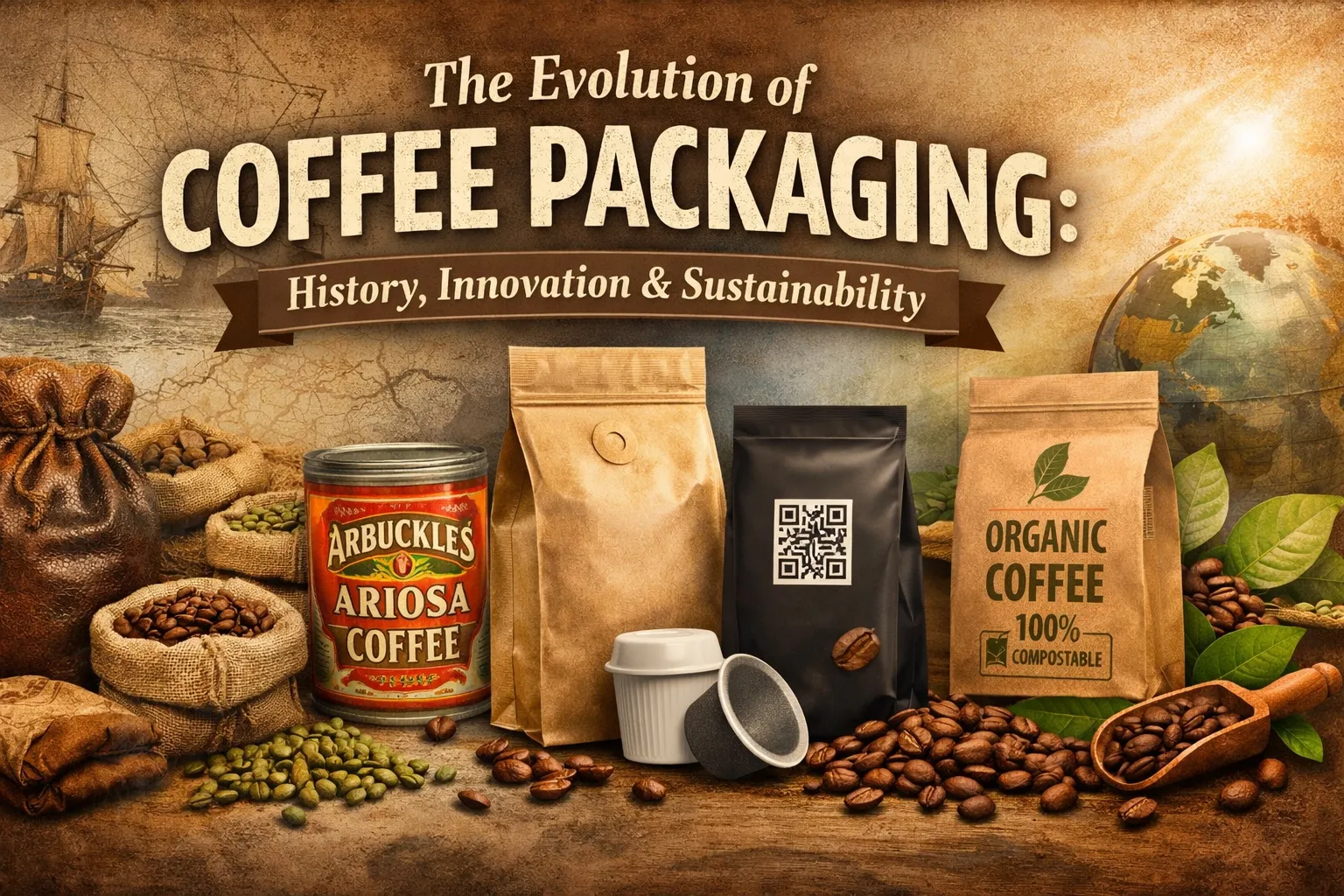
Packaging in the current coffee business world is much more than a container. It guards freshness, conveys brand name, affects buying behavior, and denotes sustainability principles. Since the 18 th century in the form of wax-coated leather bags through to the 20 th century with the introduction of eco-friendly coffee bags with a degassing valve, coffee packaging has a history of centuries of innovations.
This is a comprehensive guide where we examine the history of coffee packaging, some of the biggest technological advancements and emerging trends that will shape the future of specialty coffee packaging in the world.
1. Early Coffee Packaging: Secluded Utilitarian (1700s1860s)
Prior to the commoditization of coffee into a mass-market, packaging had a very straightforward use; it was used to provide transportation and protection.
In Europe, coffee beans and grounds were kept in leather containers coated with wax in around the 18th century and kept in cloth bags to preserve the flavor and prevent contact with moisture. Green coffee beans were carried in huge jute bags in the case of international trade. These were durable and breathable bags that were best applied in long-sea trips and are still commonly used nowadays to transport unroasted coffee.
Packaging was minimal at the consumer level. Customers usually bought loose coffee to be sold by merchants and kept it at home made of paper, cloth or ceramic. Branding did not really exist, functionality was all.
2. The Emergence of Branding in Coffee Packages (1870s-1900s).
The end of the 19 th century became another milestone in the history of coffee packaging. With the increase in coffee consumption in the United States and Europe the companies started appreciating packaging as a marketing tool.
The introduction of pre-measured and sealed coffee, packaged in printed papers, began to sell by the brands. Bright illustrations, logos and promotional offers turned packaging into what is currently known by marketers as the silent salesman. Packaging has become brand recognition and customer loyalty, rather than offering security to the product.
The period formed the basis of the present day retailing coffee packs- shelf appeal and appearance became the main factors of competition.
3. Technological Discoveries: Freshness Preservation (1900s-1960s).
With the change in consumer expectations, the most important innovation in the coffee packaging process came to be freshness.
Vacuum Packaging
At the beginning of the 20th century, the vacuum sealing was introduced in the coffee industry and was considered revolutionary. This stopped the oxidation process in the package greatly extending flavor and aroma, since manufacturers removed oxygen inside the package.
This invention enabled widespread distribution of coffee without compromising quality of coffee which was a significant breakthrough in the commercialization of coffee around the world.
Nitrogen Flushing
Advances later brought about nitrogen flushing, which involves replacement of oxygen in the bag by an inert gas. This increased shelf life further and it became the norm of high-quality and specialty coffee brands.
One-Way Degassing Valves
Probably, the best invention in the contemporary coffee packaging is the one-way degassing valve. Newly roasted coffee emits carbon dioxide (CO 2 ) days following the roasting process. The valve enables the escape of CO 2 without oxygen entering to minimize the rise of the bag and also to preserve the freshness.
This is because modern high quality specialty coffee bags have degassing valves.
4. The Third Wave Coffee Movement and Story-Contact Packaging (1970s-Present)
When the third wave coffee movement emerged, packaging was changed once more; it became a narration platform.
customers were now more interested in:
· Coffee origin
· Information about farms and producers.
· Roast profiles
· Flavor notes
· Brewing recommendations
The current coffee packaging designs have emphasized traceability, transparency, and craftsmanship. Minimalist design, specialty typography, and eco-friendly materials became the norm of the artisan coffee brands.
QR codes are also being added to packaging by a large number of companies, enabling the customer to read the digital content, brewing instructions, and stories of origin - a mixture of physical packaging with digital interaction.
5. Sustainable Coffee Packaging: The New Priority of the Industry.
The most significant agent of coffee packaging innovation is sustainability at the present.
With the increasing environmental awareness, consumers are now demanding environmental friendly coffee packaging which minimizes waste and carbon footprint. Brands are responding with:
· Monolithic bags that can be recycled.
· Biodegradable coffee packaging.
· Biodegradable films
· BPA-free valves
· Water-based inks
Sustainability in coffee packaging is however complicated. Coffee needs a high level of oxygen and moisture barriers to keep it fresh and many eco-friendly materials fail to compete with the traditional multi-layers laminates.
The future also consists in balancing sustainability and product protection, a problem that is still motivating updates in material science.
6. Current Coffee Packaging Trends.
The modern day coffee packaging depicts a blend of pragmatics, branding, and environmental preservation.
Stand-Up Pouches with Reusable Zippers.
These enhance convenience and after sales shelf life.
Single-Serve Packaging and Portion Packaging.
Single dose sachets and coffee capsules are convenient and pose a sustainability challenge.
Minimalism and Premium Designs.
Simplistic beauty conveys genuineness and purity, particularly in niche markets.
Intelligent and Interactive Packaging.
The QR codes, augmented reality, and digital storytelling can make consumers even more engaged.
Why Coffee Packaging is more than ever before.
There are several strategic roles of coffee packaging nowadays:
· Guarantees freshness and aroma.
· Brand differentiation in competitive retailing.
· Reporting sustainability promises.
· Enhances user convenience
· Develops emotional attachment by telling stories.
With the current saturation of the world coffee market it is easy to think of packaging as the initial contact that a consumer has with a brand. It has a direct effect on the perceived quality and buying.
Coffee Packaging of the Future.
In the future, the future of coffee packaging will probably be influenced by a number of trends:
· Further use of mono-material solutions that can be recycled completely.
· Increased visibility of sourcing and sustainability assertion.
· Customized and exclusive wrapping.
· Digitization of experience using intelligent packaging.
· Refill and circular packaging.
Since basic waxed pouches, development of coffee packaging has been in line with the larger technological, marketing, and consumer values shifts.
Coffee brands, coffee roasters and packaging suppliers need to be familiar with this evolution in order to remain competitive in an industry that is rapidly changing.

Written by
ypak.coffee
ypak
YPAK PACKAGING GROUP was established in 2011 and formed with 3 companies based on Hongkong, Dongguan and Foshan. We have become one of the largest coffee bag manufacturers in China. We use the best quality WIPF valves from Switzerland to keep your coffee fresh.
Conform to the plastic ban policy imposed to many different countries, we have researched and developed the sustainable packaging bags, such as RECYCLABLE and COMPOSTABLE pouches.
No minimum quantity, no color plates are required with our HP 25K INDIGO DIGITAL PRINTING service.
You are welcome to visit YPAK.
Related Articles
Two Gates on the Road to the EU: Reduction by Design and the Documentation Chain for Coffee Packaging

Recyclable Coffee Bags: How to Protect Freshness Without Compromising Sustainability

Your Brand, Perfectly Packaged: The YPAK Guide to Selecting a High-Quality Custom Coffee Bag