


sustainable coffee packaging
Sustainability has emerged as one of the key concerns of coffee brands and consumers. With the rising environmental awareness, the pressure is increasing on the roasters and packaging manufacturers to minimize waste and abandon the customary plastic packaging.
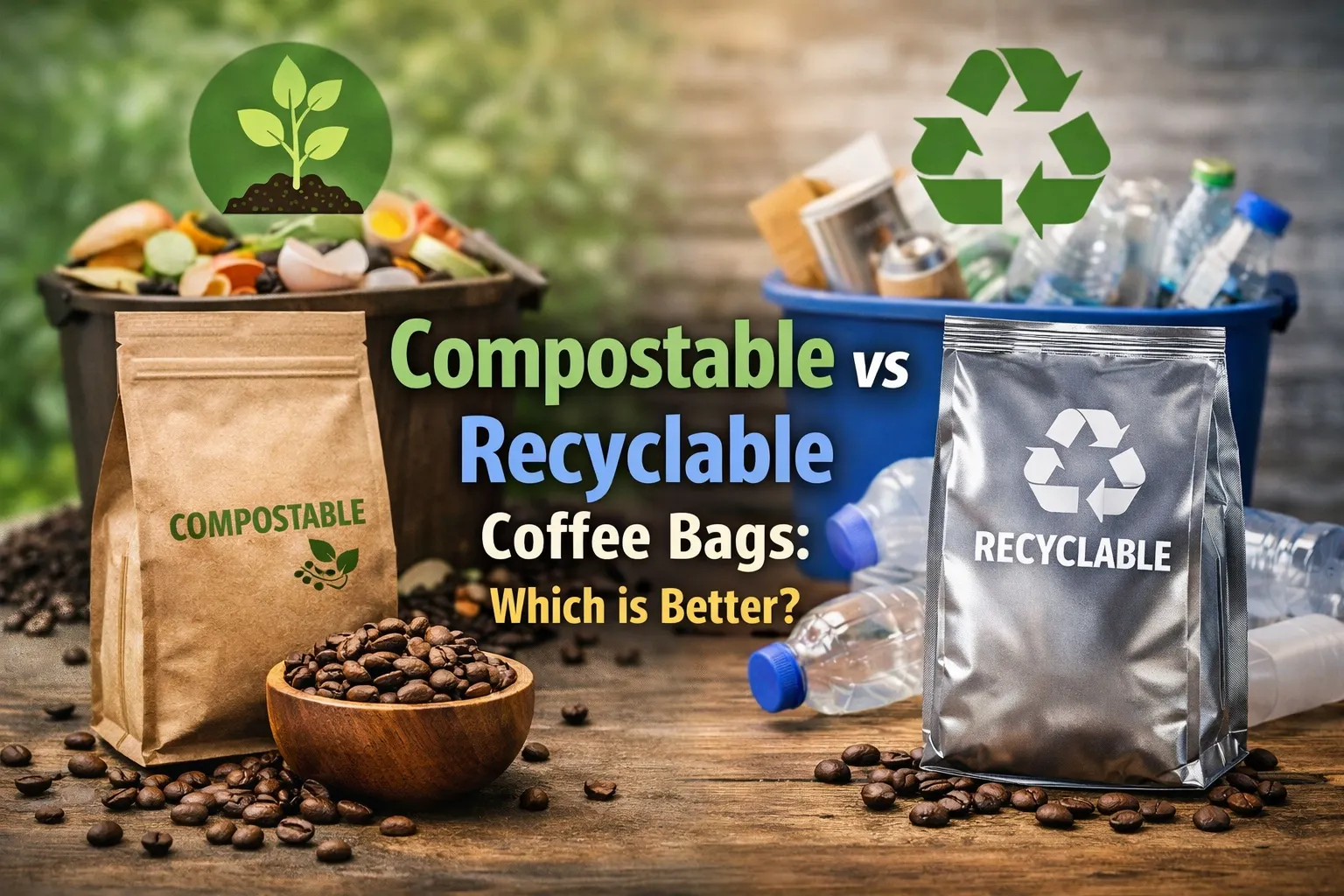
The issue of whether coffee bags can be composted or recycled became one of the greatest questions of the coffee industry today.
The two packaging solutions will help in minimizing environmental impact, though they operate in a very different manner. Knowing the benefits and drawbacks of every alternative may assist coffee brands to be smarter in their decisions and address sustainability expectations.
We discuss the main distinction between compostable and recyclable coffee bags, the effect they have on the environment, and where you can find the best solution to your coffee business in this guide.
The Rationale of Sustainable Coffee Packaging.
Coffee bags are normally constructed of plastic, foil, and paper in multi-layers. These materials are a great barrier to oxygen, moisture and light that will keep coffee fresh. But these are very hard to recycle since they are hardly separable in most of the recycling plants.
Consequently, this has led to the situation where most traditional coffee bags are disposed of in landfills and may take decades or even centuries to deteriorate.
Meanwhile, environmentally responsible packaging is being demanded more by the consumers. It has been demonstrated that over 60 percent of coffee consumers are willing to buy products with environmentally friendly packaging, and younger generations, who are more likely to be consumers of sustainable brands, represent the biggest target audience.
This has caused coffee companies to seek alternative like compostable and recyclable packaging.
What Do Compostable Coffee Bags Mean?
Plant-based or biodegradable materials are used to create compostable coffee bags that can decompose in the composting space. The most popular ones are polylactic acid (PLA), starch blends, kraft paper, and cellulose films made of renewable sources such as corn or sugarcane.
When such materials are put under the right condition of composting, they break down to form water, carbon dioxide, and organic materials which can be utilized in soil enrichment.
Advantages of Compostable Coffee Bags.
1. Reduced Plastic Waste
Compostable bags are used to decrease the use of fossil fuel-based plastics. They are less harmful in the long-term plastic contamination since they are normally made using renewable plant materials.
2. Soil Enrichment
Compared to traditional plastics, compostable packaging can be broken down into organic material that can be used to enhance the quality of soil and promote healthier ecosystems.
3. Lower Environmental Impact
Plant-based materials tend to be relatively less carbon-intensive compared to petroleum-based plastics, which allow brands to overall decrease emissions.
4. Sustainable Packing Innovation.
The current technological advancements have enhanced the use of compostable coffee bags. Most of the designs nowadays have compostable valves, zippers, and high barrier layers which do not interfere with the sustainability but keep coffee fresh.
Arguments of Compostable Packaging.
Compostable bags have their disadvantages in spite of their advantageous nature.
Lack of Composting Facilities.
Compostable packaging normally needs high heat and moisture-based industrial composting plants to decompose. Cases where such facilities are lacking mean that compostable bags are likely to be discarded in landfills where the process of their decomposition is far much slower.
Consumer Confusion
These consumers lack the knowledge of the proper disposal of compostable packaging. When compostable materials are put in recycling containers, they may get into the recycling stream and pollute it.
Which Coffee Bags Can be recycled?
Coffee bags that are recycled are made to be recycled using the available recycling machines once they are used. These bags are typically mono-material i.e. polyethylene (PE) or polypropylene (PP) which can be melted and reused to be used as new products.
Contrary to compostable packaging, recyclable packaging cannot decompose naturally. They are instead recycled into mechanical or chemical recycling in their new packaging or plastic products.
The Advantages of Recyclable Coffee Bags.
1. There is the current Recycling Infrastructure.
Recyclable packaging has one of the greatest benefits of being compatible with the existing waste management systems. A significant number of communities already have recycling programs in which some plastics or paper packages are accepted.
2. Energy Savings
Recycling materials may need fewer energy inputs as compared to the energy input in the production of raw materials. This assists in the conservation of natural resources and emission of greenhouse gases is minimized.
3. Strong Barrier Protection
Coffee bags made of recyclable material can give a great shield against moisture and oxygen that will give coffee beans their freshness and aroma over an extended duration.
4. Circular Economy Potential
Recycles into a package is used again, and recyclable packaging helps the world to have a circular economy where resources are not wasted as they can be used again.
Problems with Recyclable Packaging.
Multi-Layer Material Issues
Several coffee bags continue using more than one material like foil, plastic, and paper. These mixes are not easy to separate and this lowers the chances of the packaging to be recycled.
Improper Disposal
Recyclable materials are also capable of polluting the environment, in case they are not properly disposed. Disposing recyclable packaging material to landfills or littering cannot ensure its sustainability value.
Recyclable vs. Compostable Coffee Bags: Major Differences.
Characteristic Compostable Coffee Bags Recyclable Coffee Bags.
· The end-of-life process Decompose into organic material Reprocessed into new materials
· Materials Plant-based polymers, PLA, paper, PE or PP or recyclable laminates.
· The infrastructure required Industrial or domestic composting Recycling plants.
· Environmental benefit Less plastic waste and a more enriched soil Less use of resources by reuse.
· Hurdle of the main priority Little access to composting Recycling contamination and sorting.
Both alternatives are sustainable but the quality of the local waste management systems and consumer behaviour would dictate how effective each of the two alternatives would be.
What Coffee Packaging Solution Is More Sustainable?
There is no universal answer. The most sustainable solution is based on a number of factors:
Local Infrastructure
Recyclable coffee bags might be the more feasible option in case the area has a high recycling culture and few composting sites.
Consumer Behavior
The sustainability of packaging can only be done when the consumers properly dispose of the packaging. It is necessary to educate the customers on recycling or composting measures.
Product Protection
Freshness of coffee is also a sustainability aspect. When packaging is ineffective in safeguarding the product and coffee becomes stale, the environmental cost of wasted coffee can be even more than the cost of packaging.
Brand Sustainability Goals
There are those brands that work towards zero-waste systems and others that specialize in the circular economy model that focuses on recycling and recovery of materials.
The Future of Stylish Coffee Packaging.
Sustainable packaging is also a current innovation in the coffee industry. Emerging solutions include:
· Completely biodegradable bags containing biodegradable valves and zippers.
· Mono-material recyclable laminates of better barrier properties.
· Renewable cellulose bio-based films.
· Recyclable and compostable hybrid packaging.
Due to the development of technology, the boundary between compostable and recyclable packaging can be shifted and, therefore, solutions that would provide the advantages of both can be found.
Final Thoughts
The compostable vs. recyclable coffee bag debate is representative of a larger issue with sustainable packaging: achieving a balance between environmental conservation, infrastructure constraints and product safety.
Compostable bags can also be potentially used as a solution to lessening plastic waste and promoting the organic waste system. On the other hand, recyclable bags are easier to combined with the current recycling facilities and contribute to reusing materials in a circular format.
Finally, the most viable option is conditioned by the local waste systems, consumer behavior, and conscientious packaging design. The coffee industry is able to get nearer to having sustainable packaging solutions by innovating and training the consumers.

Written by
ypak.coffee
ypak
YPAK PACKAGING GROUP was established in 2011 and formed with 3 companies based on Hongkong, Dongguan and Foshan. We have become one of the largest coffee bag manufacturers in China. We use the best quality WIPF valves from Switzerland to keep your coffee fresh.
Conform to the plastic ban policy imposed to many different countries, we have researched and developed the sustainable packaging bags, such as RECYCLABLE and COMPOSTABLE pouches.
No minimum quantity, no color plates are required with our HP 25K INDIGO DIGITAL PRINTING service.
You are welcome to visit YPAK.
Related Articles
Two Gates on the Road to the EU: Reduction by Design and the Documentation Chain for Coffee Packaging

Recyclable Coffee Bags: How to Protect Freshness Without Compromising Sustainability

Your Brand, Perfectly Packaged: The YPAK Guide to Selecting a High-Quality Custom Coffee Bag