

Updated 2 weeks ago
PPWR Questions Holding Up Your Packaging Plans? Bring Them to YPAK at SCAJ 2026
ypak.coffee
YPAK PACKAGING GROUP was established in 2011 and formed with 3 companies based on Hongkong, Dongguan and Foshan. We have become one of the largest coffee bag manufacturers in China. We use the best quality WIPF valves from Switzerland to keep your coffee fresh.
Conform to the plastic ban policy imposed to many different countries, we have researched and developed the sustainable packaging bags, such as RECYCLABLE and COMPOSTABLE pouches.
No minimum quantity, no color plates are required with our HP 25K INDIGO DIGITAL PRINTING service.
You are welcome to visit YPAK.

SCAJ 2026 Coffee Packaging exhibition invitation from YPAK
YPAK will be at SCAJ 2026 in Tokyo — Booth 1704, South Halls, Tokyo Big Sight, 14–16 October. We are there for one reason: to work through the packaging questions currently holding decisions up, from recyclable structures and recycled content to freshness protection and sealing reliability. Bring your current pouch and your most awkward question.
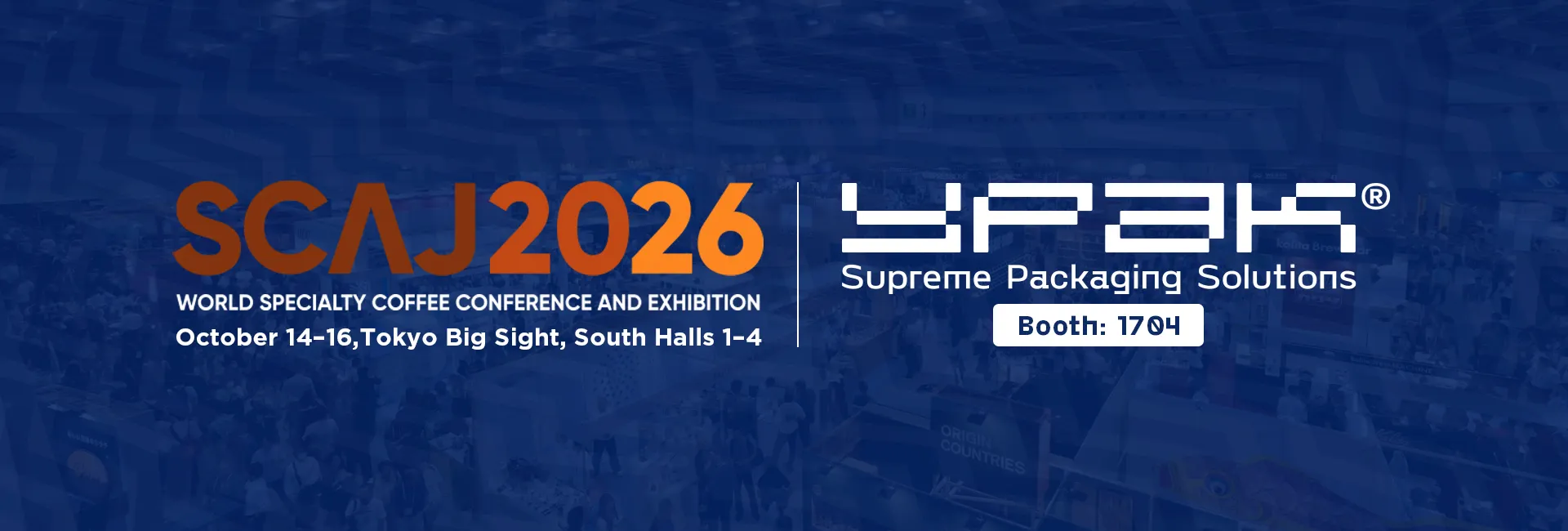
Meet us at SCAJ 2026, Tokyo
SCAJ is the largest specialty coffee event in Asia, with around 500 exhibitors and some 95,000 visitors expected this year. It is one of the few places where a roaster, a packer and a materials supplier can sit at the same table.
The stand runs as an open table rather than a presentation schedule. Walk up with a pouch, a specification or an artwork file and we will go through it with you there and then.
The essentials
Taken from the organiser official information — worth re-checking against the official site before you travel.
| Item | Details |
| Event | SCAJ World Specialty Coffee Conference and Exhibition 2026 (SCAJ2026) |
| Organiser | Specialty Coffee Association of Japan (SCAJ) |
| Theme | Brew the future |
| Dates | 14–16 October 2026 (Wednesday to Friday) |
| Opening hours | 10:00–17:00; last day until 16:00 |
| Venue | Tokyo Big Sight, South Halls 1–4, 3-11-1 Ariake, Koto-ku, Tokyo |
| YPAK booth | Booth 1704, South Halls |
| Admission | Pre-registration JPY 2,000 / on-site JPY 3,000 (incl. tax), valid across the show; free of charge with an invitation |
| Pre-registration | Required for every visitor, including invitation holders — official form: https://www.tenjikai-uketsuke.com/form/scaj2026/ |
| Exhibitor list and floor map | https://scajconference.jp/visitor/exhibitors |
| Organiser estimate | Around 500 exhibitors / 750 booths; around 95,000 visitors; exhibitors from 35 countries and regions |
Print your admission badge before you travel, or have it ready on your phone, and allow extra time at the entrance on the first morning.
Four questions we hear most from coffee brands
Recyclable materials: what actually recycles where you sell
Recyclability is a local question, not a universal one: a structure that flows through one country collection stream can be rejected by the next. We will look at the specific materials in your current pouch — film layers, coatings, closures, valves — explain what each does to the end-of-life route, and set out what a move to mono-material would change in barrier terms.
PCR options: recycled content you can trace
Recycled content is a purchasing criterion now, and increasingly an evidence question. We will walk through where post-consumer material can sit in a coffee packaging structure, what it does to appearance, stiffness and food-contact requirements, and how the chain of custody behind a recycled-content claim is documented so that the claim survives its own audit.
Freshness protection: barrier, valves and shelf life
Roasted coffee is one of the harder products to pack: it degasses, it oxidises, and it is highly sensitive to moisture. We will go through how barrier targets are set for your format, how the degassing valve interacts with the film structure, and where the trade-offs sit between a longer shelf life and a simpler, more recyclable construction.
Reliable sealing: the failure that costs the most
Seal failure almost never shows up as a complaint about the seal. It shows up as a consumer saying the coffee was flat. We will look at the seal window for your structure, the fill conditions that affect it, and the checks that catch a problem before a pallet leaves the factory.
PPWR: bring the specific question, not the general worry
If you sell coffee into the European Union — or plan to — the rulebook has changed. The Packaging and Packaging Waste Regulation has applied since 12 August 2026, and the PFAS limits for food-contact packaging took effect the same day.
Most of the uncertainty is not whether the rules exist, but which rule applies to which piece of packaging. Two examples catch people out.
- Empty space. The 50% maximum empty space ratio applies to grouped, transport and e-commerce packaging from 1 January 2030, or three years after the implementing acts setting the calculation method, whichever is later. Sales packaging — the retail coffee bag itself — is treated separately: from 12 February 2028 its empty space must be reduced to the minimum necessary for functionality, and no fixed percentage is set for it.
- Labelling. The harmonised label showing the material composition of the packaging applies from 12 August 2028, or 24 months after the relevant implementing acts enter into force, whichever is later. A standardised digital marking is required for packaging containing substances of concern, and a QR code may be added to carry sorting information. This is an artwork question long before it is a compliance question.
Bring your market list and your current specification. We are not your legal advisers, but we can tell you exactly what your packaging is made of, and what each material choice implies for the obligations you are asking about.
What to bring
One item is enough to start. Bring whatever of the following you have.
| Bring with you | What we will do with it |
| A current pouch or film sample | Open it, read the structure layer by layer, and map it against the recycling, barrier and sealing options available to you |
| Your film structure specification | Identify where layers, coating or thickness can come out without losing shelf life — and where they cannot |
| Artwork or dieline file | Mark where the 2028 identification and digital carrier space can be reserved in the same revision |
| Your target market list | Flag the recycling, labelling and producer-responsibility points that differ between them |
| Volume and format plan | Give a realistic view of what is feasible in your format, and what it does to unit cost |
| Your freshness target | Set barrier and valve requirements against a number — shelf-life months, opening type — instead of a preference |
One supplier, every touchpoint
YPAK produces the full set a coffee brand needs: valve and flat bottom coffee bags, side gusset pouches, drip bags and hanging ear bags, filter paper, folding cartons and rigid gift boxes, and drinking cups. Production is certified to BRCGS and ISO 22000.
On materials we work with PFAS-free coating, water-based and PLA lamination, mono-material structures with high-barrier coating for recyclability, and post-consumer recycled content supported by certified chain-of-custody documentation.
The benefit of buying the set from one place is not the price list. It is that the bag, the carton, the drip bag and the cup share one specification logic and one artwork approval cycle — which matters more when labelling rules are moving.
Let us work it through in Tokyo
So what is the packaging question you have been putting off? Freshness that does not hold, a structure that will not recycle where you sell, artwork that has to be redone next year, a seal that behaves differently in winter — most of these are cheaper to fix before the next print run than after it.
If you would like us to prepare in advance, send a short note with your market and your current specification and we will have the relevant samples and figures ready on the stand. Booth 1704, 14–16 October — or reach us any time at.
Two things worth knowing before you travel
We do not sell into the EU. Is the stand still relevant to us?
Yes. Recyclable structures, recycled content, freshness protection and sealing reliability are commercial questions in every market. The PPWR discussion is one part of what we can cover, not the whole of it.
What if I only have a few minutes?
One sample and one question is enough. Most of the useful conversations at a show start exactly that way and then run longer than planned.
Event information and source note
Event dates, opening hours, venue, admission fees and the pre-registration requirement are taken from the organiser official information published by the Specialty Coffee Association of Japan. YPAK booth details are our own. This page is YPAK invitation content and not an official SCAJ publication — confirm the details at https://scajconference.jp/ before travelling.
1. Where can I meet YPAK at SCAJ 2026?
You can meet YPAK at Booth 1704 in the South Halls of Tokyo Big Sight, Japan, from October 14 to 16, 2026. Our team will be available to discuss coffee packaging solutions, sustainable materials, and custom packaging requirements.
2. What coffee packaging solutions will YPAK discuss at SCAJ 2026?
YPAK will discuss recyclable coffee bags, PCR packaging materials, high-barrier films, degassing valves, and custom coffee packaging. Visitors can explore solutions suited to their products, target markets, and freshness requirements.
3. Can YPAK help coffee brands understand PPWR packaging requirements?
Yes. YPAK can help coffee brands review packaging materials, recyclability, recycled content, and design considerations related to EU PPWR requirements. Our team provides practical packaging guidance rather than formal legal advice.
4. What should I bring to discuss custom coffee packaging at SCAJ 2026?
You can bring existing coffee bags, packaging samples, artwork files, or material specifications. Sharing your target markets, packaging quantities, and shelf-life requirements will help our team recommend suitable options.
5. Do I need an appointment to discuss coffee packaging with YPAK?
No appointment is required to visit YPAK's booth. However, contacting our team before SCAJ 2026 can help us prepare relevant packaging samples and technical information for your discussion. Visitors must still follow the exhibition's registration requirements.
Written by
ypak.coffee
ypak
YPAK PACKAGING GROUP was established in 2011 and formed with 3 companies based on Hongkong, Dongguan and Foshan. We have become one of the largest coffee bag manufacturers in China. We use the best quality WIPF valves from Switzerland to keep your coffee fresh.
Conform to the plastic ban policy imposed to many different countries, we have researched and developed the sustainable packaging bags, such as RECYCLABLE and COMPOSTABLE pouches.
No minimum quantity, no color plates are required with our HP 25K INDIGO DIGITAL PRINTING service.
You are welcome to visit YPAK.
Related Articles

Alpine Roasting Championship 2026: Mariya Manerkina Wins the First Edition

YPAK × Giesen: Co-Branded Packaging at the Alpine Roasting Championship 2026
PPWR Questions Holding Up Your Packaging Plans? Bring Them to YPAK at SCAJ 2026