

Updated 6 months ago
How to Measure Box Dimensions for Packaging, Shipping & E‑Commerce Success
ypak.coffee
Coffee Box Dimensions.jpg
When you are drawing up the products to sell, delivering the products to customers overseas, or creating personalized packaging that satisfy the clients, it is important to know how to accurately measure the size of the box. The size of the box influences not only the degree of product protection, material prices, and dimensional weight prices but consumer perception as well. The following is a detailed guide on the steps to follow in order to measure the dimensions of a box, the reasons why it is important, and how size information can be utilized to achieve better packaging and minimize the total expenses.
📏 What Are Box Dimensions and Why They Matter
The three primary dimensions of a box are:
-
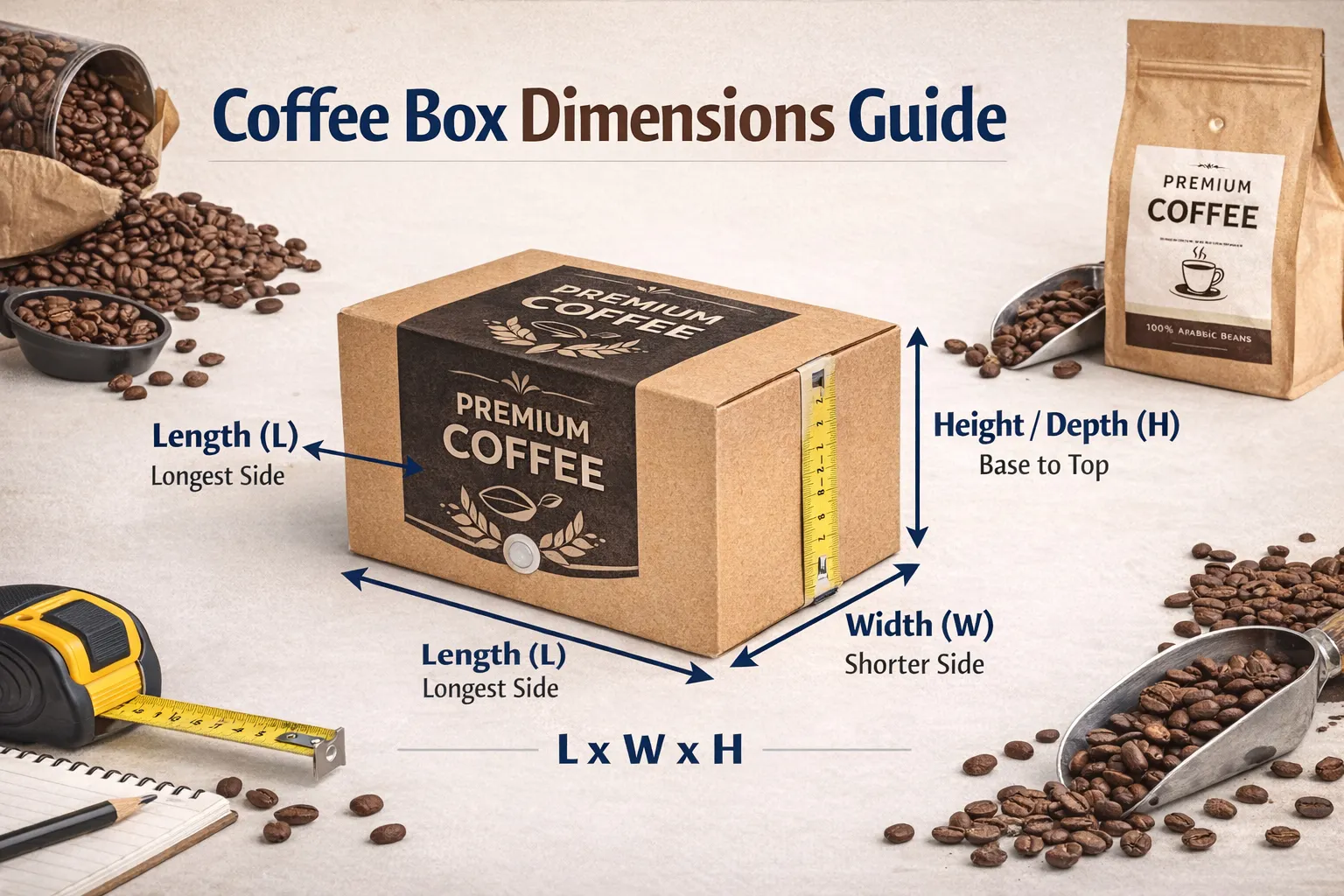
Length (L) – The longest side of the box when looking across its opening.
-
Width (W) – The shorter side across the opening.
-
Height / Depth (H / D) – The vertical distance from base to top.
These three dimensions define the internal space of a box — the space that literally holds your product — and they are typically written in the order L x W x H or L x W x D. Accurate measurements ensure your product fits snugly, minimizing movement inside the box while optimizing material use.
📌 Internal vs. External Measurements
Internal dimensions, not external, are important in the design or order of custom packaging. Internal measurements take into account the actual space that can be used within the box and is crucial in the fit of the products, inserts, padding or protection materials. External dimensions: such as material thickness (corrugated board) can give you a false impression when taken to measure a product or a shipment size.
📍 How to Measure Your Box Step‑by‑Step
Accurate box measurement isn’t complicated — but it does require a methodical approach. Here’s how to measure box dimensions reliably:
1. Prepare Your Tools
Most measurement tasks require only basic tools:
-
A tape measure (flexible for longer distances).
-
A ruler (for smaller boxes).
-
A flat surface to stabilize the box.
-
Clear labeling materials to record data.
2. Measure Length
Place the tape measure horizontally across the longest side of the box opening. This is your length — the first number in the standard box dimension format. Make sure the measuring tool is flat and level for accuracy.
3. Measure Width
Measure the shorter side across the box opening, keeping the tape straight and flush with the box edges. This is your width.
4. Measure Height (Depth)
Stand the box upright and measure from the bottom interior up to the top edge. This is the height (sometimes called depth).
5. Record and Repeat
Always measure twice to confirm accuracy. If your product or box has irregular shapes or protrusions, measure at the widest or tallest point. Use the same units (inches or centimeters) consistently.
📦 Calculating Volume and Dimensional Weight
Once you have length, width, and height, you can determine the volume of the box:
Volume = Length × Width × Height
This provides the cubic capacity of the box. Volume plays a critical role in shipping costs, especially with carriers that use dimensional (DIM) weight pricing — where charges are based not just on physical weight but on the space a package occupies in transport.
📊 What Is Dimensional Weight?
Dimensional weight (also called volumetric weight) is a theoretical weight based on package size rather than actual weight. Carriers like DHL, FedEx, and UPS may bill based on the greater of actual or dimensional weight, calculated using the box’s L x W x H dimensions. This means large, lightweight boxes could cost more to ship than smaller, heavier ones.
🚛 Why Accurate Box Dimensions Matter for Shipping & E‑Commerce
1. Lower Shipping Costs
Correct sizing helps avoid unnecessary dimensional weight charges and reduces wasted space in pallets or containers — a critical consideration for businesses shipping globally.
2. Better Product Protection
Snug packaging reduces product shifting, lowering breakage during transit. Too much empty space increases the risk of damage and may require additional filler materials — increasing cost and waste.
3. Enhanced Customer Experience
A perfectly sized package offers a premium unboxing experience, strengthening brand perception and customer satisfaction — especially important in e‑commerce.
4. Material Optimization
Smaller, precise boxes use less material, which can lower production costs and reduce environmental impact — aligning with sustainability goals.
✨ Tips for Packaging Optimization
👉 Minimize Empty Space: Choose the tightest fit that still allows safe packing and unpacking.
👉 Consider Inserts: Protective inserts can improve product safety without increasing box size drastically.
👉 Standardize Sizes: For high‑volume products, standard box sizes help streamline warehousing and reduce complexity.
👉 Test Fit Before Production: Always prototype and test fit products before bulk box ordering.
🧠 Wrap Up: Mastering Box Measurement for Business Growth
One of the most straightforward and most effective processes of packaging and logistics is the measurement of box sizes. Accurate box sizing forms the basis of business success, whether it is lowering the cost of shipping and product security, improving brand experience and achieving sustainability objectives.
Adhering to the described steps, including knowing the difference between internal and external measurements, applying the appropriate tools, finding the volume of the assigned tasks and dimensional weight, and making a package fit perfectly, you will reduce wastage and enhance the efficiency of your work and improve the strategy towards packing.
Having difficulties with designing or selecting the most appropriate packaging? As a suggestion, you may want to speak with professionals in packaging to make sure that your boxes are constructed to impress, and to make sure that they perform in the real world.
Related Articles

2030 PCR Mandate: Why Your Brand’s Supply Chain Integrity Must Be Audit-Proof by August 12
The 1% Risk: Is Your Degassing Valve a Compliance Time Bomb?

Raúl Rodas (2012 World Barista Champion)—When Specialty Coffee Began Listening to Origin