


Updated 4 天 ago
Inside the Championship: How Alexander Ruas Won the 2014 Sweden Brewers Cup
ypak.coffee

The Stage – Where Brewing Becomes Precision
The Sweden Brewers Cup is one of the most technically demanding coffee competitions in Scandinavia.
Unlike espresso-based contests,
this stage is stripped down.
No machines.
No pressure systems.
Just:
- Water
- Coffee
- Control
By the mid-2010s, something had changed.
Competitors were no longer limited by access to quality beans.
In fact, many had already begun using world-class competition coffees — including Geisha.
The game was no longer about who had the rarest coffee.
It was about something far more difficult:
Who could express it best.And that’s where Alexander Ruas found his advantage.
The Competition – Control Without Machines
Brewers Cup leaves no room to hide.
Every variable is exposed:
- Pouring technique
- Water distribution
- Extraction timing
- Temperature control
In 2014, many competitors leaned into the new reality:
Access to exceptional coffees.
Geisha, in particular, had already become a symbol of top-tier competition beans —
known for its floral intensity and complexity.
But this also created a new challenge.
When everyone has great coffee…
great coffee is no longer enough.
Alexander Ruas approached the competition differently.
Instead of relying on the prestige of the bean,
he focused on something deeper:
how the coffee is understood and delivered.
The Winning Edge – Beyond the Bean
Winning at this level isn’t about choosing the best coffee.
It’s about revealing its full potential.
1. Extraction as a System
Ruas built his brewing approach around one idea:
Consistency above all.
Using methods that mimicked cupping-style immersion,
he ensured:
- Even saturation
- Stable extraction
- Predictable results
Every cup behaved the same —
and that’s what judges trust.
2. Clarity Over Complexity
While Geisha coffees were often celebrated for their intensity,
Ruas took a different route.
He refined the cup.
The result was:
- Layered floral notes
- Clean fruit expression
- Structured sweetness
Not overwhelming —
but understandable.
3. Mastery Without Dependence
This is what truly set him apart.
In a competition where many relied on the prestige of rare beans,
Ruas demonstrated something more powerful:
Control can outperform rarity.
He showed that even without leaning entirely on Geisha,
a barista could still deliver a championship-level experience.
Beyond the Stage – The Role Behind Standout Coffee
After his championship,
Alexander Ruas became a key partner in Standout Coffee.
Behind every great coffee brand,
there is often someone responsible for consistency and control.
That’s his role.
Not just creating ideas —
but making sure those ideas work, every time.
The philosophy is clear:
- Understand the coffee
- Control the variables
- Deliver clarity in every cup
The same principles that won him the competition
now define the brand.
What This Means for Coffee Brands Today
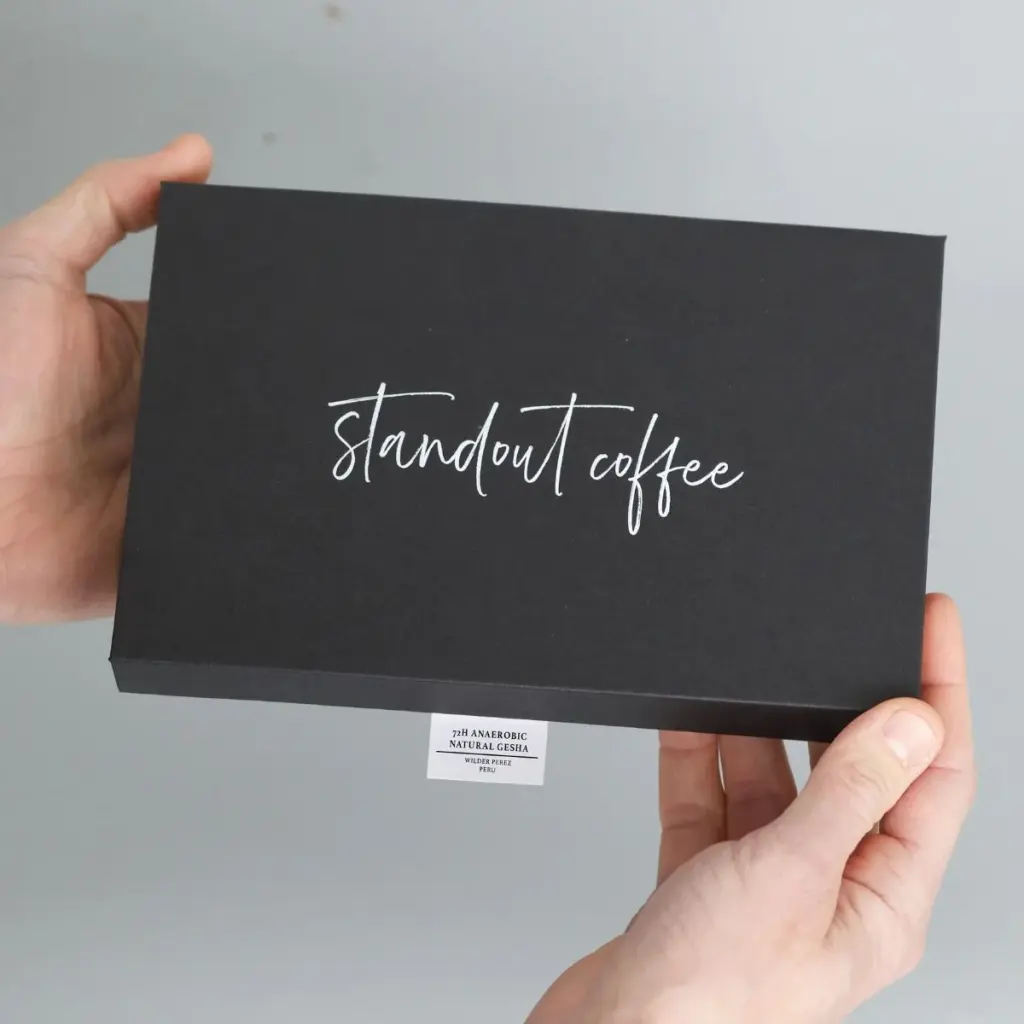
The rise of Geisha in competitions signaled something important:
The industry had reached a new level of raw material.
But that only raised the standard.
Because once great coffee becomes accessible,
the difference shifts elsewhere.
To:
- Extraction
- Presentation
- Experience
For coffee brands, this creates a critical question:
If your coffee is already good — what makes it consistent?
Because outside the competition stage:
- Brewing is less controlled
- Storage varies
- Customer experience is unpredictable
That’s where systems matter.
And that includes:
- Roast stability
- Freshness protection
- Packaging performance
Great coffee is no longer just selected.
It must be protected and delivered correctly.
The Missing Piece in Coffee Consistency – Beyond Brewing
At the competition level, consistency is engineered.
Every variable — from water composition to extraction — is carefully controlled.
But in real-world coffee businesses, that level of control becomes much harder to maintain.
Because once coffee leaves the roastery, it enters an unpredictable environment:
Oxygen exposure
Humidity changes
Transportation conditions
Storage inconsistencies
This is where an often overlooked factor becomes critical: packaging as a control system.
At YPAK, packaging is not treated as a final step — but as part of the coffee workflow itself.
As a specialized coffee packaging manufacturer, YPAK focuses on:
High-barrier material structures to preserve aroma and flavor
Degassing valve systems that protect freshness after roasting
Stable sealing performance for consistent storage across markets
These are not just features.
They are extensions of the same principle that wins competitions:
control and consistency.
That’s why many specialty coffee brands — especially those operating at a high level —
see packaging not as an accessory, but as part of the system that delivers the final cup.
Final Thoughts – When Great Coffee Isn’t Enough
Alexander Ruas didn’t win because he had better coffee.
He won because he understood it better.
In a time when competitions were entering the era of
top-tier beans like Geisha,
he proved something deeper:The future of coffee isn’t just about better beans —
it’s about better control.
A Question for Coffee Brands
If your coffee is already high quality…what ensures it stays that way?