

The Stage – When Brewing Became a Science
In the early years of specialty coffee competitions, brewing was often viewed as an extension of barista skills.
Competitors focused on:
- Coffee selection
- Brewing technique
- Presentation
But in 2012, something changed.
The World Brewers Cup was beginning to evolve into a competition where scientific thinking mattered just as much as craftsmanship.
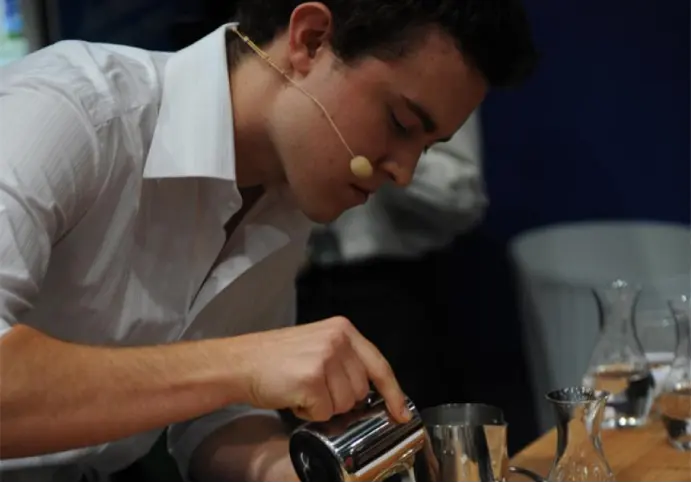
That year, in Vienna, Australia's Matt Perger represented Melbourne's renowned St Ali and won the World Brewers Cup, becoming one of the most influential brewing champions in coffee history.
His victory didn't just earn a trophy.
It helped redefine how the coffee industry thought about extraction, brewing consistency, and data-driven coffee preparation.
The Competition – More Than Just Pouring Water
The World Brewers Cup is one of the most technically demanding competitions in specialty coffee.
Unlike espresso competitions, there is nowhere to hide.
Competitors are judged on:
- Flavor clarity
- Balance
- Aroma
- Extraction quality
- Presentation
Every decision affects the final cup.
In 2012, many competitors were already using exceptional coffees.
But Matt Perger understood something important:
Great coffee alone would not win the championship.
The difference would come from how efficiently that coffee was extracted.
The Winning Coffee – A Geisha Ahead of Its Time
One of the most significant details of Perger's championship routine was his coffee choice.
He used a washed Geisha from Finca Santa Teresa in Panama, roasted by St Ali.
Today, Geisha coffees are common in competitions.
In 2012, that wasn't yet the case.
The industry was entering what could be called the "Geisha Era" — a period when competitors increasingly began using world-class coffees to push sensory boundaries.
This meant competitors could no longer rely solely on having rare coffee.
Everyone was gaining access to extraordinary coffee.
The challenge became:
Who could extract it best?
And that question became the foundation of Perger's winning routine.
The Winning Edge – Why Matt Perger Changed Coffee Forever
1. Treating Extraction Like a Measurable Variable
Before Perger, many brewing discussions were based largely on intuition.
Perger approached brewing differently.
He focused on measurable extraction performance.
Instead of asking:
"Does this taste good?"
He asked:
"Why does this taste good?"
That shift would later influence countless baristas worldwide.
2. Popularizing Particle Control
One of the most talked-about aspects of his championship routine was the use of a sieve to remove extremely fine coffee particles before brewing.
At the time, this was considered highly unconventional.
His goal was simple:
- Improve extraction consistency
- Reduce bitterness
- Increase clarity
Today, particle distribution and grind uniformity are standard topics in specialty coffee.
In 2012, they were revolutionary.
3. Making Water Part of the Recipe
Perger also highlighted something many competitors overlooked:
Water.
He customized brewing water through filtration and mineral adjustments because he believed water composition directly influenced flavor.
Today, custom brewing water is widely discussed.
Back then, it was still considered advanced competition territory.
His routine helped push the industry toward a more scientific understanding of brewing.
From Champion to Industry Influencer
Many champions are remembered for winning.
Matt Perger is remembered for changing how coffee professionals think.
Following his championship victory, he continued competing at the highest level:
- 3rd place World Barista Championship 2011
- World Brewers Cup Champion 2012
- Runner-up World Barista Championship 2013
- World Coffee in Good Spirits Champion 2014
More importantly, he became one of the industry's most influential educators.
Through Barista Hustle, Perger helped make advanced coffee knowledge more accessible to coffee professionals around the world.
The Legacy of St Ali
At the time of his championship win, Perger represented St Ali, one of Australia's most influential specialty coffee companies.
St Ali was already known for challenging traditional coffee thinking.
The company's culture encouraged experimentation, curiosity, and innovation.
In many ways, Perger's championship routine reflected those same values:
- Question assumptions
- Test everything
- Improve continuously
That mindset helped shape modern specialty coffee.
What This Means for Coffee Brands Today
More than a decade later, many of Perger's ideas have become industry standards.
Today's coffee professionals routinely discuss:
- Extraction yield
- Water chemistry
- Grind uniformity
- Particle distribution
In 2012, those conversations were still emerging.
His championship reminds us of an important lesson:
Innovation rarely comes from doing more.
It comes from understanding more.
The brands and professionals who continue pushing coffee forward are often the ones willing to challenge accepted practices and explore new possibilities.
Final Thoughts – The Champion Who Made Coffee More Scientific
Matt Perger didn't simply win the 2012 World Brewers Cup.
He helped transform how the industry approaches brewing.
By combining:
- Exceptional coffee
- Scientific thinking
- Measurable consistency
- Relentless curiosity
He demonstrated that great brewing is not just an art.
It is also a science.
And more than a decade later, the ripple effects of that idea can still be found in cafés, roasteries, and competitions around the world.
A Question for Coffee Professionals
If better coffee comes from better understanding...What part of your brewing process are you still taking for granted?