

Updated 4 weeks ago
How to Choose the Right Custom Coffee Bags for Your Brand: A Complete Guide
zainbaexiu

Custom Coffee Bags
Choosing the right custom coffee bags isn't just a packaging decision — it's a branding decision that affects shelf appeal, product freshness, and customer trust. Whether you're a new roaster launching your first product line or an established brand switching suppliers, picking the wrong coffee bag can lead to stale beans, wasted inventory, and packaging that fails to stand out on a crowded shelf.
At YPAK, we've been manufacturing flexible coffee packaging since 2011, working with roasters, distributors, and private-label brands across more than 20 international markets. This guide walks through everything you need to know before ordering custom coffee packaging bags — materials, formats, closures, printing options, compliance, and how to evaluate a manufacturer — so you can protect your product and strengthen your brand at the same time.
Why Your Coffee Bag Is More Than Just Packaging
Coffee is a perishable product. Oxygen, light, and moisture are its biggest enemies, and the bag you choose is the first line of defense against all three:
- Oxygen oxidizes coffee's aromatic oils, flattening flavor within days of exposure.
- Light, especially UV, accelerates that same oxidation and can degrade coloring inks.
- Moisture causes clumping, mold risk, and loss of the crema-producing gases in fresh-roasted beans.
- Aroma loss happens even without a puncture — some films are simply more permeable to volatile compounds than others, which is why barrier performance comes down to a combination of oxygen transmission rate (OTR), water vapor transmission rate (WVTR), and light-blocking properties, not just the material's name on a spec sheet.
Beyond protection, your packaging also acts as a silent salesperson — often the first physical touchpoint a customer has with your brand, whether on a retail shelf or unboxed at their doorstep. That's why every structure we build is totally customized around the product it's protecting, not pulled from a fixed template.
Types of Custom Coffee Bags to Consider
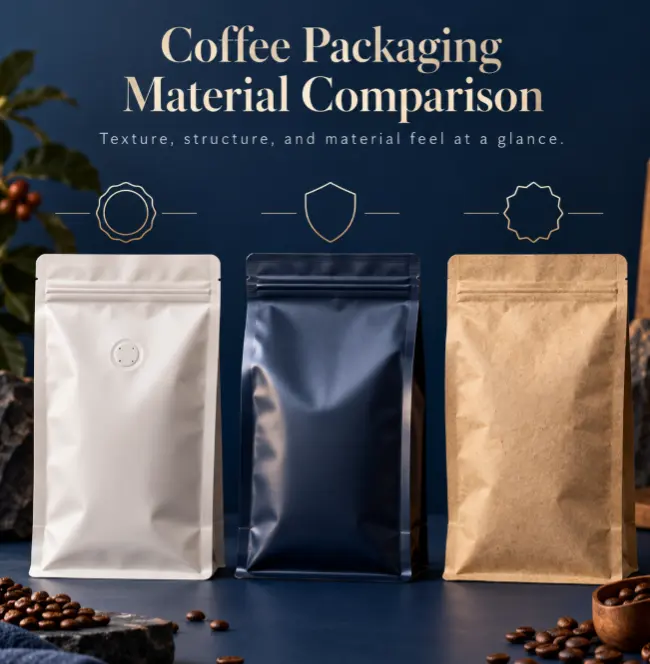
1. Coffee Bag Materials
| Material | Best For | Trade-Off |
| Kraft paper bags | Natural, artisanal branding | Needs an inner foil/PE liner for real barrier protection |
| Foil-lined (aluminum/mylar) bags | Long shelf life, export, maximum freshness | Less "eco" visual appeal on shelf |
| PCR (post-consumer recycled) bags | Sustainability-focused brands needing durability | Slightly higher cost than virgin plastic |
| Compostable bags | Eco-conscious brands and DTC subscriptions | Shorter shelf life and higher cost — certification and disposal requirements vary by material and region |
| Recyclable mono-material bags | Brands preparing for EU recyclability mandates | Barrier still trails traditional multi-layer laminates for very long shelf-life needs |
A detail most buyers overlook: the material named on a spec sheet describes only the visible outer layer. We share the full layer structure with every quote we send, so you know exactly what's between your coffee and the outside air before you commit to a production run.
2. Coffee Bag Formats
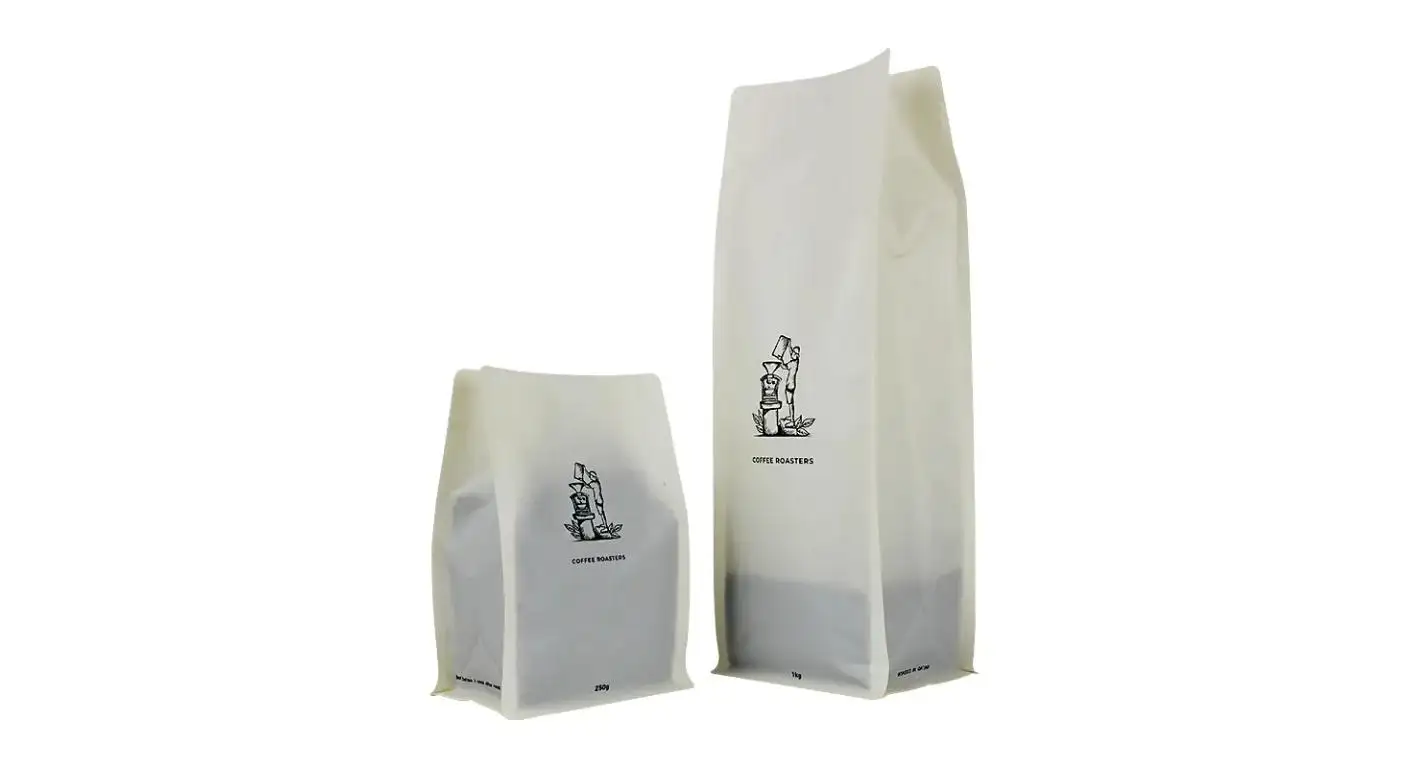
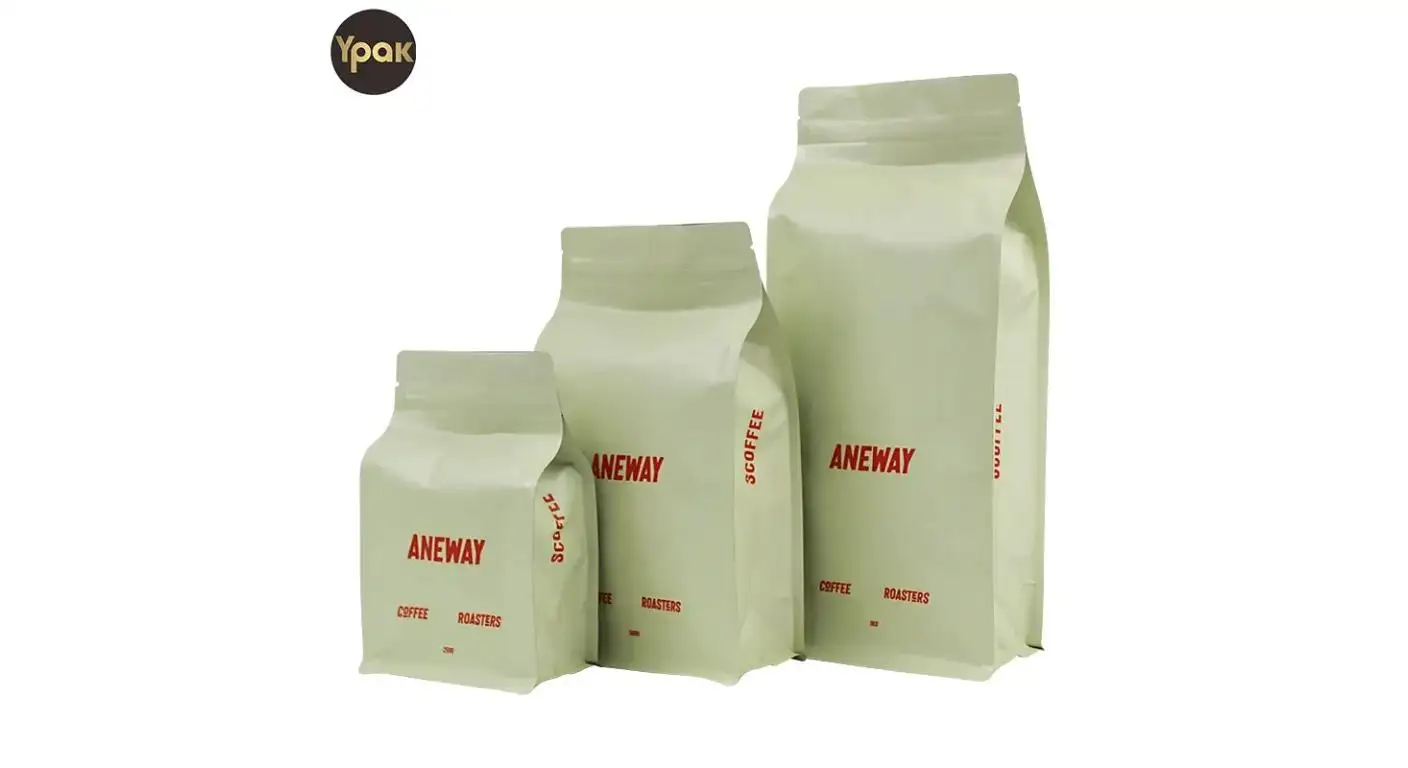
- Flat bottom bags — Stand upright with a wide base, giving strong shelf presence and the most surface area for branding.
- Side gusset bags — A classic coffee bag shape, often paired with a tin-tie closure for a traditional look.
- Stand-up pouches with valve — The most common format for roasted whole bean or ground coffee, letting CO₂ escape without letting oxygen in.
Valve and Closure: What Keeps Coffee Fresh
A one-way degassing valve is essential for freshly roasted coffee. It releases the CO₂ that beans naturally emit after roasting without exposing the coffee to outside air — something that matters more the closer to roast date your bag gets filled. We fit our valve bags with Swiss-made WIPF valves, chosen specifically for consistent, reliable degassing rather than the cheaper generic valves that are more prone to sticking or leaking over a bag's shelf life.
Pair the valve with a resealable zipper or tin-tie so the package stays fresh after opening — something that matters for both retail buyers and repeat customers.
What "Custom" Really Means: Printing and Branding Options
This is where custom coffee packaging bags turn a generic product into a recognizable brand. We offer three printing methods, each suited to a different stage of growth:
- Digital printing — Best for low minimum order quantities, fast turnaround, and multiple SKU variations, with no plate or cylinder setup fees. Ideal for seasonal blends, limited releases, or brands still testing designs.
- Gravure (rotogravure) printing — Best for high-volume orders that need consistent, vivid color across large production runs. Requires cylinder setup, so it's best suited to finalized designs and repeat production.
- Flexo printing — A cost-effective middle option for medium-volume runs.
- Matte, glossy, or soft-touch finishes — Shape how your brand feels in hand, which matters more than most brands initially expect.
If you're a smaller or newer brand, digital printing lets you test designs and flavors without a large upfront commitment. Every custom order also comes with free design support from our in-house team, from concept through final artwork.
Private Label Coffee Bags vs. Fully Custom Packaging
Not every brand needs a fully custom bag from day one. We offer both starting points:
- Stock bags with stickers or hot stamping use an existing bag structure with your logo or label applied. Faster turnaround, lower upfront cost — ideal for startups or brands testing a new market.
- Fully custom coffee bags are built from scratch: your chosen size, material, printing method, and finish. Full brand control, with MOQs kept low so growing brands aren't forced into oversized orders.
Many of our clients start with a stock bag with stickers or a card-slot format to test the market, then move to fully custom production once volume justifies it — you can move between the two without switching suppliers.
How to Choose the Right Coffee Bag Manufacturer
The supplier you choose matters just as much as the bag itself. Here's what to check, and where YPAK stands on each:
- Food safety certifications — Look for BRCGS Food Safety and ISO 22000 certifications, confirming documented material control and traceability for food-contact packaging. Our Dongguan and Foshan production sites are managed to both standards.
- MOQ flexibility — A good manufacturer should offer low-MOQ options, especially with digital printing, so smaller brands aren't forced into oversized orders.
- Design support — Free design assistance saves time and helps you avoid costly artwork errors before production. We provide this on every custom order at no additional cost.
- Material transparency — Ask specifically what layers make up the bag and whether recyclable, PCR, or compostable options are available.
- Sample policy — Always request physical samples before committing to a production run. Our sample policy is built exactly for this, so you can catch color or material surprises, and test the valve and zipper, before scaling up.
- On-time delivery track record — Packaging delays disrupt your filling and shipping schedule. We maintain a 99.5% on-time delivery rate, supported by coordinated artwork review, printing, pouch conversion, inspection, and shipment planning.
Compliance: What the EU PPWR Means for Your Coffee Packaging
If you sell into the EU, packaging compliance is no longer future planning — it's active law. The EU's Packaging and Packaging Waste Regulation, formally Regulation (EU) 2025/40, entered into force on February 11, 2025, and became fully applicable from August 12, 2026. A few points that directly affect coffee packaging:
- From 12 August 2026, all packaging sold in the EU must be accompanied by a Declaration of Conformity (DoC), and single-use tea and coffee bags must meet industrial compostability requirements under the regulation.
- Plastic packaging must contain a minimum level of recycled content, be reduced in weight and volume, and have lower levels of contaminants, with additional restrictions on substances of concern such as PFAS.
- Single-serve coffee capsules and similar beverage units are now explicitly classified as packaging, bringing them under EU collection, recycling, and Extended Producer Responsibility (EPR) systems for the first time.
- The regulation also introduces empty-space (headspace) limits for retail packaging starting in 2028 — protective gas and degassing headspace inside a valve bag do not count as exempt space, so brands need to plan fill ratios accordingly. We cover this in detail in our Article 24 empty-space breakdown.
Practical takeaway: if you're shipping into EU markets, confirm with your manufacturer that your bag's material structure, recycled content, and documentation already meet PPWR requirements — don't rely on packaging that was compliant under the 1994 Packaging Directive it replaces. Our recyclable, compostable, and PCR lines are built with this shift in mind.
Common Mistakes Brands Make When Choosing Coffee Bags
- Skipping the valve on whole bean bags, causing packages to swell or burst from trapped CO₂.
- Choosing based on price alone, without checking barrier performance — leading to stale coffee and returns.
- Not requesting samples, resulting in color or material surprises at delivery.
- Underestimating MOQ requirements, tying up cash in excess inventory for a design that hasn't been market-tested.
- Ignoring regional compliance, especially for brands selling into the EU, where PPWR requirements now apply directly.
Frequently Asked Questions
What is the best material for custom coffee bags?
It depends on your priorities. Foil-lined bags offer the best freshness protection for long shelf life, while kraft paper, recyclable mono-material, and PCR bags suit brands prioritizing a natural look or sustainability — provided the barrier layer underneath is adequate for your roast-to-sale timeline.
Do I need a valve on my coffee bag?
Yes, if you're packaging freshly roasted whole bean or ground coffee. The valve releases built-up CO₂ without letting oxygen back in. We use Swiss-made WIPF valves across our valve bags for consistent long-term performance.
What's the minimum order quantity for custom coffee packaging bags?
This varies by printing method. Digital printing typically allows much lower MOQs than gravure printing, which requires cylinder setup and is only cost-effective at higher volumes. Get in touch for current MOQs by format.
Can I order private label coffee bags before going fully custom?
Yes. Many new brands start with a stock bag with stickers or hot stamping to keep upfront costs low, then move to fully custom coffee bags once sales volume justifies a larger production run.
Does the EU PPWR affect my coffee packaging even if I'm not based in the EU?
Yes, if you sell or ship into EU markets. The regulation applies to packaging placed on the EU market regardless of where it was manufactured, so exporters need PPWR-compliant documentation and materials, not just domestic-market compliance.
Summary
Choosing the right coffee bag comes down to balancing four things: protecting your product, representing your brand, staying within a realistic budget and order volume, and meeting the regulatory requirements of the markets you sell into. Whether you start with a stock bag or invest in fully custom coffee bags from the outset, YPAK's BRCGS and ISO 22000-certified production, free design service, low MOQs, and 99.5% on-time delivery rate are built to get your packaging right the first time.
Related Articles
YPAK at World of Coffee Panama 2026: Coffee Packaging for Short Runs and EU-Bound Lots
PPWR Recyclability Grades for Coffee Packaging: What Survives 2030, and What Survives 2038
Customized Coffee Packaging Solutions: From Product Ideas to Market-Ready Packaging