

Updated 3 months ago
Coffee Paper Box: Guide on buying coffee papers to Specialty Coffee Brands.

ypak.coffee
YPAK PACKAGING GROUP was established in 2011 and formed with 3 companies based on Hongkong, Dongguan and Foshan. We have become one of the largest coffee bag manufacturers in China. We use the best quality WIPF valves from Switzerland to keep your coffee fresh.
Conform to the plastic ban policy imposed to many different countries, we have researched and developed the sustainable packaging bags, such as RECYCLABLE and COMPOSTABLE pouches.
No minimum quantity, no color plates are required with our HP 25K INDIGO DIGITAL PRINTING service.
You are welcome to visit YPAK.

Paper Coffee Packaging
Coffee paper box is bought as a converted structure, as opposed to buying a piece of paper having graphics drawn on it. Its performance is determined by the board, grain, direction, crease design and accuracy of die-cut, glue, coating, finishing, storage and how the finished product is packed.In the case of specialty coffee brands, the paper structure would typically be located externally to a closed pouch, or sachet. It keeps shape, information and presentation and the inner package is usually left with the primary freshness duty. Customers are supposed to then specify the paper component with reference to its real job and not to judge it based on its color or even thickness alone.
Find out the Paper structure.
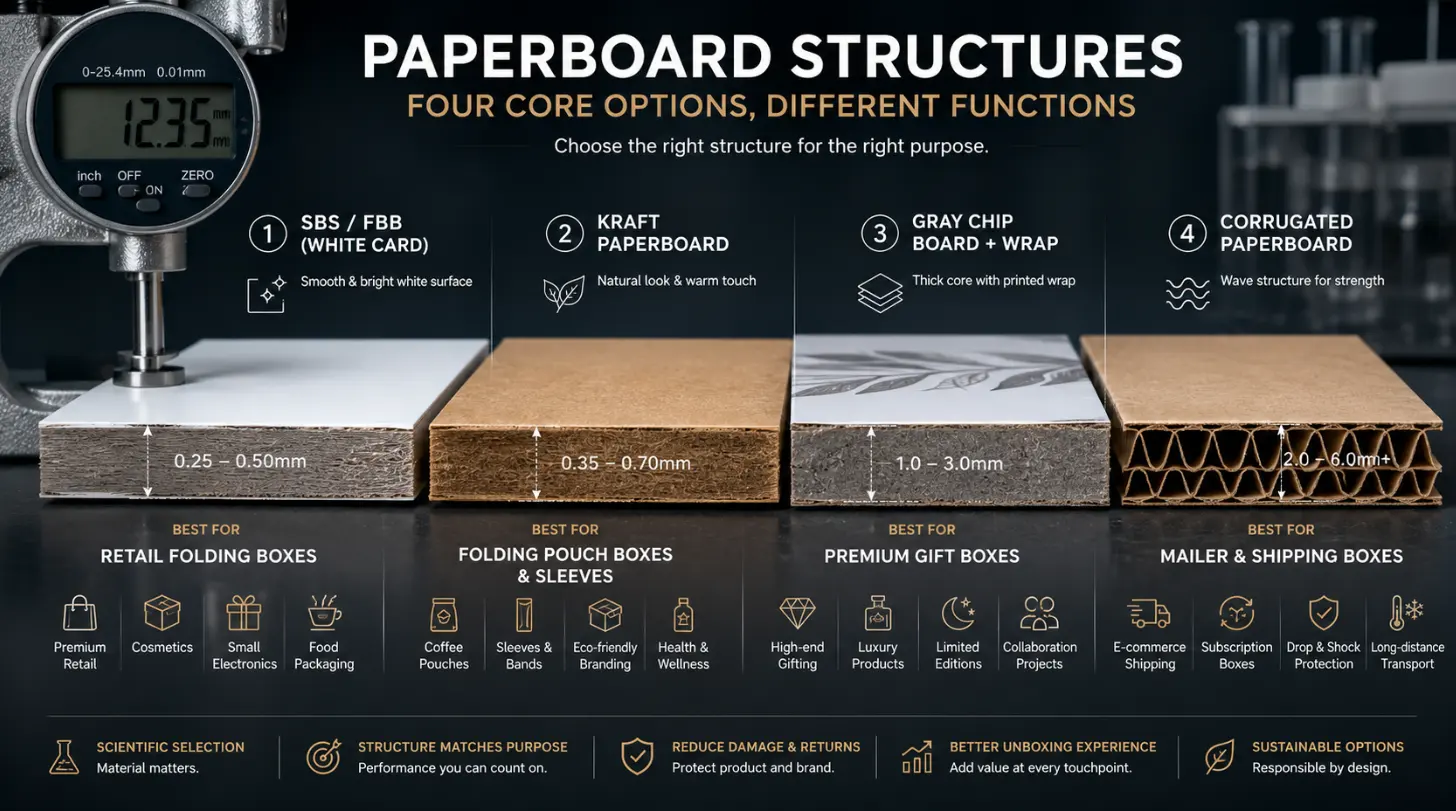
The word paper includes various constructions, which exhibit varying behavior. Request the supplier to give the name of proposed board and why it is best to be used in packed load and sales route.
| Construction | Typical characteristic | Suitable direction |
| Solid bleached board | Clean and unscored smooth white print surface. | Folding retail cartons |
| Kraft board | Natural look, with changing color of the print. | Folding packs and sleeves. |
| Wrapped greyboard | Fat solid core, coated with a printed paper. | Forms of presentation and gifts. |
| Corrugated board | Stiffened middle-layer of compression and cushioning. | Transport-oriented and mailers. |
Folding Board
Folding board is printed, die-cut, creased and glued and packed in a flat state. It is supposed to be able to bend along the desired scores without cracking, delaminating or springing open. Fine text, color and coating are influenced by surface smoothness.
Rigid Board
Rigid formats are made of a thick core and an independent wrap. They are able to develop a large presentation but eat up additional storage and freight space since they usually come preassembled. Important acceptance points include corner wrapping, edge covering, adhesive and dimensional squareness.
Corrugated Board
Fluted medium is made out of corrugated material that uses liners. Flute profile, paper combination, direction and wall construction influence thickness, compression, cushioning and printing. A mailer to be used to deliver a parcel needs to be considered as a packed shipping unit.
Spell Out Performance, not a Colour Name.
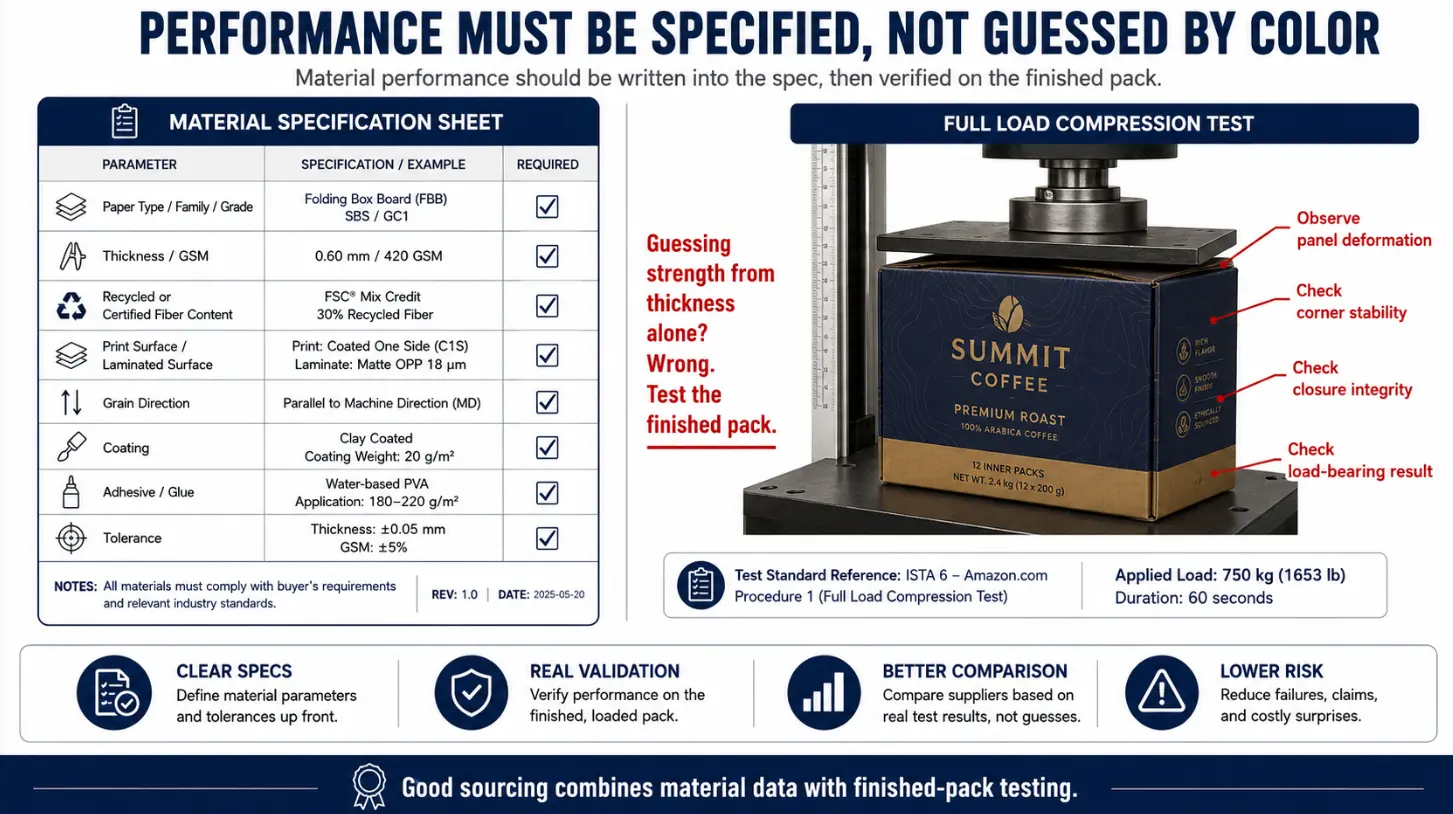
Structural performance is not characterised as white board or kraft board. The purchase specification must consist of both measurable material information as well as evidence on the converted box.
Record Material Details
Ask supplier to state:
- board, family and grade;
- core thickness or basis weight, caliper, or core thickness;
- when claiming, recycled or certified-fiber content;
- printing and covering sides;
- the direction of a grain or a flute;
- coating, lamination over a surface;
- adhesive and wrapped-paper construction when appropriate;
- approved manufacturing tolerance.
Basis weight by itself can never indicate the finished outcome. Similar boards of a comparable weight can vary in thickness, stiffness, water, responsiveness, surface and folding characteristics.
Equal Stiffness to the Load.
The building must be able to withstand bowing, collapsing of panel and collapse of the building under the anticipated product weight. Simultaneously, excessive rigidity may result in a challenging experience to create and bad creases can occur. Evaluate the converted sample with the real contents.
Examine Grain, Creases, Folds.
The connection between paper fibers and direction of the fold influences the appearance and manufacturing.
Confirm Grain Direction
Board usually tends to fold in one direction in a more predictable manner than the other. The grain direction may influence the cracking, spring-back, the stiffness of the sheet of the panel, and nesting. Production yield should not be altered in situations where the supplier will revert the direction this time without permission.
Examine Crease Quality
The crease forms room allowing compressed and dislocated fibers to settle during folding. It should be as wide and deep as the board. Examine the exterior and interior of the fold cracking, whitening, or delamination, uneven line.
Test Repeated Forming
Take a number of samples, not just the purest one. Compare lock set, corner set, flap memory, glue seams and force necessary to assemble the pack. Differences between samples can help identify a tooling or converting problem concealed to a single presentation sample.
Establish the Fit of the Product.
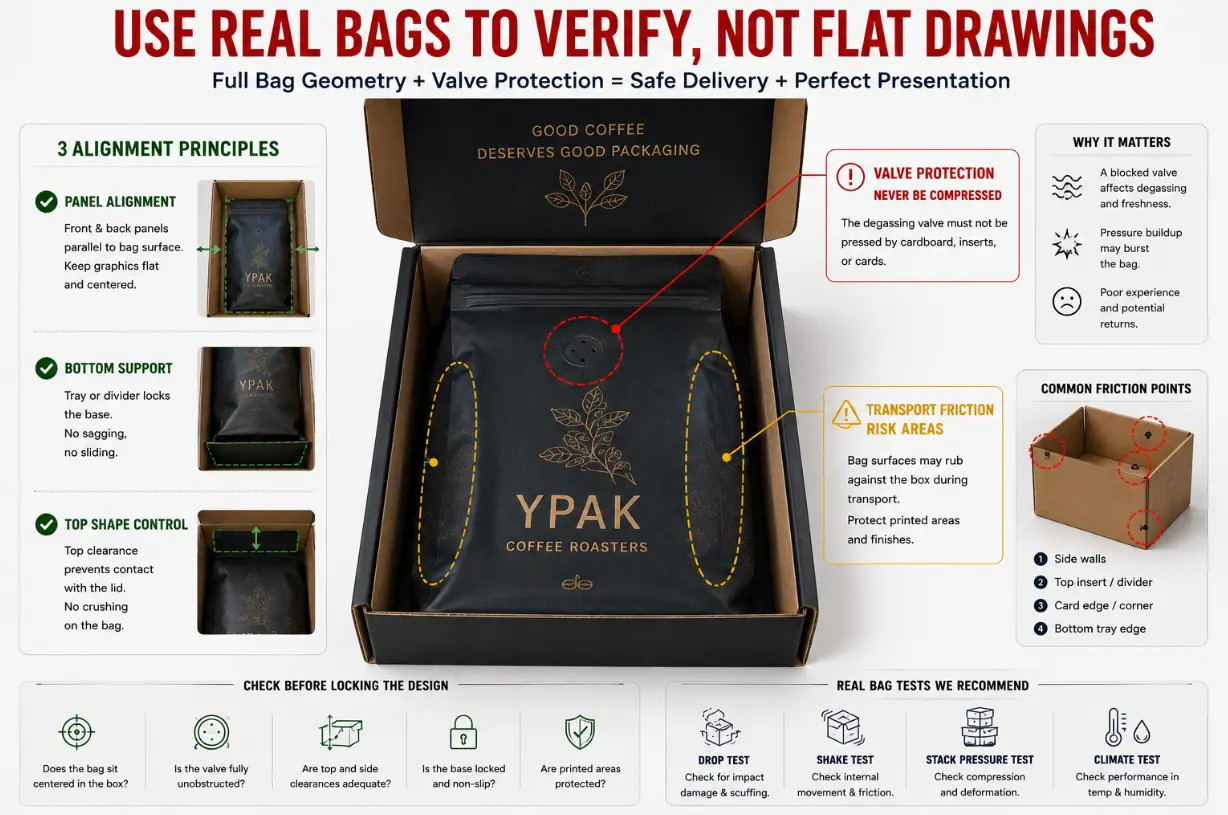
Dimensions should be indicative of actual packed goods and how the goods are to be loaded. An impractical filled result can even be achieved with a technically accurate flat drawing.
Use Filled Samples
Measure sachet or pouch when filled and closed. Insert gussets, zippers, valves, heavy seals and all accessories put in. Set of a sensible maximum size and make sure that the products are loaded manually or with machines.
Protect Sensitive Features
A degassing valve should not be pressed by paper panels, inserts, or by tight clearances, it should not be distorted by a seal, or a tear notch. Scuffing can also be experienced during the shipment of printed surfaces.
Check Completed Geometry.
When packed unit is supposed to stand, stack, close, and open, it should do so. Inspect:
- Alignment and squareness of the panels;
- security by filling;
- bottom-stability and shape of top-panel;
- location and movement of products;
- barcode and what is needed to be seen;
- master-case load and direction.
spells out the Food-Contact Boundary.
There are numerous paper boxes with a complete coffee pack and in which there is no contact with the product. The specification must indicate whether there is a direct or indirect food-contact in the paper, coating, adhesive, ink, window or insert.
Different Primary and Secondary Packaging.
The controlled barrier of coffee is usually provided by the sealed pouch or sachet. The outer paper component cannot be said to maintain freshness unless there is an evidence to show that it serve that particular purpose.
Request Relevant Documentation
Request documents suitable to the reality on the ground of construction, the target market and the condition of the contact. An overall statement regarding paper cannot replace information regarding the provided board, coating, ink, adhesive or other applicable component.
Match to be Printed and Finished at Board.
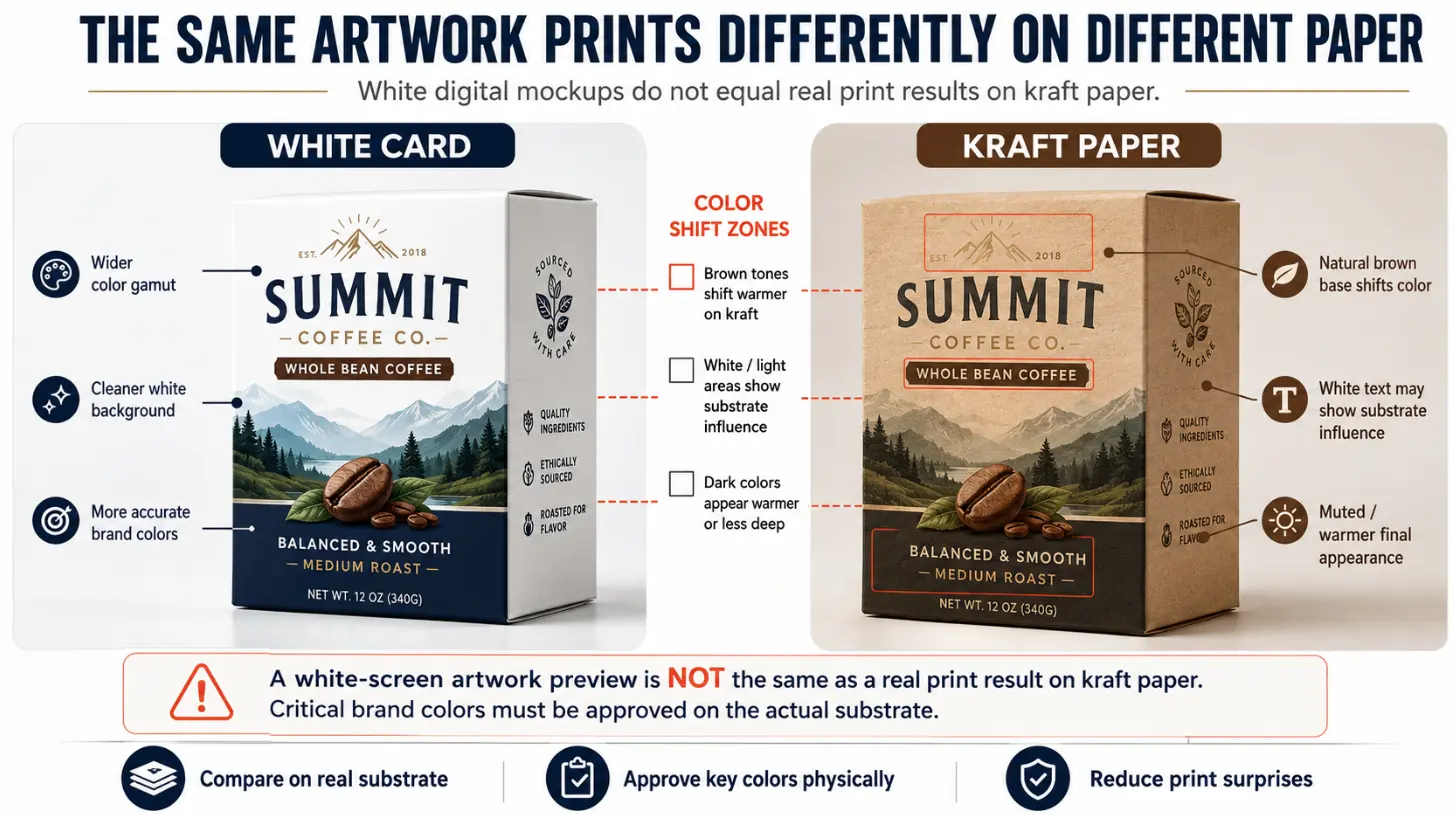
Artwork should be developed for the selected surface. Contrast and color appearance can be altered with kraft color, recycled fibers, textured and paper without utter coat.
Pass Color on Material
Important color approval should always be done using the actual substrate proposed whenever feasible. A white digital proof does not give an inkling as to how brown kraft or a textured wrap will perform. Determine center colors, white ink and any region of the board that becomes a part of the design.
Check Final at Borders and Edges.
Lamination, coating, foil, embossing, debossing, as well as spot effects can act in a different way in the areas of creases, cuts, glue areas and corners covered with the wrap. Examination of registration, cracking, lifting, scuffing and blocking of gluing.
Test Environmental Causes.
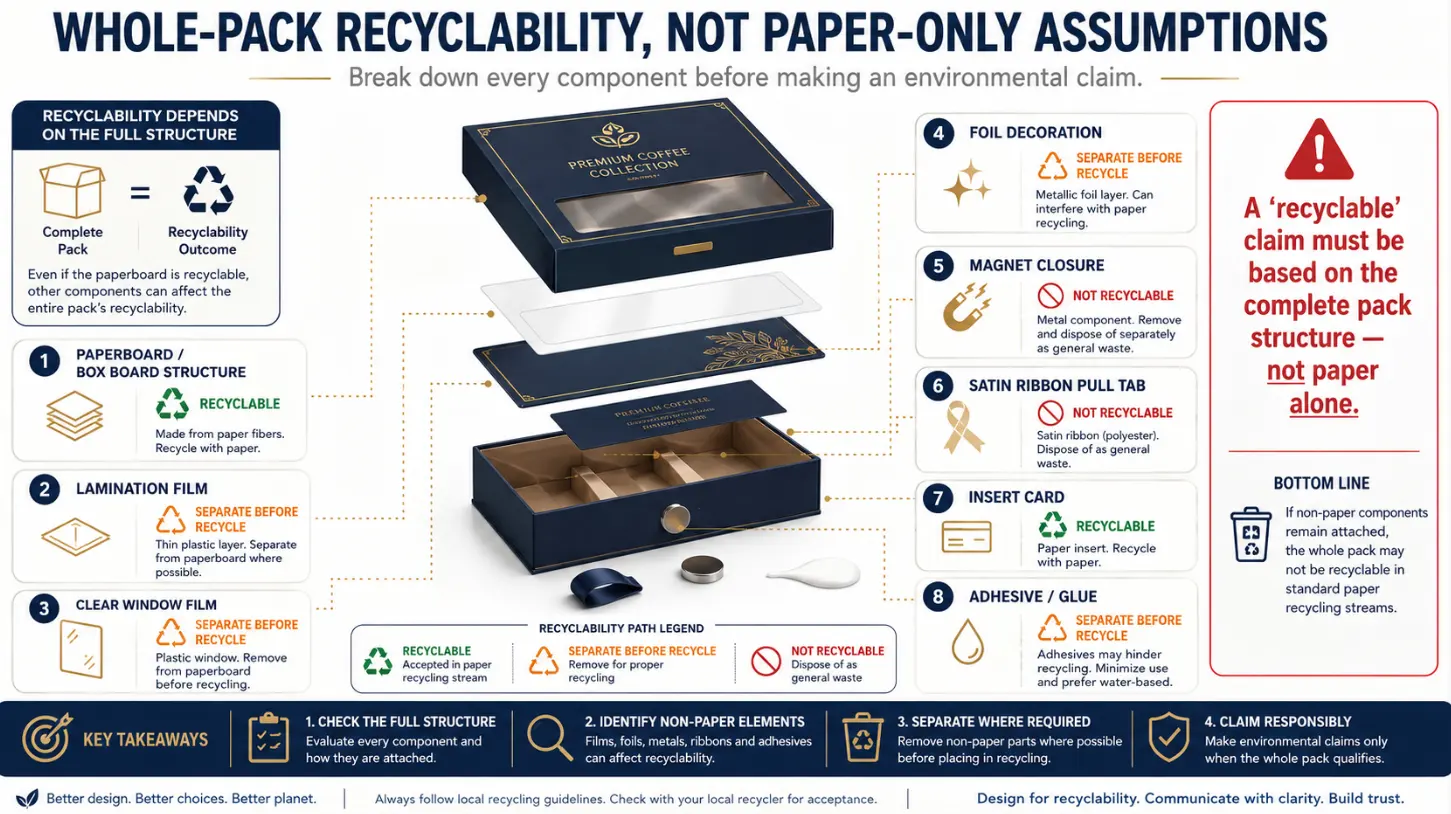
The appearance of paper does not determine the recyclability, recycled material, certification and compostability.
This Entire Construction; Can Be Described.
These include the board, wrap, lamination, coating, window, foil, magnet, ribbon, insert, adhesive and label. Composites can require de-contamination, and they might be subjected differently by local collection facilities.
Request Evidence of Claim.
Tie each statement to supplier records and market in which the pack will be distributed. Do not make general statements which cannot be justified to the specific completed construction.
Construct a Sample and Test Plan.
The approval of evidence should be in phases by a buyer and not based on a single refined prototype.
| Evidence | Main question | Review point |
| Flat dieline | Are dimensions and panels good? | Cuts, creases, glue areas, information areas. |
| Unprinted sample | Does the mechanism work? | Making, loading, closure, fit of product. |
| Printed prototype | Does the appearance proposed reproduce? | Colour, writing, finish, cracking, scuffing |
| Packed trial | Does the whole unit? | Case packing, opening, stability, movement. |
| Distribution trial | Does it pass through the passage? | Corners, panels, closures, arrival condition |
Define Pass Conditions
It must be clear in every review the things that will be accepted and who is in authority to approve the same. Modify a record contrary to current dieline or sample in a manner that design commentaries would not get out of sync with production data.
Keep the Approved Reference.
Retention of signed or otherwise regulated sample along with the revision of the artwork and material specification. The incoming production in comparison to that reference should be compared and not to memory and screen image.
Will Production Deliveries be inspected?
More than print color should be controlled during production. Conduct a constant incoming check each in the shipment among selected cases and positions.
Inspect:
- dimensions and performance of forming;
- damage on board surface, warping and moisture;
- cuts, lines, glue joints, clips;
- location of print, text, barcode and color;
- veneers, papers, stamping and other ornaments;
- scratches, dents, contamination and smell;
quantity packed, master cases, labels and pallet condition.
Be Suppositions YPAK.
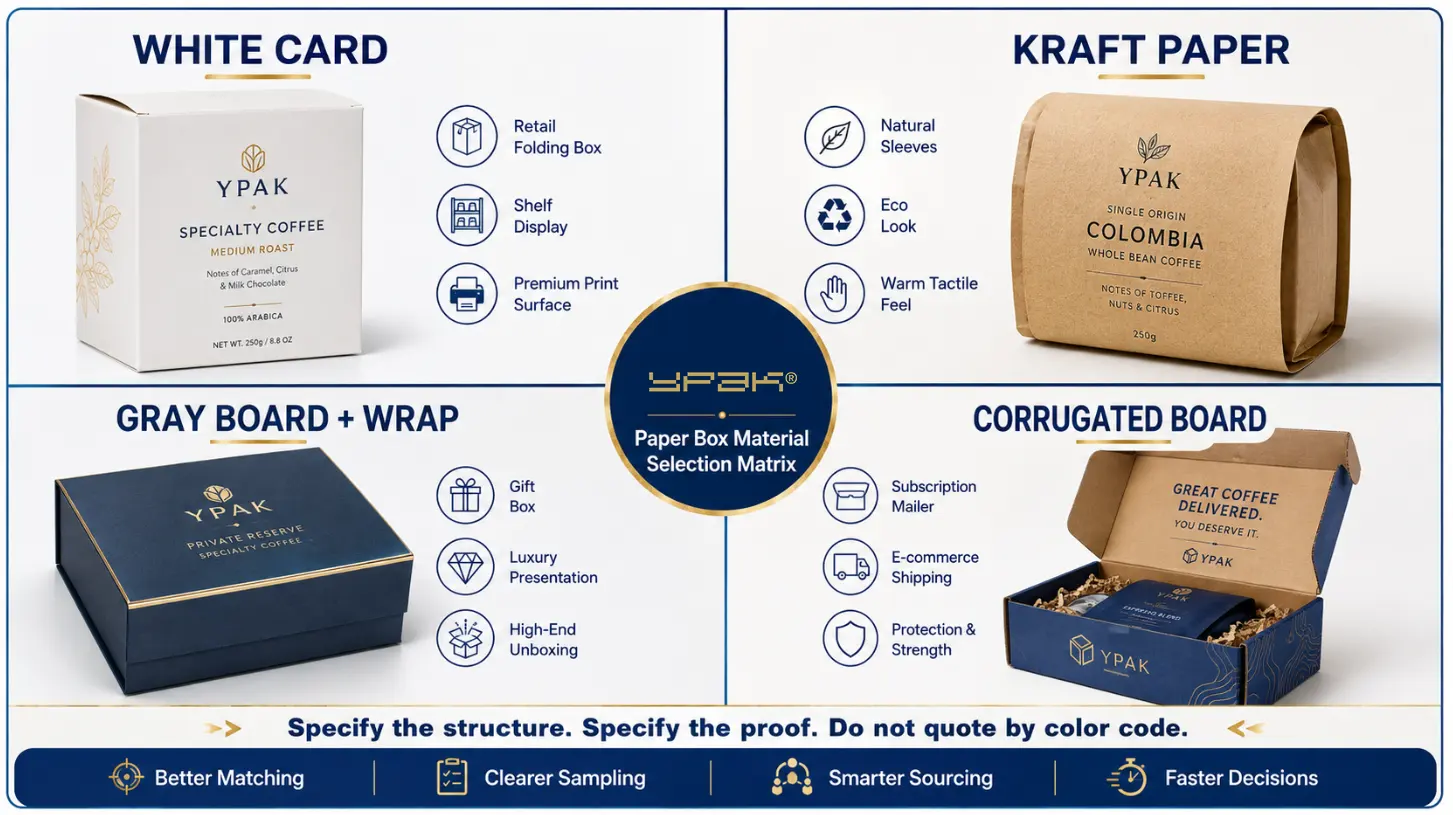
YPAK offers mailer folding cartons, rigid formats, corrugated mails, paper inserts, surface finishes and coordinated inner-coffee packaging. The information on its drip-coffee packaging also gives information about white paperboard, kraft, covered rigid board and corrugated that can be used on various uses.
Questions that are helpful must send YPAK the completed contents, the desired route wished to follow, the desired structure, print and finish direction, supply condition, claim requirements and the acceptance tests. Request presented material construction and sample evidence, rather than just by appearances request paper.
Conclusion
Material and conversion needs to be controlled to select a coffee paper box. The buyer must determine the board construction, specify performance, examine grain and creases, size of filled products, specify the contact boundary, authorize printing on the proposed surface and environmental claims.The purchase specifications must then refer to that final purchase to the samples and the production inspection. The said evidence enables the brand to access a manufactured pack instead of an appealing flat evidence.
FAQ
Written by
ypak.coffee
ypak
YPAK PACKAGING GROUP was established in 2011 and formed with 3 companies based on Hongkong, Dongguan and Foshan. We have become one of the largest coffee bag manufacturers in China. We use the best quality WIPF valves from Switzerland to keep your coffee fresh.
Conform to the plastic ban policy imposed to many different countries, we have researched and developed the sustainable packaging bags, such as RECYCLABLE and COMPOSTABLE pouches.
No minimum quantity, no color plates are required with our HP 25K INDIGO DIGITAL PRINTING service.
You are welcome to visit YPAK.
Related Articles
YPAK at World of Coffee Panama 2026: Coffee Packaging for Short Runs and EU-Bound Lots
PPWR Recyclability Grades for Coffee Packaging: What Survives 2030, and What Survives 2038
Customized Coffee Packaging Solutions: From Product Ideas to Market-Ready Packaging