

Updated 2 months ago
Step-by-Step Coffee Packaging Bag Customization: Manufacturer YPAK 's Guide

ypak.coffee
YPAK PACKAGING GROUP was established in 2011 and formed with 3 companies based on Hongkong, Dongguan and Foshan. We have become one of the largest coffee bag manufacturers in China. We use the best quality WIPF valves from Switzerland to keep your coffee fresh.
Conform to the plastic ban policy imposed to many different countries, we have researched and developed the sustainable packaging bags, such as RECYCLABLE and COMPOSTABLE pouches.
No minimum quantity, no color plates are required with our HP 25K INDIGO DIGITAL PRINTING service.
You are welcome to visit YPAK.
Coffee Packaging Bag Manufacturer
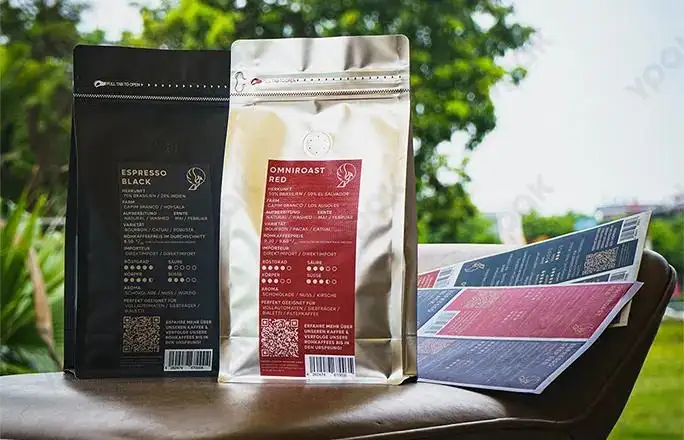
When coffee brands begin developing custom packaging, they often focus first on colors, logos and visual design. However, from the perspective of a coffee packaging bag manufacturer, an effective package must begin with the product itself.
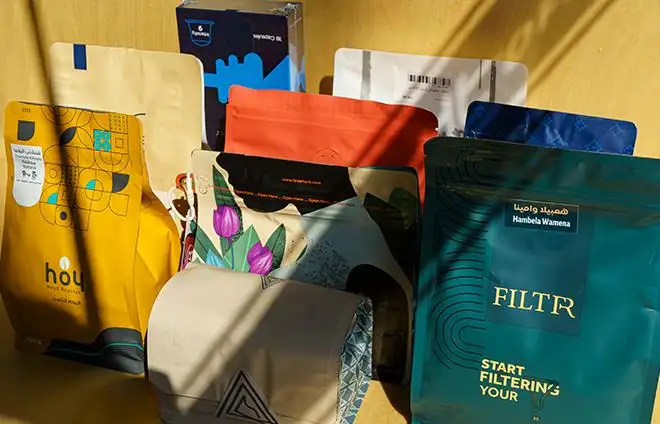
At YPAK, we normally define a custom coffee bag through eight elements: the packed product, bag type, filling size, order quantity, material category, material structure, surface finish and functional add-ons. Reviewing these elements before artwork development helps reduce specification errors and improves production feasibility.
A visually attractive bag may still create problems if its dimensions, barrier performance, valve position or sealing structure does not match the product and filling process.
Step 1 — What Product Will Be Packed?
Before recommending a bag, we first need to understand what the customer will pack. Products may include:
• Whole coffee beans
• Ground coffee
• Drip coffee
• Instant coffee
• Coffee concentrate
• Cold-brew liquid
• Tea, cocoa or related products
The following information helps a coffee packaging bag manufacturer establish a practical specification:
| Product Information | Effect on Packaging |
| Product type | Determines the bag format, material and add-ons |
| Filling weight | Influences bag width, height and gusset dimensions |
| Product volume | Determines actual internal capacity |
| Target shelf life | Affects barrier requirements |
| Filling method | Influences bag opening, dimensions and tolerances |
| Sales channel | Affects presentation and functional design |
Bean density, roast level and shape can change the required volume. Whenever possible, we recommend conducting a filling test with the actual product.
Step 2 — How Do We Choose a Coffee Bag Type?
At YPAK, we select a bag format according to filling weight, shelf presentation, storage, filling equipment and consumer use rather than appearance alone.
| Bag Type | Typical Application | Main Characteristics |
| Flat Bottom Bag | Specialty coffee and premium retail | Stable base with wide front and side panels |
| Stand Up Pouch | Retail, subscriptions and multiple SKUs | Flexible format suitable for many sizes |
| Side Gusset Bag | Cafés, wholesale and larger packs | Higher filling capacity |
| Flat Pouch | Drip coffee, samples and single-use packs | Compact and material-efficient |
| Spout Pouch | Cold brew and coffee concentrate | Controlled pouring and portability |
| Roll Film | Automatic packaging lines | Must match bag-making and filling equipment |
A more complex bag is not automatically more suitable. Flat-bottom bags provide strong shelf presentation, but their construction is generally more demanding than that of standard stand-up pouches.
For large coffee packs, we evaluate bottom strength and sealing areas rather than simply enlarging a retail bag. Roll film projects also require confirmation of film width, winding direction, core size and machine specifications.
Step 3 — How Do We Determine the Right Size?
Nominal filling weight does not represent one universal bag dimension.
| Nominal Size | Typical Filling Weight | Common Application |
| Sample Pack | 20–25 g | Samples and drip coffee |
| 4 oz | 125–150 g | Small retail packs |
| 8 oz | 200–250 g | Specialty coffee |
| 12 oz | 340 g | North American retail |
| 1 lb | 500 g | Home and café retail |
| 2 lb | 1 kg | Cafés and commercial users |
| 5–10 lb | 2.2–5 kg | Wholesale and foodservice |
As a coffee packaging bag manufacturer, we also evaluate:
• The actual volume of beans or ground coffee
• Bottom or side-gusset dimensions
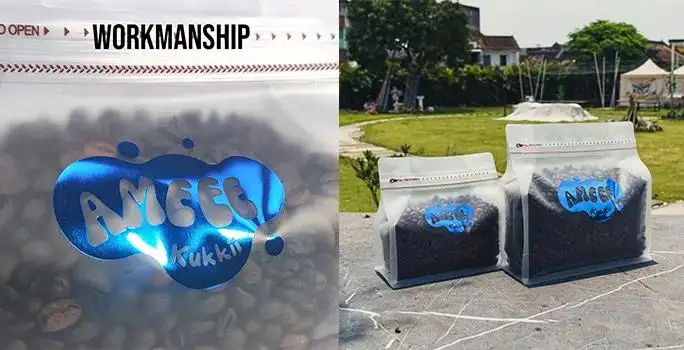
• Space above the zipper for heat sealing
• Degassing-valve position
• Required opening width for filling
• Headspace after filling
• Transportation and stacking conditions
YPAK can produce custom dimensions, but the final size should be confirmed through actual filling and sealing tests.
Step 4 — How Does Quantity Affect Production?
The size of the order impacts many aspects of the management of the supply chain such as printing, planning, unit cost, exposure to excess inventory, and management of the artwork.
| Order Type | Principal Purchasing Objective |
| New Brand Introduction | Minimize the risk of excess inventory and design. |
| More than one Origin or Flavor | Distribute the allocated quantities to the differing artwork versions. |
| Seasonal Coffee | Optimize the balance of lead time and packaging that will go to waste. |
| Repeat Retail Coffee Program | Maintain Standards in Color, Material and Size |
| Large Order | Plan the necessary production and the time of each delivery. |
Orders that are smaller in size usually require more design flexibility. On the other hand, large orders require a balance between consistency in production and a secure and constant supply.
For lots with many different stock keeping units, the purchaser should communicate the quantity allocated to each individual design rather than specifying the total quantity for the lot. MOQ also depends on bag style, material, printing method and special finishes—not only package size.
YPAK uses digital printing and other production approaches to support market testing, multiple designs and regular bulk programs where technically appropriate.
Step 5 — Which Material Should We Recommend?
At YPAK, we do not select packaging materials through sustainability claims alone. We first consider barrier performance, sealing, filling conditions, shelf life and the waste-management system in the target market.
| Material Type | Main Value | What Buyers Should Verify |
| High-Barrier Foiled Bags | Protection from oxygen, moisture and light | Whether foil is necessary |
| Recyclable Bags | Supports mono-material recycling designs | Local collection and recycling access |
| Compostable Bags | Designed for specific composting routes | Industrial or home composting conditions |
| PCR Packaging | Includes post-consumer recycled content | PCR percentage and food-contact layer |
| Custom Structure | Combines layers for a defined function | Barrier, sealing and processing compatibility |
A recyclable bag may not be recycled if the local system does not accept it. Compostable packaging also requires an appropriate disposal environment.
As a coffee packaging bag manufacturer, we are capable of producing packaging solutions that are compostable, recyclable, high-barrier, and made from post-consumer recycled (PCR) materials. However, the final material should still be evaluated against the product, bag style, and intended shelf life.
Step 6 — What Does Material Structure Mean?
In flexible packaging, the material category describes the general sustainability or barrier direction, while the material structure identifies the functional layers used to print, protect, seal and preserve the packed product.
| Material Layer | Typical Function |
| Outer Layer | Printing, abrasion resistance and appearance |
| Barrier Layer | Reduces oxygen, moisture or light transmission |
| Structural Layer | Provides strength and dimensional stability |
| Inner Sealant Layer | Food contact and heat sealing |
| Paper or Special Layer | Adds paper texture or a specific appearance |
More layers do not automatically produce better packaging. No other design features shall be included other than the shapes which should match the necessary bags with the same sealing process and required add-ons. The inclusion of valves, zippers, spouts, etc. will also change material selection.
When designing for recyclability we will generally try to reduce the number of incompatible components whilst achieving the required functionality.
Step 7 - How Do Special Finishes Affect the Bag?
Special finishes change both appearance and tactile experience.
| Finish | Effect | Typical Design Use |
| Embossing | Raised texture | Logos and product names |
| Glossy | Reflective surface | Bright retail graphics |
| Holographic | Multicolor reflection | Limited editions |
| Hot Stamping | Metallic foil effect | Premium collections |
| Matte with Gloss | Matte base with glossy areas | Highlighted graphics |
| Metallic Shine | Metallic color appearance | Modern designs |
| Rough Matte | Fine, sand-like texture | Natural or craft positioning |
| Soft Touch | Smooth, soft surface | Tactile premium packaging |
We normally recommend using special finishes selectively, especially when the finish supports a clear visual hierarchy or tactile purpose.
Finishes may also affect MOQ, sampling, color reproduction, lead time, abrasion resistance and barcode areas.
Step 8 — Which Add-Ons Does a Coffee Bag Need?
| Add-On | Function | What We Evaluate |
| Degassing Valve | Releases gas from roasted coffee | Product condition, position and seal |
| Zipper | Enables repeated closing | Zipper height and usable capacity |
| Tear Notch | Supports initial opening | Position relative to zipper and seal |
| Laser Scoring | Creates a controlled opening line | Material and tear direction |
| Window | Displays the product | Window material and barrier impact |
| Tin Tie | Secures a folded bag top | Retail use and attachment |
| Hang Hole | Enables hanging display | Top strength |
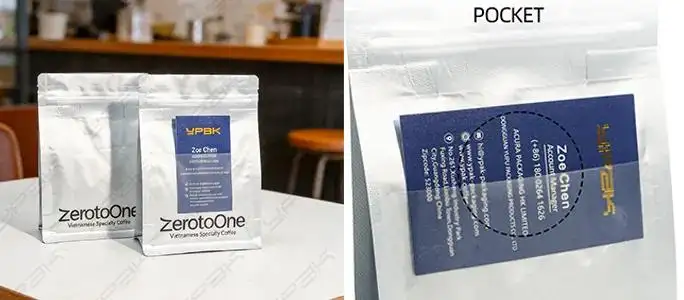
| Card Slit | Holds a product card | Position and transport stability |
| Rope | Improves carrying | Bag strength and attachment |
| Spout | Dispenses liquids | Spout diameter, position and sealing |
Not every coffee bag needs a valve. Single-use packs, instant coffee and some pre-degassed products may use different structures. A bag can include both a zipper and valve, provided their positions leave sufficient filling and sealing space.
Adding more features does not always improve the package. It can increase material, processing and quality-control requirements.
Build the Specification Before Production
As a coffee packaging bag manufacturer, YPAK recommends confirming product type, filling weight, bag size, materials, finishes, and add-ons before production. Our Packaging Builder compiles these requirements. The sampling and technical review validate capacity, sealing, artwork, and other final manufacturing specifications.
FAQs
Q1. Is it possible for a coffee bag to have both a zipper and a valve?
Yes. A coffee bag can have both a zipper and a valve, as long as there is enough space for filling and heat sealing, and the valve is appropriately placed relative to the zipper.
Q2. What types of coffee bags can YPAK produce?
YPAK can produce flat-bottom bags, stand-up pouches, side-gusset bags, flat pouches, spout pouches, and roll film.
Q3. How do you properly size a coffee bag?
The proper size of a coffee bag can depend on multiple variables such as filling weight, product density, roast level, gusset width, zipper position, and the headspace required. It is best to test a coffee bag with the product it will contain.
Q4. What size coffee bag is appropriate for 250 grams of coffee?
Typically 8 oz bags are used for 200–250 grams of coffee, but due to the varying density of different coffee beans and roast levels, it is best to test the coffee with the bag to finalize the dimensions.
Q5. Do all coffee bags require degassing valves?
No. Degassing valves are only required for whole beans or ground coffee that is freshly roasted and still degassing. Coffee products that do not degass, such as instant coffee and single-use coffee products, do not require degassing valves.
Written by
ypak.coffee
ypak
YPAK PACKAGING GROUP was established in 2011 and formed with 3 companies based on Hongkong, Dongguan and Foshan. We have become one of the largest coffee bag manufacturers in China. We use the best quality WIPF valves from Switzerland to keep your coffee fresh.
Conform to the plastic ban policy imposed to many different countries, we have researched and developed the sustainable packaging bags, such as RECYCLABLE and COMPOSTABLE pouches.
No minimum quantity, no color plates are required with our HP 25K INDIGO DIGITAL PRINTING service.
You are welcome to visit YPAK.
Related Articles
Two Gates on the Road to the EU: Reduction by Design and the Documentation Chain for Coffee Packaging

Recyclable Coffee Bags: How to Protect Freshness Without Compromising Sustainability

Your Brand, Perfectly Packaged: The YPAK Guide to Selecting a High-Quality Custom Coffee Bag