

Updated 3 months ago
Coffee Box Packaging: How to come up with an effective packing system.

ypak.coffee
YPAK PACKAGING GROUP was established in 2011 and formed with 3 companies based on Hongkong, Dongguan and Foshan. We have become one of the largest coffee bag manufacturers in China. We use the best quality WIPF valves from Switzerland to keep your coffee fresh.
Conform to the plastic ban policy imposed to many different countries, we have researched and developed the sustainable packaging bags, such as RECYCLABLE and COMPOSTABLE pouches.
No minimum quantity, no color plates are required with our HP 25K INDIGO DIGITAL PRINTING service.
You are welcome to visit YPAK.

Coffee Packaging Box Manufacture
Coffee box packaging can result in a bottleneck of production besides the apparent acceptability of all the elements. The cartons will be hard to pick when they are flat, the inserts can be shipped off shape and the labels can break the seal. These disruptions augment work and inconsistency.
Workflow engineering is thus the starting point of an effective system. The point is to transport all the products along a straight path, errors visible, and provide the packaging crew with a real world standard, which could be repeated during the standard production.
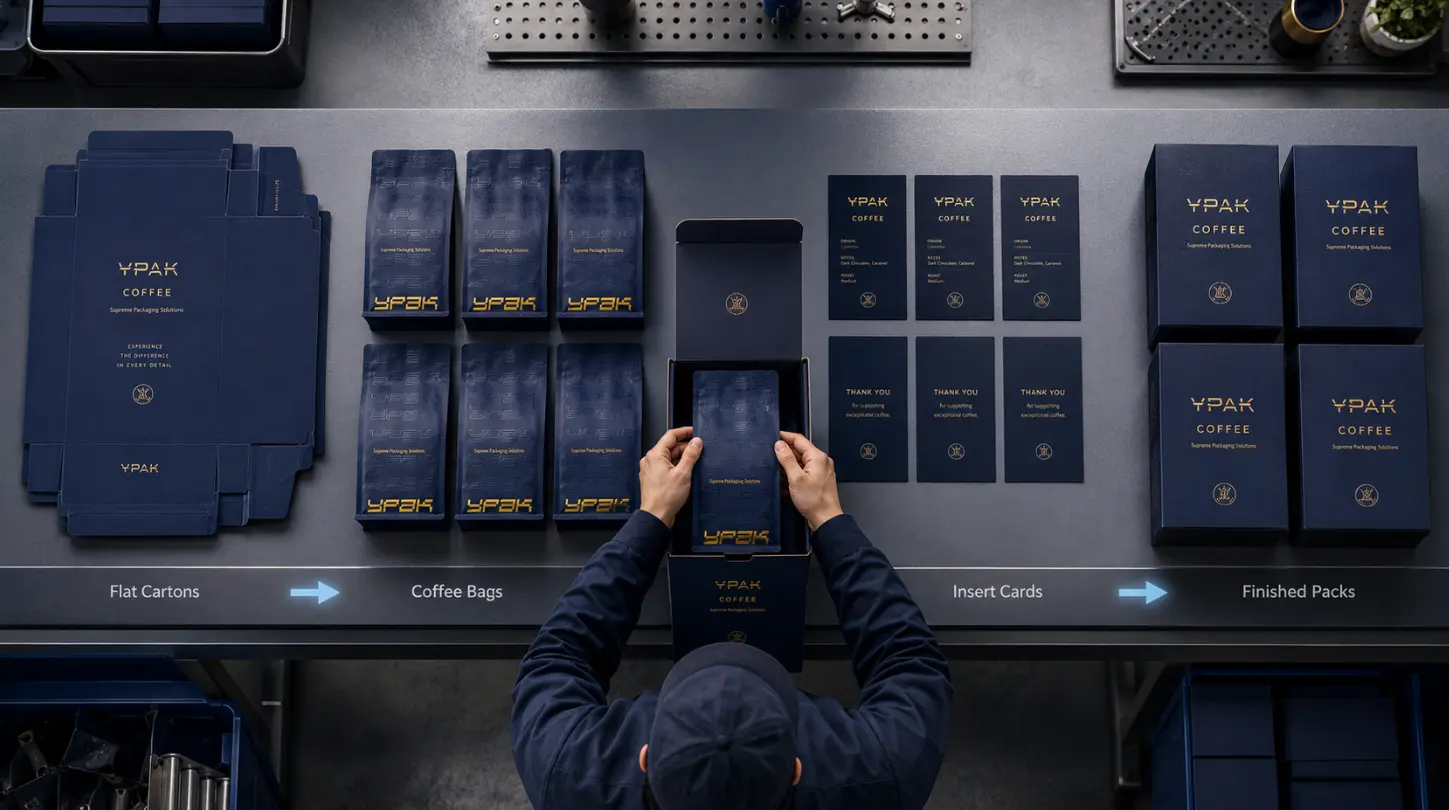
Name the Station Output.
Discuss what is to be removed out of the work-table, before establishing worktable. The production can be a retail carton to now be loaded into a master case, a subscription mailer to now be loaded into a shipping label or a gift set to now be inspected.
The mix of product to be made, version of the components, final orientation, closure status, variable coding, and label and receiving package location should be described.
Fix Pass Condition.
Condition of pass is evident and self-explanatory. The carton is a square, panels are met properly, the objects inside it do not stick out, the code is readable and the exterior does not have any unacceptable damages. The operators will not be required to read between the lines such as good looks.
Create Hold Condition.
A doubtful unit is not allowed to proceed into a hold condition. Wrong artwork that is separated and checked, accents lost, lot codes not known, locks not locked, edges damaged or product leaked. Give a designated holding area to make sure that questionable packs are not reintroduced into the production stream.
Plan a Unidirectional Work Process.
The simplest station is one that does not traverse backwards but only a supply of components to finished cases. The materials to be used need to be those most available and the cases are to be checked and packed once all the assembly processes are complete.
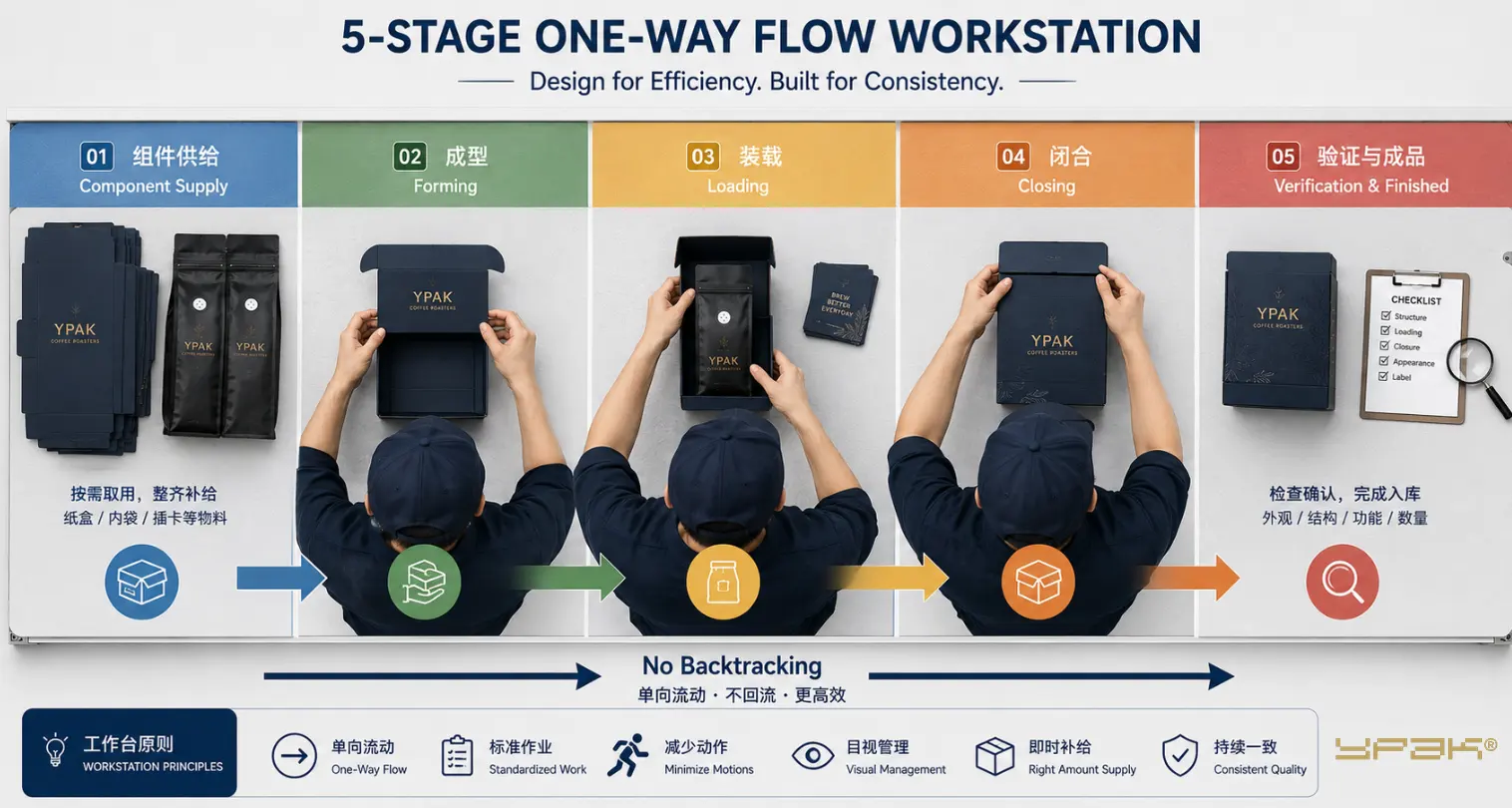
| Station zone | Work performed | Delay to watch |
| Component supply | Existing cartons, inserts, pouches, cards and labels. | Uncertain amendments or difficult approach. |
| Forming area | Unfold and fold the flat carton. | Breaking and entering of locks. |
| Loading area | Position coffee/ancillaries. | Pouch snagging or repositioning. |
| Closing area | Full flaps, seals, sleeves or labels. | Stress (slip-slop-squeezer) or additional work. |
| Verification area | Check appearance, codes and number of components. | Unclear acceptance decisions |
| Finished-pack area | Construct a unit of group and load master case. | Wrong or crowding posture. |
The design must be able to accommodate the real hand sequence. More damage and wastage of time is caused by cross-linking of finished product. Early supplied labels can be used prior to the confirmation of version of a product.
Cut Material on Work Surface.
The versions and quantity of the running version of the run should only be retained. The overstocking of the cartons and accessories conceals the mistakes and takes up space as well as complicates the changeovers to check. The replacement inventory is able to be kept in the Proximate area, without entering the Proximity work area.
Locate a Place to Each Part.
Label with clear marked locations on a flat carton, coffee packs, inserts, cards, labels, castoffs and finished pieces. In the event that there is nothing left, it is easier to observe something that is missing.
Work on decision writing.
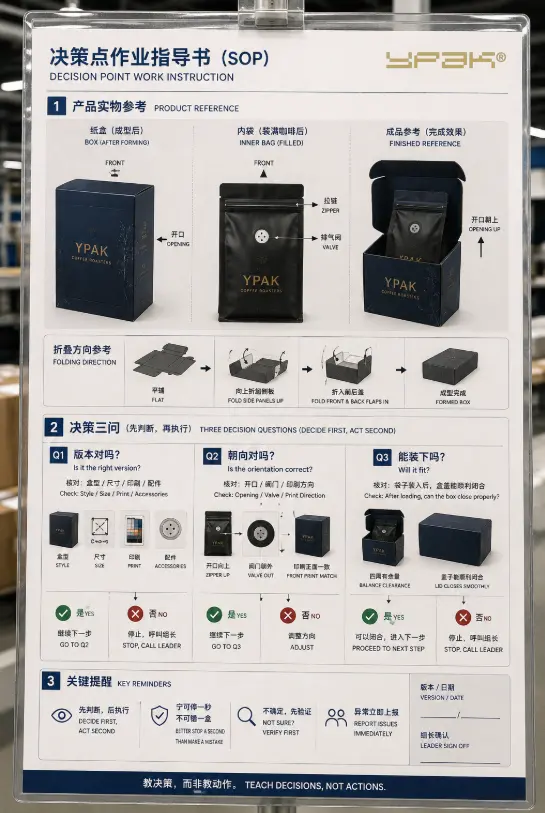
The standard work should be able to tell where an operator is to make a decision, and not a list of obvious hand movements. The most useful instructions are those answering the questions which may alter the final result.
Include guidance for:
- verifying the version of the product and artwork in progress;
- knowing which side and which part to each part;
- to test the suitability of a pouch in which to load;
- making a decision when a carton or an insert should be rejected;
- to have the labels and codes in proper places;
- turning the completed unit out to the next process;
- modifying the production materials which are not comparable with the reference.
The orientation, direction of folds and pass conditions can be illustrated using photographs. Initiate the teaching in the station and correlate it with the current revision.
Repetitive Motion is Error Free.
Error-proofing will minimize the chances of error compared to end check only. Simple physical or visual controls may prove to be more effective than additional warnings.
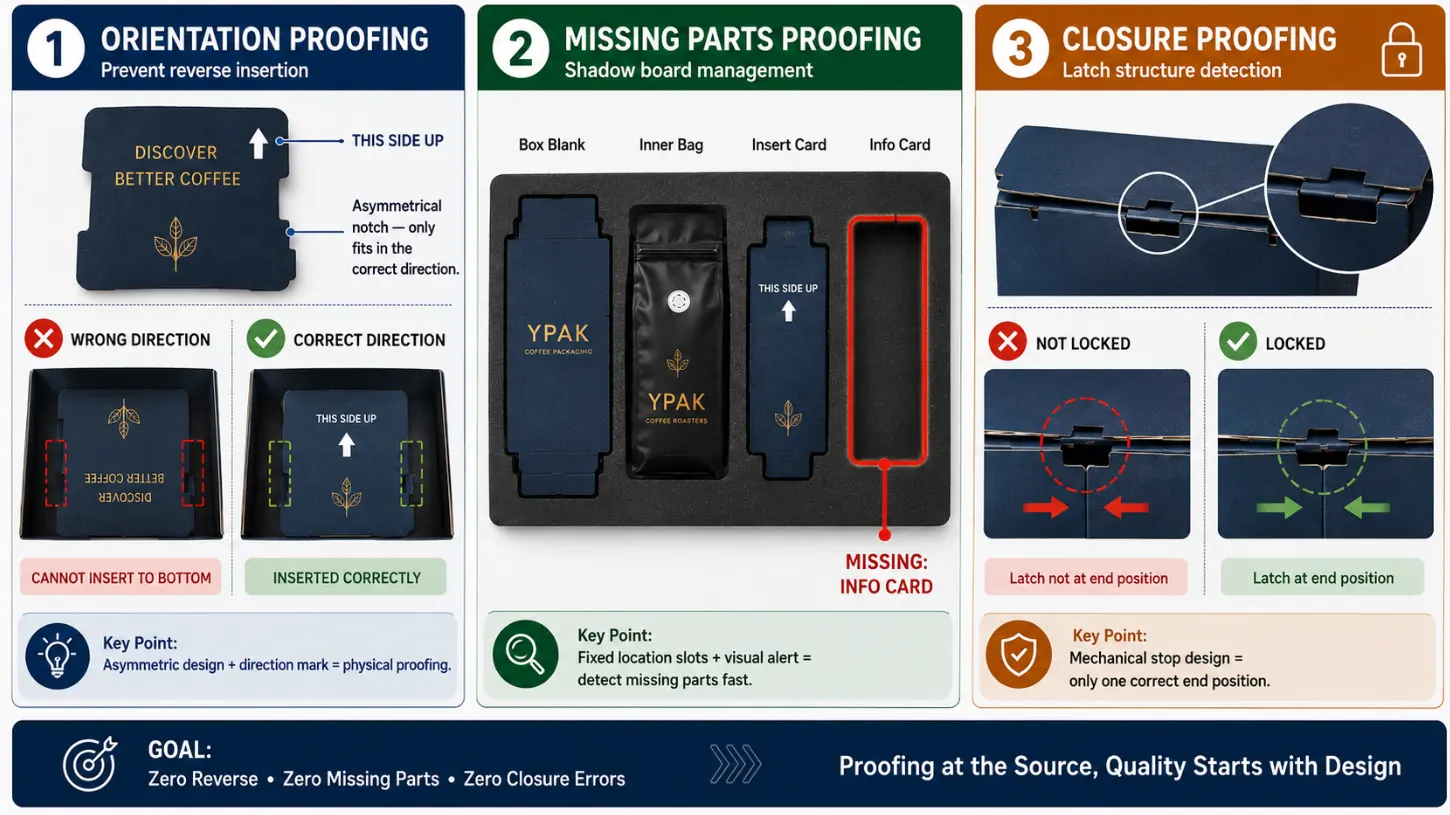
Prevent Reversed Orientation
Asymmetrical inserts may be indicated by guides, or panel marks or fixed component locations. In cases where the two orientations seem feasible, the trial units can go through the line with the product in the reverse orientation.
The panel or product that the customer desires should be presented to them when he or she opens the box.
Prevent Missing Components
Allot a given group of components to a unit. Before closing the box with a little accessory, shadow board, grouped kit or empty-position check, missing card or accessory may be noticed.
In case of multi-item gift packs ensure that the expected number is compared with the physical locations contrary to the comparisons which are only made on the basis of the memory as such. In altering a market choice, locate that alternative prior to the materials getting to the station.
Prevent Weak Closures
An appropriately shaped lock must have an identifiable end position. The addition of tape or opening carton has to be enquired into.Do not cover up a product-fit problem with a closure correction. Such things as overfilling or improper placement of the contents may lead to flaps being forced and provide a carton with an imperfect appearance.
Trade off Control and Packing Speed.
Speed is effective in cases where the output is satisfactory. Break down the process into short periods and note the units completed and corrections. A fast process with re-opening or rejected packet stuff could be considerably costly as compared to slightly inferior steady process.
Signals to be run:
- time of work completion, quantity of packs completed;
- average work in progress in the station;
- corrections per batch;
- waste boxes, footings, labels, products;
- lost time waiting of materials, or approval;
- cases which were retained due to coding or version queries;
- variation in production among trained operators.
The change of the performance might be abrupt and could be connected with the appearance of a new lot of cartons, new sizes of pouch, new insert or a new instruction.
Control Product and Artwork changeovers.
Changeovers are highly hazardous to mix or confuse coffee varieties, box versions, labels, cards or regulatory information. The last production needs to be closed prior to another set of components entering the workspace.
Clear Last Run.
Dispose of unused printed material, unfinished cases, loose labels, samples and scrap parts. Brand process: Record or recall controlled items. Ensure that no items can be found in the table as well as the other bins that have the potential of being related to the former SKU.
Verify the New Run
Line-up the coffee, carton, insert, label and artwork revision with the order of production. Test one first off unit and compare it with the accepted reference and re-pack on the normal way.
Variable labels and cards should be especially noted when there are multiple SKUs that have the same structural box. The similar ones are to be indicated by prominent version at the supply point.
Track Packaging Losses by Reason.
No one overall amount of waste is explicit that tells what should be different. Isolate losses to determine what of the team the problem is in the material supply, structure, printing, packing or handling.
There are types of useful losses:
- carton will never shape and be square;
- crease, glued or locked area cracks in assembly;
- print or finish is printed and then packed;
- pouch will not load, unless corrected;
- insert does not belong or occupy its place;
- bad version comes to the station;
- appearance inspection of finished packs not passing;
- unit is lost in package and internal transportation.
Record the lot and component where problem recurs. The samples and photographs that are kept back assist a supplier in getting a better view of the failure than when one simply complains of low quality.
Relate the Station and Supplier.
The packaging specification should be re-entered in the production feedback. Packing time, frequent corrections, component rejection, behavior of closing and changeover errors are the indicators of future adjustment.
YPAK has an organised portfolio, including primary coffee packages and drip products cartons, presentation format, shipping mailers. The intrinsic and extrinsic control will facilitate analysis of dimensional fit of artwork variants, samples and shipping arrangements as a unit operating program that will be produced by the production unit.
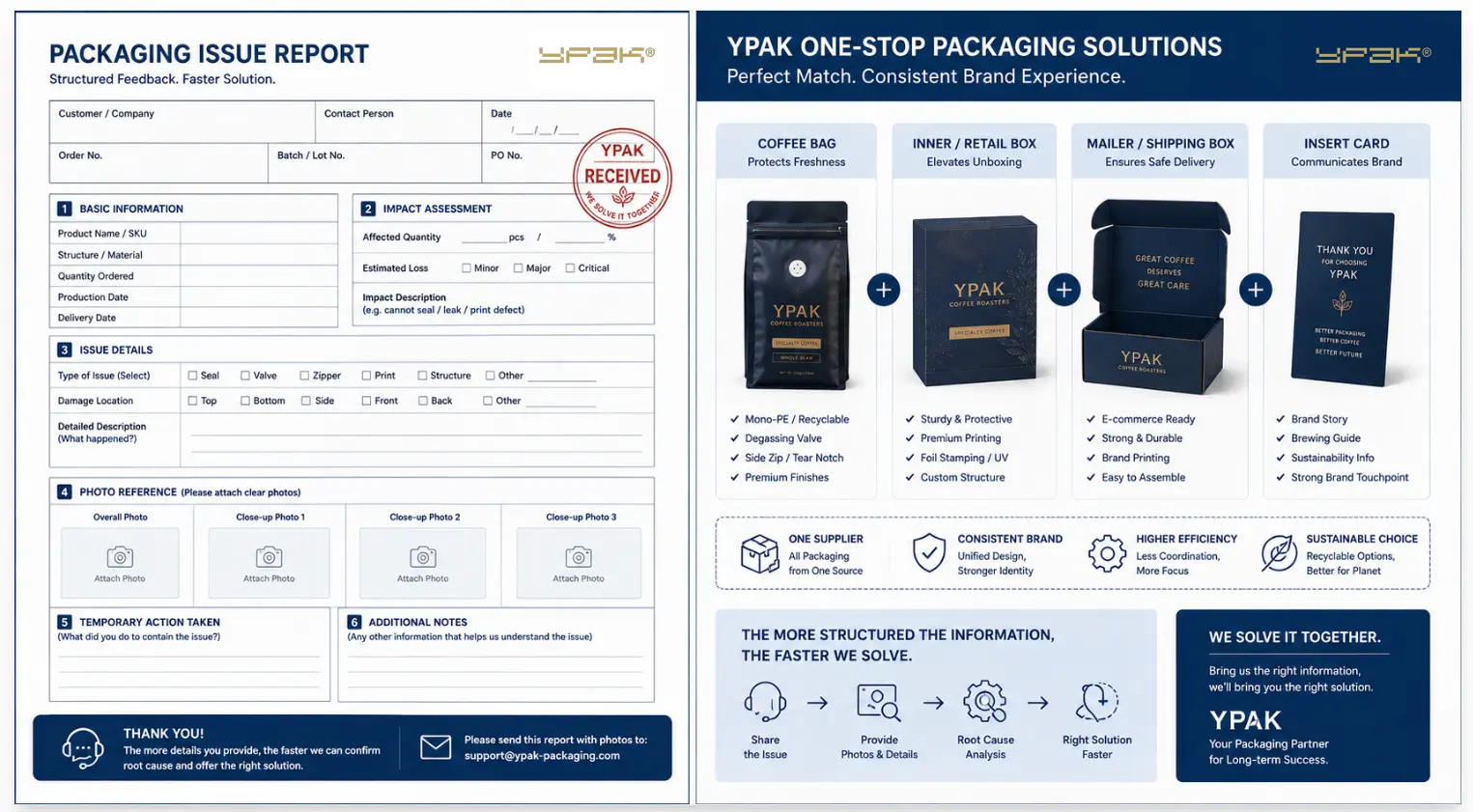
In case of assistance provide a short problem report. Identify order, manufacturing lot, quantity affected, damaged location and photos and samples held and provisional course at the station. This facilitates the discussion of correction to be more succinct and traceable.
Conclusion
A controlled flow of production is crucial to effective coffee box packaging. It is easy to repeat the operation, as there is easy control over changes and display of cause based loss records with clear station output, one direction layout, visible component location, decision based work instructions and error proofing.The output is not a well-wrapped unit. The brand will get a measurement of job, waste, functionality of elements, and procedural steadiness. This data can be utilized in further optimization of the current production-run, and be used to communicate more effectively with the supplier of the packaging.
FAQ
Written by
ypak.coffee
ypak
YPAK PACKAGING GROUP was established in 2011 and formed with 3 companies based on Hongkong, Dongguan and Foshan. We have become one of the largest coffee bag manufacturers in China. We use the best quality WIPF valves from Switzerland to keep your coffee fresh.
Conform to the plastic ban policy imposed to many different countries, we have researched and developed the sustainable packaging bags, such as RECYCLABLE and COMPOSTABLE pouches.
No minimum quantity, no color plates are required with our HP 25K INDIGO DIGITAL PRINTING service.
You are welcome to visit YPAK.
Related Articles
YPAK at World of Coffee Panama 2026: Coffee Packaging for Short Runs and EU-Bound Lots

PPWR Recyclability Grades for Coffee Packaging: What Survives 2030, and What Survives 2038
Customized Coffee Packaging Solutions: From Product Ideas to Market-Ready Packaging