


Why Coffee And Bag Labels Matter?
Any specialty coffee shop will give you an impression firstly, coffee bags are filled with information. It may seem like a lot to take in: starting with origin and roast level all the way to tasting notes and processing methods, which is particularly true when you are new to specialty coffee.
However, here is the reality, there is a purpose behind each detail on a coffee bag. And when you know all about it, you can always get better coffee--and enjoy every cup all the more.
In this guide, we will deconstruct what is actually on your coffee bag and why it is important to your taste, quality and experience of brewing.
The importance of Coffee Bag Labels.
A coffee bag is not just a package, it is a means of communication between the roaster and the drinker. It informs you of the origin of the coffee, how it was handled and what you will find in the cup.
Properly crafted labels minimize guesses and assist you in discovering coffee that suits your taste. Bad labels, however, may well confuse or mislead you.
Imagine that it is a wine brand: the more transparent and detailed the label is, the more sure you are that you have made the right choice.
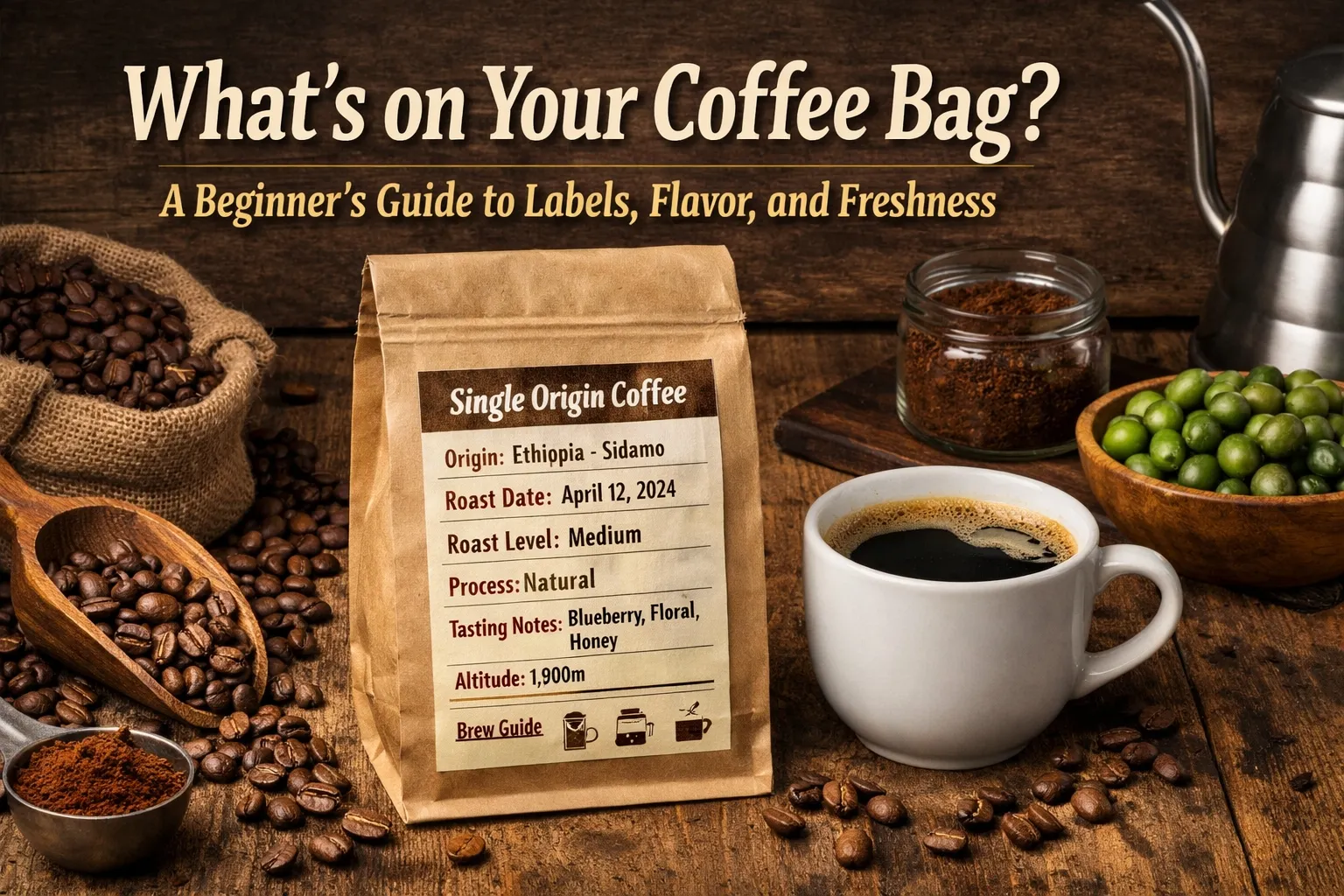
1. Origin: Where Your Coffee Comes From.
A coffee bag has one of the most essential details which is the origin. It informs you of the country where the beans were raised--country, region, or even a farm name.
Why it matters:
· Regions have varied flavors.
· Greater specificity of origin = increased traceability and quality is frequently improved.
· It assists you in anticipating flavor prior to brewing.
For example:
· Ethiopia → flowery, fruitful, tea-ish.
· Colombia → balanced, chocolatey
· Brazil → low acidity, nutty.
When a bag merely claims to be a South American blend, that is a red flag, it is not transparent and clear in terms of flavors.
2. Roast Date: Freshness Indicator.
The only thing you have to look at on a coffee bag is the roast date.
Coffee has a window of consumption: the coffee is usually consumed within 2-4 weeks of roasting. Thereafter it starts to lose its aroma and complexity.
Why it matters:
· Cold Coffee = poorer taste and smell.
· Stale, old coffee = old, flat taste.
· The best before dates are not effective as indicators.
Pro tip: When buying coffee, always opt to buy coffee with a date that is printed on the package with a clear roasted on date.
3. Roast: Light, Medium or Dark.
Roast level informs you about the manner in which the beans have been roasted, which has a direct impact on flavor.
· Light roast → sharp acidity, fruitful, complicated.
· Medium roast: harmonious, sweet, multi-purpose.
· Dark roast - bold, bitter, chocolatey.
Why it matters:
· It influences the general flavor even more than other issues.
· It finds out which brewing technique is optimal.
· It assists in making coffee to suit your taste.
In case, you are a fan of espresso with milk, medium and dark roasts are most likely to be effective.
4. Tasting Notes: What You Will Taste (More or Less)
The most misconceived aspect of a coffee bag is likely to be tasting notes.
When you read such words as blueberry, caramel, or jasmine it does not imply that those ingredients were introduced. They are natural flavor compounds, which are discovered in professional tasting.
Why it matters:
· Assists you in forecasting the flavor direction.
· Facilitates the comparison of coffees.
· Guides repeat purchases
Notable hint: tasting notes are not rules, but guidelines. The way you brew, and the palate you use, will have a bearing on what you taste.
5. Processing Method: Preparation of Coffee.
The procedure of removing the bean off the coffee cherry is known as coffee processing. Common methods include:
· Washed - clean, delicate tastes.
· Natural → fruity, bold, fuller body.
· Honey → sweet, complex, partially fermented.
Why it matters:
· Flavour is much influenced by processing.
· It discusses the reason why two coffees of the same region have different tastes.
This is one of the least appreciated but influential information on a coffee bag.
6. Altitude: A Quality Hidden Mark.
The altitude (in meters above sea level) will inform you of the height at which the coffee was cultivated.
An elevated altitude tends to imply:
· Slower bean development
· More complex flavors
· Higher acidity
The majority of specialty coffee is cultivated over 1,200 meters.
Although it is not a necessity among the beginners, it is a good indicator of quality.
7. Variety (Varietal): The Coffee “Genetics”.
Similar to grapes in wine, coffee is available in various varieties (or varietals) like Bourbon, Caturra or Heirloom.
Why it matters:
· All the varieties possess different tastes.
· It affects sweetness, acidity and body.
This fact is more applicable when you learn more about coffee.
8. Brewing Advice (Not Mandatory, but Assistance)
Other coffee bags have the recommended brewing methods, which include:
· Espresso
· Pour-over
· French press
Why it matters:
· Support novices to do better.
· Matches profile to brewing style.
It is not mandatory, but a good compliment- particularly when you are trying things out.
What a Good Coffee Bag ought to contain.
The standard components of a high quality coffee bag are:
· Roast date
· Specific origin (country and region or farm)
· Roast level
· Processing method
· Clear tasting notes
When any of these are not provided, it can be a sign of reduced transparency or quality.
Some of the Red Flags to avoid.
Watch out for these warning signs:
· No roast date
· Indeterminate provenience (“premium blend”)
· Adjectives such as smooth or rich (generic).
· Missing processing information
These mostly point to mass-produced coffee as opposed to specialty-grade beans.
Directions on how to use coffee bag information to select improved coffee.
The following is an easy method to put your learning into practice:
1. Check freshness (first roast date)
2. Select degree of roasting according to choice.
3. Find roots that you like.
4. Follow tasting notes as a guideline.
5. Test and try your own flavor.
The more coffee you taste, the less complicated label reading becomes and locating your cup of heaven.
Final Thoughts
Coffee bag labels may appear complex initially, but they are, in fact, one of the strongest items you can possess as a coffee drinker.
You will be able to make informed decisions, rather than guessing which beans will suit your taste, brewing technique, and expectations.
Once you know how to read a coffee bag, you are not purchasing coffee anymore, you are buying an experience.

Written by
ypak.coffee
ypak
YPAK PACKAGING GROUP was established in 2011 and formed with 3 companies based on Hongkong, Dongguan and Foshan. We have become one of the largest coffee bag manufacturers in China. We use the best quality WIPF valves from Switzerland to keep your coffee fresh.
Conform to the plastic ban policy imposed to many different countries, we have researched and developed the sustainable packaging bags, such as RECYCLABLE and COMPOSTABLE pouches.
No minimum quantity, no color plates are required with our HP 25K INDIGO DIGITAL PRINTING service.
You are welcome to visit YPAK.
Related Articles
Two Gates on the Road to the EU: Reduction by Design and the Documentation Chain for Coffee Packaging

Recyclable Coffee Bags: How to Protect Freshness Without Compromising Sustainability

Your Brand, Perfectly Packaged: The YPAK Guide to Selecting a High-Quality Custom Coffee Bag