

Understanding the Conversion: 12 Cups to Ounces
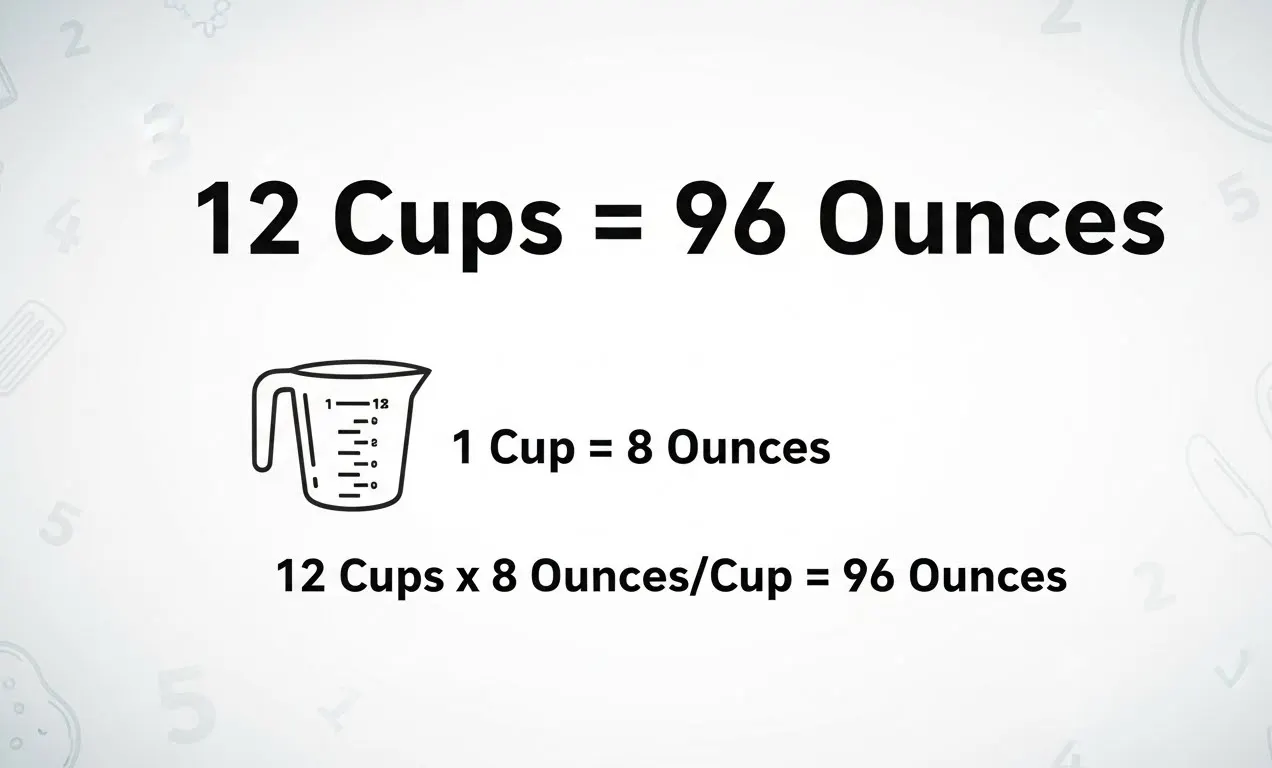
Bogged down on an ingredient list which requires 12 cups? It is easy to guess, it is 96 fluid ounces. This one math problem is the solution to most of the kitchen measurement confusions and the basis of how to measure cups of fluid ounces of any liquid.
The single rule that should be considered with almost any US recipe is that 1 standard liquid measuring cup is equal to 8 fluid ounces. In our case of 12 cups it is only a matter of multiplying: 12 cups times 8 ounces per cup equals 96 fluid ounces. Then is a cup 8oz of liquid all the time? The response is a resounding yes when it comes to cooking.
This procedure is always effective in the case of the conversion of standard liquid measuring cups. Consider that some other recipe requires 4 cups of chicken broth. You would just multiply 4 cups x 8 ounces, 32 fluid ounces. This easy formula will ensure that you can easily solve any liquid measurement that a recipe throws at you.
Your Quick Reference: A Cups to Ounces Conversion Chart
This handy cups to ounces conversion chart is the best kitchen item in those times when you need an answer quickly. You can save this page or print this guide to place it on your refrigerator, and you would not have to stop your recipe to calculate anything anymore! As you are able to see in the photo, the usual rule is that one cup have 8 fluid ounces.
This list helps you visualize how cups build into larger, more familiar containers like quarts and gallons.
-
1 Cup = 8 fl oz
-
2 Cups = 16 fl oz
-
4 Cups (1 Quart) = 32 fl oz
-
8 Cups (Half Gallon) = 64 fl oz
-
12 Cups (¾ Gallon) = 96 fl oz
-
16 Cups (1 Gallon) = 128 fl oz
It would be nice to know that there is 16 cups to a gallon of milk! Simply bear in mind that this chart is of liquids. Next, we shall discuss the most common error of all in changing ounces to cook and bake.

Fluid vs. Weight Ounces: The #1 Mistake in Baking and Cooking
You will have noticed that we are continuously saying fluid ounces. This little word provides the secret of escaping one of the most prevalent errors at the kitchen, and this is the attainment of the correct baking measurement equivalents. The 1 cup = 8 oz is a rule that should only be used to measure the liquids in terms of the space they occupy.
Good, consider a cup of popcorn and a cup of water to find out the reason. Both are in the same one-cup measuring cup, but it is clear that the water is considerably much heavier. Fluid ounces are used to measure the space (volume), and regular ounces are used to measure heaviness (weight). This is everything when it comes to the conversion of wet and dry ingredients.
This variation is of particular concern to baking. A cup of general-purpose flour, say, usually does not weigh 8, but 4.5 ounces. Treating them like that, and weighing 8 ounces of flour to make a recipe that required a cup of it, you would have nearly twice the quantity of flour, which results in a dry, dense cake.
The golden rule is easy, therefore, follow the 1 cup = 8 fluid ounce rule in liquids such as water, milk and broth. In the case of dry products such as flour and sugar, one had better adhere to the instructions in the recipe.
What About My 12-Cup Coffee Pot? Why the Math Might Seem Wrong
The cup on your coffee machine is one of the most bewildering things in any kitchen. In case you have ever had a 12 cup full pot and seemed to fill about half of a 100 ounce beverage dispenser, you are not losing it. The appliance sector has a different standard, in which a coffee cup is not a standard liquid cup.
To the majority of coffee machine manufacturers, a single cup is not much more than 5 or 6 fluid ounces - a typical portion of a cup of coffee. That is equivalent to the fact that your 12 cup coffee pot really makes between 60 and 72 ounces of coffee, which is a much smaller amount compared to the 96 ounces of coffee we had computed in the previous step using the standard conversions.
Therefore, in recipes, to be on the side of the official rule, 1 cup is 8 fluid ounces. And even then, when you decide that you need to make precisely 96 fluid ounces of iced tea to serve at party you will need to measure 12 standard cups of water, not simply make two pots in your 12-cup coffee machine.
Seeing the Big Picture: How 12 Cups Fits into a Gallon
And it is always convenient to observe how cups can be inserted into bigger containers. The liquid measures are building blocks that can fit in one another. The system is not as complicated as you may imagine: there are two cups to make a pint, two of them to a quart. Take a quart of milk-there are four cups in all.
So where do our 12 cups fit in? In that elementary calculation, 12 cups will be equivalent to 6 pints. Going a step further whereby 2 pints constitute a quart, then 6 pints are 3 quarts. This comes in handy where you are purchasing broth or juice that is usually packaged in quart containers.
4 quarts occupy a gallon; so that your 12 cups (a quarter of 3 quarts) occupy in a gallon jug three-quarters (3/4) full. The simplest representation of this is the Gallon Man diagram: imagine a large G (Gallon) which contains four Qs (Quarts). Every P has two Qs (Pints), and every c has two Ps (cups). This is a mental map that allows you to approach any liquid measure with confidence.
Your Kitchen Conversion Questions Answered
When your measuring jug reads ounces it will no longer stop you when the recipe is to use cups. The ability to easily make the translation between them will transform a possible confusion into confidence.
So, is a cup always 8 oz? For liquids in US recipes, yes. This kitchen ruler of measurement is based on that rule. Keep in mind the differences between the imperial and the metric system kitchen since a cup in the UK is slightly bigger, but in the meantime, you know the US standard.
We must remember this trick with liquids, with dry goods, a scale is your friend. Now that you know this, you will have better knowledge on how to do any recipe because you understand its measurements.