


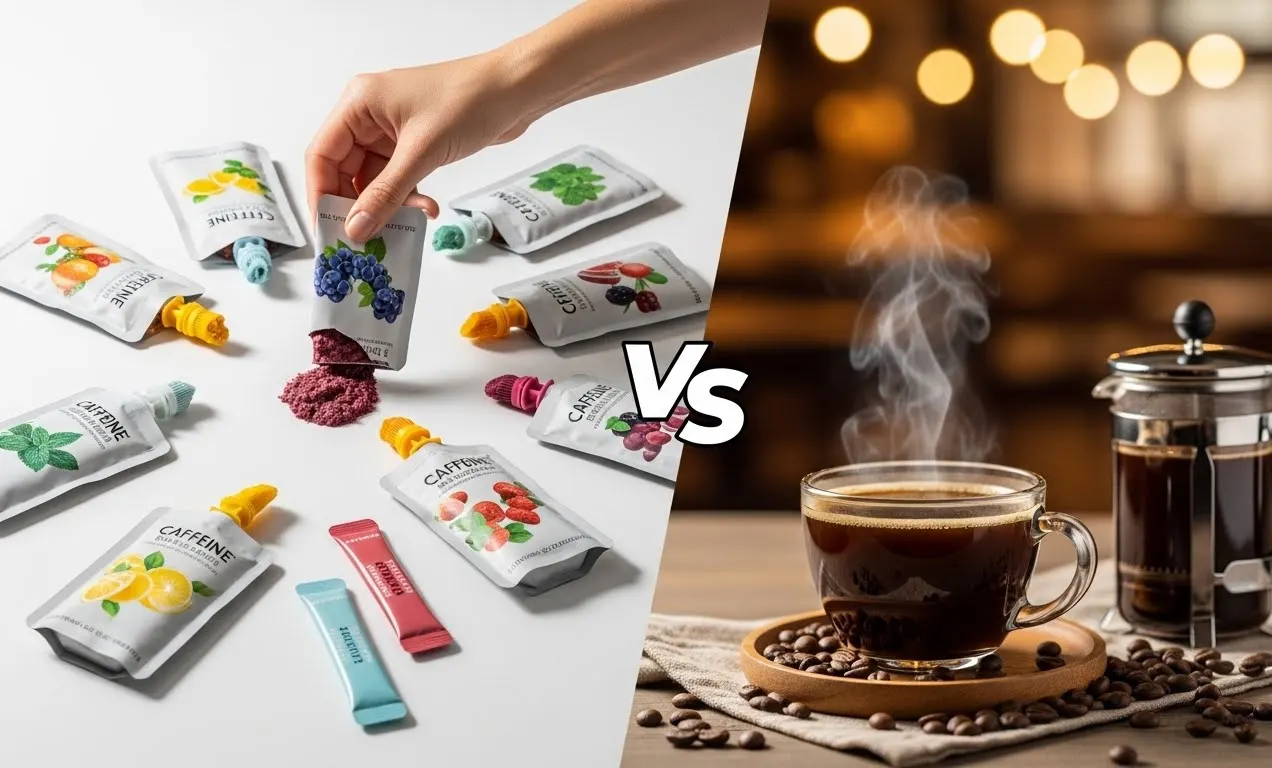
Caffeine Pouches vs Coffee: Which Is Better?
We are fond of coffee as it provides us with energy that we can count on, though it cannot always be convenient. On one side is the danger of spills on your morning commute, the time it takes to make the coffee, and the acidity that may upset your stomach, and, on the other side, there is the need to have something safer and faster, as a caffeine boost.
A contemporary coffee substitute, such as caffeine pouches, comes in that way. These energy pouches are tiny, discreet and they are placed between your gum or your lip, injecting caffeine directly into your bloodstream without any form of liquid, brewing or risk of coffee breath. They are even as alert as you trust in but in an entirely new format.
But are they worthy of taking the place of your daily cup? That is their comparison in terms of speed, cost, convenience, and side effects, and it will help you make the right choice as a part of your routine.
What’s Really Inside? A Look at Pouch vs. Coffee Ingredients
You are aware of what you drink in the morning coffee: beans and hot water. But what of that small pouch? Majority of caffeine pouches are prohibitively straightforward. They begin with a vegetable filler, as in a teabag, that provides the pouch with its plush form. To which manufacturers are also adding caffeine, additives such as mint or citrus, and a little non-sweetening sweetener to complete the taste.
A key area of light is that these are not nicotine pouches. Although the similarity exists and the brands are similarly used, there are no tobacco or nicotine content in popular energy pouch brands. They are specifically designed to provide caffeine as the sole active substance to suit an entirely different requirement and avoid the health risks of nicotine.
Coffee is essentially a one ingredient product that is made out of a plant. A caffeine pouch, in its turn, is a designed product in which every element is introduced with a purpose to manage the delivery, taste and feel. It is important to the way they work and the amount of caffeine that you receive.
The Caffeine Count: How Many Pouches Equal a Cup of Coffee?
In the process of controlling your energy, a liquid cup can seem just as much like apples and oranges when you are trying to compare it to a tiny pouch. To see a vivid picture we should consider the real quantity, in the form of milligrams (mg) of caffeine. An average cup of 8 ounces of brewed coffee has an approximate of 95mg of caffeine, but this figure can easily increase or decrease depending on the type of beans used and the method of preparation. We use this 95mg as our benchmark.
With that said, the figure of caffeine pouches is much more understandable. The majority of pouches are available in the form of a certain strength, usually 25 mg or 50 mg. This simplifies the calculations: one 50mg pouch is the equivalent of half a cup of coffee. With a 25mg pouch, you are only getting a boost of only a quarter cup. The accuracy enables greater predictability and control of energy.
This dose disparity shows an important aspect of pouches, namely you always know exactly what you are getting with each portion. The number of milligrams, however, does not give the entire story. Quantity of caffeine is one thing but the speed of feeling the caffeine is a different matter altogether.
The Speed of the Kick: Why Pouches Can Act Faster Than Coffee
Although a pouch might contain less caffeine, your body will receive it in a different way and thus it will be faster to have that boost. As an alternative to swallowing, a caffeine pouch is placed in between your lip and gum. There the caffeine is absorbed through the thin lining of your mouth (this is termed as buccal absorption) and absorbed into your blood. This is a much more direct way of delivery than drinking.
The coffee that you drink should first go through your whole digestive system before the caffeine can be properly processed and put into action. The trip may take between 45 and 30 minutes. A pouch, however, cuts corners. Since it does not pass through the digestive system, a lot of users can claim feeling its action within 5 to 15 minutes, which provides a source of speedy acting caffeine without any liquid.
This basic disparity on absorption also modifies the experience of the vitality enhancement. A pouch kick is more instantaneous and is almost more acute, with a sharp peak. The effect of coffee energy is more gradual and it comes in an undulating form. This renders each of them more appropriate to the situation, which is also why the issues of the price and the portability come up.
The Real Cost of Your Kick: Comparing Price and Convenience
The next major difference between coffee and pouches can be as simple as your wallet other than the speed of the kick. You could easily spend money just going to the coffee shop daily and cost you up to 4 dollars or more. By comparison, caffeine pouches cost less than half a dollar. The financial difference between a high-quality latte and 1 pouch can be quite substantial when it comes to a month, so pouches are an attractive and cheap option to a regular consumer of caffeine.
Next, there is the mere convenience. Coffee is also sloppy, gets cold, and it is not very convenient to carry a cup to a crowded lecture room or to a morning jog. The portability of caffeine pouches compared to coffee is one of the primary advantages. They provide the quick specification of caffeine that does not require any liquid or spillage and requires no preparation only a small tin which fits in any pocket. This is why they are a convenient option to use in other cases when it is impossible to brew or carry a cup.
The price to this ultra-convenience is the experience though. To most people, coffee is a ritual of the senses, the wholesome smell, the snugness of the cup, and the silence it offers. A pouch is completely functional; it provides the energizing effect in an effective manner, but it does not substitute a warm morning cup. It is an alertness device, and not a thing to be enjoyed.
In the end, it always depends on what you cherish more at a particular time, the comforting practice or the useful functionality which decides which one to follow. Naturally, cost and portability are not the only aspects. It is just as important how each choice will turn out to be in your body- whether it is jitters or your stomach and teeth.

The Side-Effect Scorecard: Stomach, Teeth, and Jitters
Any person who has ever experienced that same acidic stomach aching after a good cup of coffee, understands that coffee is not always good to your stomach. This is because coffee is inherently acidic and it may be irritating to the stomachs of some individuals. It is in this regard that pouches have a clear advantage. However because the caffeine is absorbed directly in your mouth pouches bypass the digestive system and therefore they are one of the best coffee substitutes to the sensitive stomach.
Most of you must have also heard your dentist saying that the dark compounds in coffee in the long run cause the teeth to stain. Pouches are on the other hand a definite winner when it comes to keeping a brighter smile. The fact that they are colorless and spit-free just means that they do not leave a stain on your teeth, so one of the most apparent long-term drawbacks of coffee goes away.
However, a different type of sensitivity is brought about by the use of pouches: gum irritation. A tingling or slight burning feeling on the lip and gum where the pouch is pressed is one of the major side effects of energy pouches. This is a short-lived experience to most of them but a particular caffeine pouch is a health risk that you need to be aware of unlike anything you would get by sipping a beverage.
At last, and what of the jitters? This classical side effect is all dose dependent and not source dependent. An espresso three times, or three high-power pouches, of caffeine will make you anxious. The only difference is speed. Since the effects of a pouch can be seen as more abrupt, a high dose could cause that fidgety effect more effectively than a cup of coffee
Your Decision Guide: When to Pick a Pouch and When to Pour a Cup
It is not about having a victor to the choice between a caffeine pouch and a cup of coffee. Rather, consider it as the choice of an appropriate tool in the appropriate time. Each of them performs better in various circumstances, so the thought of giving coffee up and switching to the energy pouches is not an all or nothing one and more about having choices.
Here’s a quick guide to help you decide:
-
Choose a Pouch When...
-
Convenience is critical: On a plane, during a long road trip, or anywhere you can’t make or buy coffee.
-
You need to be discreet: In a quiet library or a long meeting. This is exactly how to use caffeine pouches for focus without disruption.
-
You're about to be active: Right before a workout to get a quick boost without liquid sloshing in your stomach.
-
-
Choose Coffee When...
-
The ritual is the reward: During a slow morning or while relaxing with a book.
-
You’re being social: Catching up with friends or connecting with colleagues.
-
You crave warmth and comfort: Nothing beats the familiar aroma and heat of a fresh brew.
-
Ultimately, pouches are for tactical, on-the-go energy, while coffee is for comfort, taste, and social connection. Understanding their distinct roles lets you build a flexible caffeine routine that works for you.
So, Are Caffeine Pouches a Safe Coffee Alternative?
In most healthy adults, the answer to this question is yes, when taken in moderation. The caffeine pouches / coffee controversy is not concerned with one being better than the other. It is a mere concession: the hurried, unobtrusive comfort of a pouch, versus the cozy, homey comfort of a cup.
In case you are more than curious, you can begin with a low-risk, less challenging test. Start with a low dose pouch, approximately 25mg and just feel the difference.